Which Rings Can and Can't Be Resized
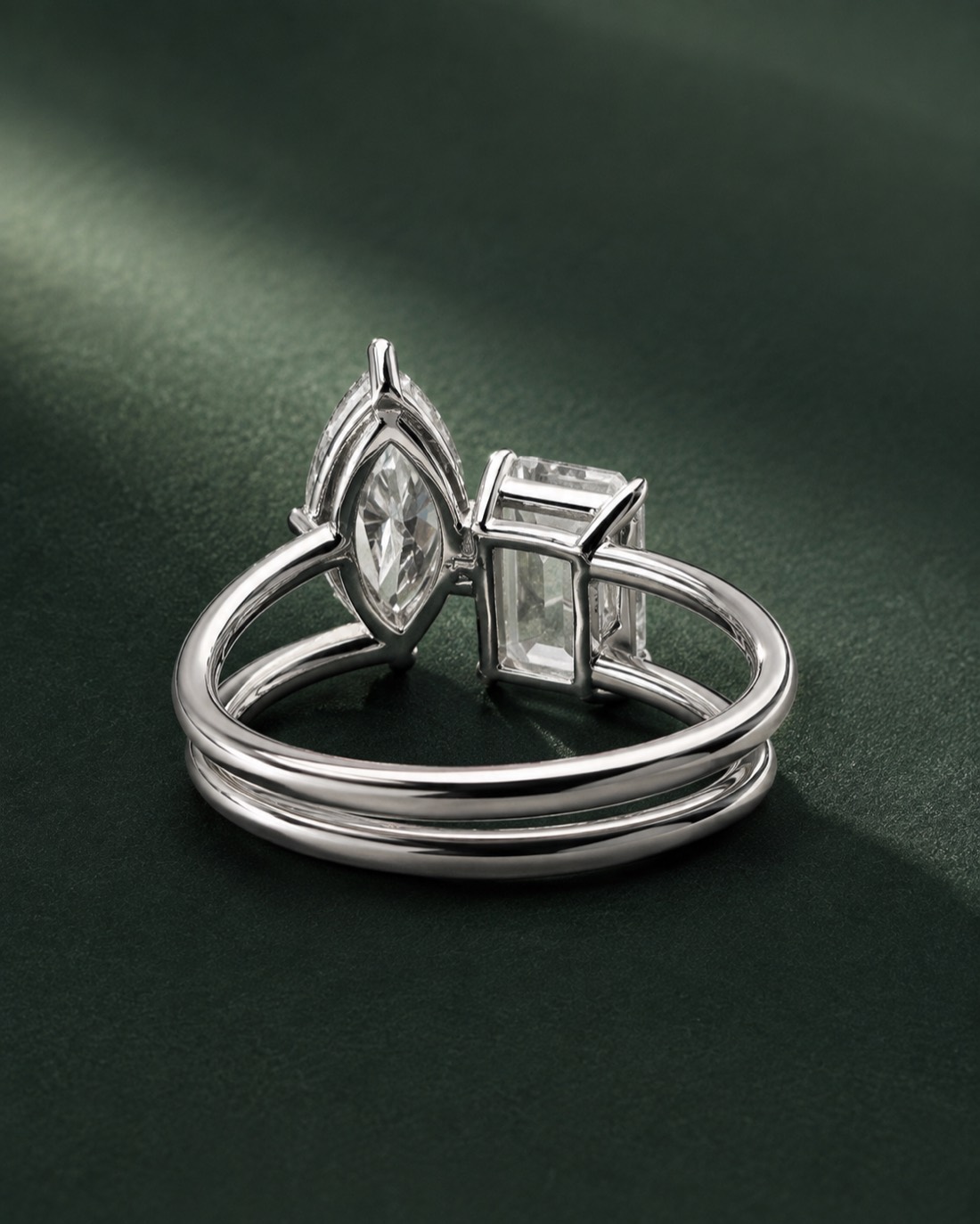
This is the fit step of our ultimate engagement ring buying guide, and it's the one most people only think about after the ring exists.
How resizing actually works
There are two ways a jeweler changes a ring's size, and knowing which one applies to your ring explains everything about what's possible.
Sizing down. The jeweler cuts a section out of the bottom of the band, brings the two ends together, solders the seam, then files and polishes it until the joint disappears. Done well, you can't find it.
Sizing up, method one — adding metal. The band is cut and a small piece of matching metal is soldered in to bridge the gap. This is the proper way to go up more than a fraction of a size.
Sizing up, method two — stretching. For small increases, the ring can be stretched on a mandrel. Fast and seamless, but it thins the band slightly, so it only works for a fraction of a size and only on bands with metal to spare.
Both involve heat. That's the constraint that drives almost everything else on this page — heat is fine for gold and platinum and fine for diamonds, but it's a problem for a band full of set stones and it's a problem for anything relying on precise tension.
The easy cases
Plain metal bands. The simplest job in the shop. Two or three sizes either direction is routine.
Solitaires. Nothing on the lower band means nothing in the way. Easy either direction.
Rings with detail only on the top half. Halos, three-stone settings, cathedral shanks, and pavé that stops partway around the band. The bottom of the band is plain metal, so the jeweler works there and never goes near a stone. This is the design choice that quietly preserves your options, and it's why half-pavé is such a practical middle ground — see our pavé band guide.
Bezel-set center stones. The bezel itself isn't affected by work at the bottom of the shank.
The hard cases
Full pavé bands. Stones run all the way around, so there's nowhere to cut without removing or resetting stones. Sometimes possible — the jeweler removes several stones, resizes, then re-sets and may add or subtract a stone to fix the spacing. It's expensive, it takes time, and the spacing is never quite what it was. Down a size, occasionally. Up, harder.
Eternity bands. Same problem, more absolute. Changing the circumference changes the stone count, which means it's not really a resize — it's a rebuild. Most jewelers will tell you to remake it instead.
Tension settings. The stone is held purely by the spring pressure of the metal pushing inward from both sides. Cutting the band releases that tension, and re-establishing it precisely enough to hold the stone is often not viable. Many tension settings are effectively non-resizable by design. Our tension setting guide covers the trade-off in full.
Rings with channel-set stones running the full band. Same logic as pavé — the channel's geometry depends on the circumference.
Intricate filigree or milgrain wrapping the whole band. The pattern won't line up across a seam.
Some alternative metals. Tungsten, titanium, and ceramic generally can't be resized at all — they're not solderable in the ordinary sense. Mostly a men's-band issue, but worth knowing.
How far can you go?
For a resizable ring, one to two sizes in either direction is comfortable and won't compromise anything. Beyond that:
- Going down a lot removes enough metal that the band's proportions change, and a very thin band can end up flimsy.
- Going up a lot means adding a visible amount of new metal and can distort a round shank into a slight oval if it's not done carefully.
- Past two or three sizes, most good jewelers will recommend remaking the shank entirely rather than fighting the original. That's not upselling — it's usually the better ring.
Sizing also isn't free of consequences on the metal. Each resize means heating the ring, and repeated heat cycles are hard on a band over decades. One or two resizes over a ring's life is nothing. Six is a lot.
Planning for it before you buy
The real move is upstream. Ask three questions before the ring is made:
1. Can this design be resized, and by how much? A straight answer names a range — "two sizes either way, past that we'd rebuild the shank." A vague "sure, no problem" about a full eternity band is a warning sign.
2. How confident am I in the size? If you got it from a borrowed ring measured by a jeweler, you're in good shape and can afford a less flexible design. If you're guessing, pick something with a plain lower band. And if you're guessing, guess large — a loose ring still goes on at the proposal and gets sized down later, while a tight one doesn't go on at all. The full method list is in how to get their ring size secretly.
3. Does the seller include a free resize, and for how long? Many include one within a set window after purchase. Get it in writing, along with what happens after that window.
There's also a design answer to a specific problem: if her knuckle is much larger than the base of her finger, no single size is right — the ring has to clear the knuckle and will then spin. Sizing beads, a slightly wider band, or a hinged shank solve that. It's a design conversation, not a resizing one.
Frequently asked questions
Can all engagement rings be resized?
No. Plain bands, solitaires, and rings with detail only on the top half resize easily. Full pavé bands, eternity bands, tension settings, and rings in tungsten or titanium often can't be resized at all.
How many sizes can a ring be resized?
One to two sizes in either direction is routine for a resizable design. Beyond two or three, most jewelers recommend rebuilding the shank rather than stretching the original band.
Does resizing damage a ring?
Done properly, no — the seam is invisible and the ring is as strong as it was. What isn't ideal is doing it repeatedly, since each resize means another heat cycle on the metal.
How long does resizing take and what does it cost?
Usually a few days to two weeks. Cost depends on the metal, the direction, and whether stones have to be removed and re-set — a plain band down a size is inexpensive, while a pavé band with stone removal is a much bigger job.
Can an eternity band be resized?
Rarely in any satisfying way. Changing the circumference changes how many stones fit, so it becomes a rebuild rather than a resize. Most people remake the band instead.
So where does this leave you?
Resizing is a normal, routine part of owning a ring — right up until the design says no. And by then the decision's already been made.
That's the actual insight here: whether your ring can be resized isn't a service question you ask afterward. It's a design question you answered, probably without realizing it, the moment you picked a setting. A full eternity band is a beautiful thing and a locked door. Half-pavé with a plain lower shank looks nearly identical from the top and leaves you every option.
Which means the best time to solve a sizing problem is before the ring exists.
Where designing the ring puts sizing back in your hands
Fair warning: we're Amana Engagement, we design custom rings, and we'd obviously say this. But it's the honest answer to the problem this whole page describes.
When you design the ring, sizing stops being something you discover and becomes something you decide. In the consultation we ask how you got her size and how confident you are in it, and that answer shapes the design. Guessing? We'll steer toward a shank that adjusts easily and looks the same from every angle that matters. Certain? You've got more freedom. Her knuckle bigger than her finger? We build for that from the start instead of solving it later.
Then you see it. About three days after the consultation you get a CAD file — the precise 3D model of your ring, band width and all. You review it, ask for changes, and we revise; that back-and-forth is normal and usually minor. When you approve, you pay the balance through an emailed link and the ring's ready roughly two weeks later.
On what it costs: a comparable ring at a traditional retail jeweler runs about $12,000, and the same finished ring bought wholesale still runs about $8,000. We charge for design and craftsmanship — typically $1,500 to $4,000 — and you still get a real, certified diamond ring. Larger or rarer stones and more complex builds can run higher, and if that's your ring, we explain exactly why before you commit to anything.
Amana means "trust" in Arabic. Earn your trust, make your ring.