Tension Settings: Are They Secure?
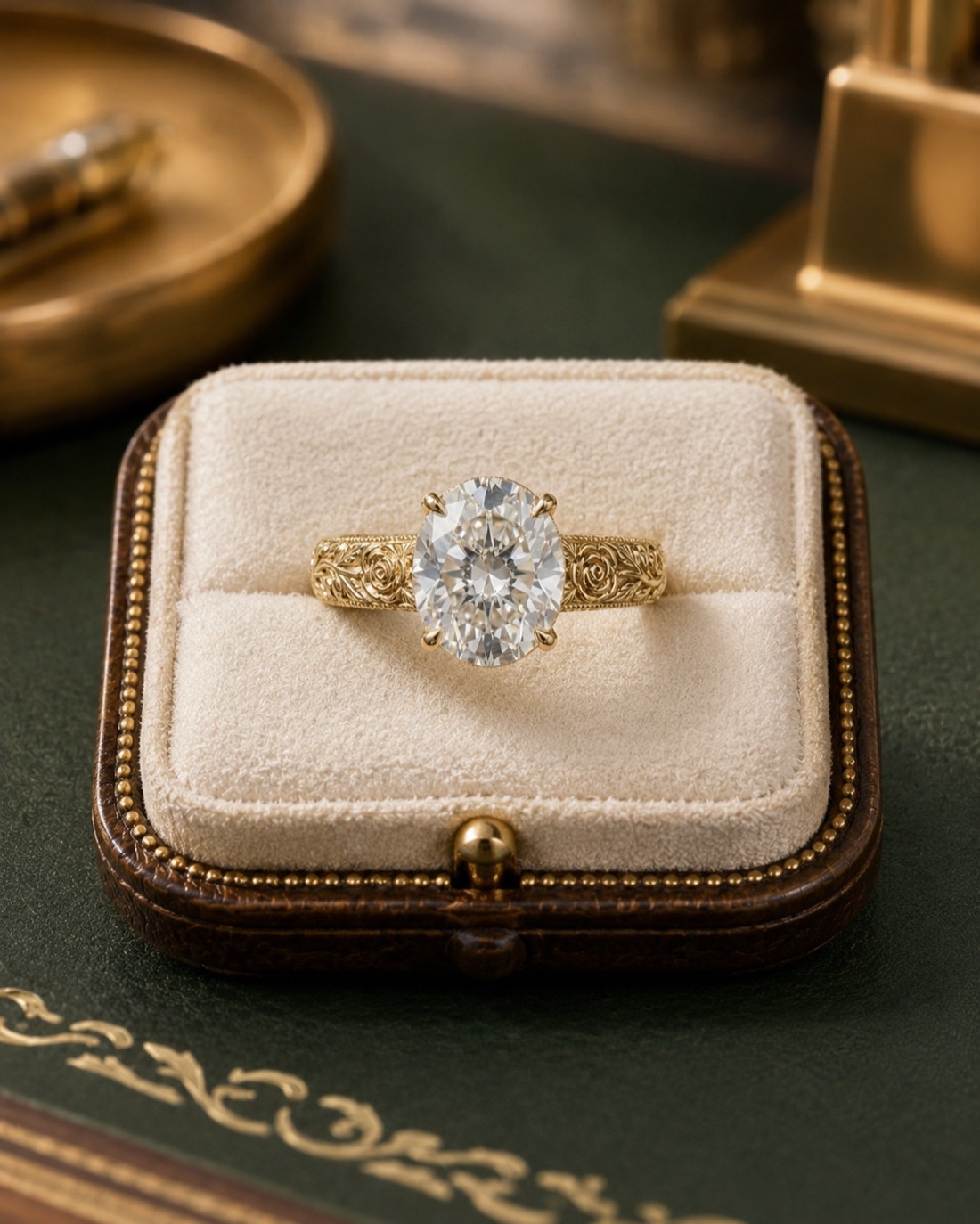
This is a specialized branch of decision three of seven — setting style — in our complete guide to designing a custom engagement ring.
How a tension setting actually works
It looks impossible, which is the appeal: a diamond appears to float in a gap in the band with nothing visibly holding it.
What's actually happening is spring engineering. The band is made from a metal with high tensile strength and good spring properties, then a gap is cut into it. The band is expanded — pried open — the stone is placed, and the metal is released. It springs back inward, and the compression is what holds the stone.
Two details make it work.
The pressure is enormous. A properly made tension setting exerts pressure measured in tens of thousands of pounds per square inch on the stone's girdle. That's dramatically more force than anything a ring encounters in daily life, which is why a correctly built tension setting doesn't just quietly let go.
There are seats. Almost every real tension setting has small grooves or notches cut into the metal faces where they meet the stone, so the girdle seats into them. The stone isn't just being squeezed by two flat surfaces — it's locked into small channels. That's what stops it from sliding out sideways.
The diamond is doing structural work here too. Diamond's extreme hardness is what allows it to sit under that pressure without being crushed. This is genuinely a setting that only works with very hard stones.
True tension vs. tension-style — know which you're getting
This is the most important distinction in the category, and it's frequently blurred.
True tension is what's described above. The metal's spring force alone holds the stone.
Tension-style (sometimes called tension-set or floating-style) looks similar from the front but includes a hidden support — a thin bar under the stone, a partial bezel on the back side, or small prongs concealed from the main viewing angle. The stone is held conventionally; the tension look is aesthetic.
Tension-style is not a lesser product. It's often the smarter buy. It's cheaper, it can be resized far more easily, it works with softer stones and more shapes, and it's easier to service. If you love the floating look and don't specifically care whether the physics is doing the work, tension-style gets you most of the way for less money and much less inconvenience.
But you should know which one you're being sold, because the practical implications differ enormously.
Where the real constraints are
Security isn't the problem with tension settings. These are.
Resizing is close to impossible on a true tension ring. The band isn't just jewelry — it's a calibrated spring. Cutting it, adding metal, and soldering it changes the spring characteristics and the gap dimension, which changes the pressure holding the stone. Most benches will not resize a true tension ring at all, and the ones who will are usually remaking the band rather than sizing it.
This is the single biggest practical reason to think hard before choosing one. Fingers change over decades — pregnancy, weight, age, arthritis, climate. If a ring can't be resized, that's a lifetime commitment to one finger size. Ask what the maker's policy is before you commit, not after.
The metal is constrained. Tension settings need high tensile strength and spring properties. Platinum alloys formulated for the purpose, certain hard 14k white gold alloys, titanium, and stainless steel work. Soft high-karat golds — 18k yellow, 22k — generally do not. So if she wants a warm, high-karat gold ring, true tension is likely off the table.
The stone must be hard. Diamond, sapphire, and ruby handle the pressure. Emerald absolutely does not — it's brittle and heavily included, and it will fracture. Moissanite is generally fine on hardness but check with the bench. Opal, pearl, tanzanite: no.
Shapes are limited. Rounds, ovals, emerald cuts, and princess cuts work because they present two opposing parallel-ish surfaces to grip. Pears and marquise are far harder to execute because the outline isn't symmetric across the gripping axis, and their fragile points don't want to live near concentrated pressure.
Repairs are specialist work. Not every jeweler will touch a tension ring, and if the stone ever needs to come out — for a repair, a recut, a reset — putting it back requires the same specialized equipment used to make it. Plan on going back to the maker.
So — is it actually safe?
Yes, with two qualifiers.
Qualifier one: execution. This setting has almost no margin for error. The gap must be cut to the stone's exact width, the seats must be precise, the metal must be the right alloy properly work-hardened. A well-made tension ring is very secure. A poorly made one is the least secure setting there is. There's no middle. This is not a setting to buy cheaply.
Qualifier two: impact. A very hard blow that deforms the band — a car door, a serious fall onto concrete — can spread the gap enough to release the stone. That risk exists for any setting, but in a tension ring the band is the setting, so band damage is stone-loss risk in a way it isn't with prongs. If she's genuinely hard on her hands, a bezel is a better recommendation.
Also worth knowing: because the band is under permanent load, a very deep scratch or gouge on the band can, in theory, become a stress point. It's uncommon, but it's a reason to have a tension ring looked at periodically by someone who understands them.
Who a tension setting is genuinely right for
Someone who wants a ring that reads as modern and architectural rather than traditional. Someone whose finger size is stable and who understands the resizing constraint going in. Someone who's happy with a hard white metal. Someone who wants the maximum possible light entering the stone, since a true tension setting has less metal touching the diamond than any other setting — light comes in from essentially every direction, and the stone can look exceptionally lively.
It's less right for someone who wants a warm gold ring, someone who works hard with their hands, someone whose ring size might realistically change, or someone who wants a ring that any jeweler anywhere can service.
Frequently asked questions
Can a diamond fall out of a tension setting?
A properly made one is very secure — the pressure is orders of magnitude beyond normal wear. The realistic risk is a hard impact that deforms the band, or poor execution in the first place. It's a setting where the quality of the bench matters more than in almost any other.
Can tension rings be resized?
True tension rings usually can't be, because the band is a calibrated spring and altering it changes the pressure. Tension-style rings with hidden support can often be resized normally. Confirm which you have and what the maker's policy is before buying.
What metals work for tension settings?
Metals with high tensile strength and spring properties — specific platinum alloys, hard 14k white gold alloys, titanium, and stainless steel. Soft high-karat golds like 18k yellow generally aren't suitable.
Can any gemstone be tension set?
No. It needs to be very hard and tough — diamond, sapphire, ruby. Emerald will fracture. Softer or more brittle stones aren't candidates.
What's the difference between tension and tension-style?
True tension uses spring pressure alone. Tension-style looks the same from the front but has a hidden bar, partial bezel, or concealed prongs doing the holding. Tension-style is cheaper, resizable, and works with more stones and shapes.
So where does this leave you?
If you love the floating look, the honest recommendation for most people is tension-style: nearly the same appearance, far fewer lifetime constraints, and much easier to service. Choose true tension if the engineering itself appeals to you, if you want the maximum light entry it uniquely allows, and if you go in clear-eyed about the resizing limitation.
Either way, notice what this setting demands more than any other. A tension ring isn't sized to "a one carat round" — it's built around one specific stone, measured to the hundredth of a millimeter, with a gap cut to that width and seats cut for that girdle. The spring characteristics of the band are calculated against that stone's dimensions. Change the stone and the ring is wrong.
Which makes tension the clearest example of something true across all of ring design: some things simply cannot be done to a ring that already exists. You can't tension-set a stone into a band that was sprung for a different diamond. You can't convert a prong ring to tension. And you can't buy a tension ring off a shelf and swap your stone into it — the shelf ring's gap belongs to the shelf ring's stone.
That's not a retail store being obstructive. It's that a manufacturer would have to produce tension bands in every gap width, for every stone size, in every suitable alloy — dozens of variants each of which might sit unsold indefinitely. Volume manufacturing can't carry that, so it doesn't. The setting exists mainly as something made to order, which is exactly what it is.
Made-to-order is the only way this setting exists anyway
At Amana we're designers. Nothing gets made until the stone is chosen and the design is approved — which for a setting like this isn't a preference, it's a requirement.
You meet with us in person or over video and we design the concept with you in the room, using AI-assisted visuals so you can see how the floating look reads on her hand, and so we can talk honestly about whether true tension or tension-style is the right call for how she lives. About three days later you get a CAD file — a precise 3D model of your exact ring, built around your exact stone's measurements. If you want the gap tighter, or the band a little wider, or the ring to sit lower, you tell us and we revise. Revisions are normal and usually minor, and we keep going until you approve. Then the ring is ready about two weeks later.
Our design and craftsmanship typically runs $1,500 to $4,000, and you get a real, certified diamond ring at the end. Larger or rarer stones — or a genuinely complex build, and a true tension setting is one of the more demanding things a bench can be asked to make — can run higher. When yours will, we tell you exactly why before you commit to anything.
For context, a comparable ring at a traditional retail jeweler runs about $12,000, and the same finished ring bought wholesale still runs roughly $8,000. We charge for the design and the craftsmanship, because that's the actual work — and on a setting like this, the craftsmanship is nearly the whole thing.
Amana means "Trust" in Arabic. Earn your trust. Make your ring.