How to Find Her Ring Size Secretly
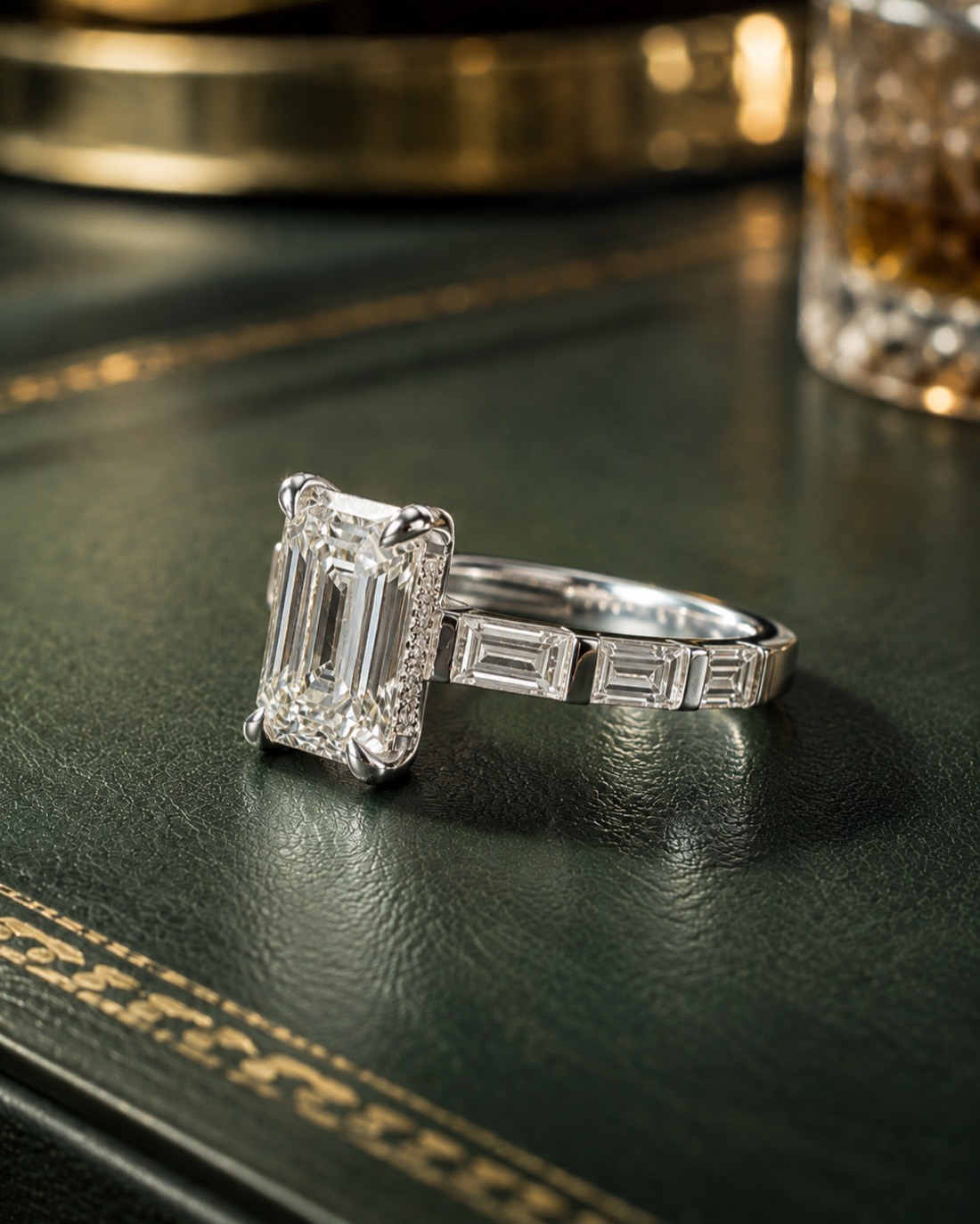
This is the sizing step of our ultimate engagement ring buying guide, and it's worth doing early — it's the one step that gets harder the longer you wait.
Why sizing feels scarier than it is
Here's the thing nobody tells first-time buyers: sizing is the most forgiving mistake on the whole list. Rings get resized every day. It's routine bench work.
What isn't forgiving is proposal day. If the ring won't go past her knuckle in the moment, the photos still happen, the yes still happens, but there's a little wobble in a memory you only get once. That's the actual thing you're protecting against — not a permanent problem, just an avoidable awkward thirty seconds.
So the goal isn't perfection. It's close enough to slide on, with a design that can be adjusted after.
The methods, ranked by accuracy
Tier 1: Nearly foolproof
1. Borrow a ring she wears on that finger.
The gold standard. Take a ring she wears on her left ring finger — or right ring finger, if that's where she wears rings, then adjust slightly — and bring it to any jeweler. They'll measure it in seconds, free, no appointment.
Borrow it when it's already off: her nightstand, the dish by the sink, the little tray in the bathroom. Take it in the morning and return it the same day. If she notices it's missing, "it was on the floor by the couch" is a very believable sentence.
2. Have her best friend or sister go ring shopping "for fun."
Wildly effective and completely undetectable. Someone she trusts suggests trying rings on at a store, gets her size from the salesperson, and reports back. Bonus: your accomplice can also confirm her style. Pick the person who can actually keep a secret — you know who that is.
3. Use a ring she already owns that's stored away.
Grandmother's ring, a ring she stopped wearing, something in a jewelry box. Less risk of her noticing it's gone, though double-check it was worn on the same finger.
Tier 2: Good, with care
4. Trace the inside of one of her rings.
Can't leave the house with it? Set it on paper and trace the inside circle with a sharp pencil, holding the pencil straight up. Then photograph it next to a ruler and take that to a jeweler. Inside diameter is what matters — tracing the outside adds the band's thickness and throws you off.
5. Press it into soap or clay.
Push the ring halfway into a bar of soap, a stick of lip balm, or modeling clay. You get a clean impression you can measure later. Wipe the ring off before you put it back, obviously.
6. String or paper strip on her finger — while she's asleep or distracted.
Wrap a strip of paper around the base of her finger, mark where it overlaps, measure the length in millimeters. That number is her circumference; any ring size chart converts it. Real talk: this works better in movies than in life. Fingers swell overnight, and people wake up. Treat it as a backup.
Tier 3: Better than nothing
7. Compare her finger to yours.
Slide one of her rings onto your finger and note where it stops — your first knuckle, your second. A jeweler can work backward from that. Rough, but it narrows the range.
8. The photo method.
Find a clear photo of her hand wearing a ring next to something of known size — a coin, a phone edge. A jeweler can estimate from it. This is an estimate, not a measurement.
9. Averages, as a last resort.
Average women's sizes run roughly 6 to 6.5. Average men's run roughly 9 to 10. These are genuinely last-resort numbers — real fingers vary enormously and averages will be wrong for a lot of people. Use them only when every other method has failed.
What to do when you have to guess: go large
If you land between two sizes, or you're working from an average, size up.
The logic is simple. A ring that's a half size too big goes onto her finger on proposal day, stays there through dinner, and gets sized down in a week. A ring that's a half size too small stops at the knuckle in front of everyone and can't be fixed until after.
One caveat that matters more than people expect: not every ring can be resized. Full pavé bands with stones all the way around, eternity bands, and tension settings often can't be adjusted at all, because the stone spacing or the structural tension can't survive it. If you're guessing at the size, favor a design that can be sized later. Which rings can and can't be resized breaks down which designs are flexible.
Things that quietly throw sizing off
- Temperature. Fingers shrink in cold and swell in heat. A size measured in a chilly store on a January morning isn't the same as an August afternoon in South Florida.
- Time of day. Fingers are usually largest in the evening.
- Knuckle size. If her knuckle is much wider than the base of her finger, the ring has to clear the knuckle and will then spin. That's a design conversation — a slightly wider band or sizing beads help.
- Band width. Wide bands fit tighter than thin ones at the same size. A 6mm band often needs a quarter to a half size up from a 2mm band.
- Salt, exercise, and flights. All temporary, all real.
Frequently asked questions
What's the most common women's ring size?
Roughly a 6 to 6.5, with men averaging around 9 to 10. Treat these as a fallback only — individual fingers vary far too much for an average to be a plan.
Should I guess big or small if I'm not sure?
Big. A ring that's slightly loose can still be worn and then sized down afterward. A ring that's too small can't go on at all, which is the one scenario you're actually trying to avoid.
Can every engagement ring be resized?
No. Plain and lightly detailed bands resize easily, usually a size or two in either direction. Full eternity bands, pavé that wraps all the way around, and tension settings often can't be resized and would need to be remade.
How do I measure a ring I can't take out of the house?
Trace the inside circle on paper with the pencil held vertical, or press the ring into soap or clay for an impression. Photograph either one next to a ruler and bring that to a jeweler.
Will she be upset if the ring doesn't fit?
Almost universally, no. It's expected, it's common, and it's fixable. The thing to plan for is whether the ring goes on that day — the perfect fit comes later.
So where does this leave you?
Sizing is a solvable problem with a clear hierarchy: borrow a ring, use a friend, take an impression, and only then guess — large. What turns a small problem into an expensive one is finding out about it too late, after a ring has been built in a design that can't be adjusted.
Which points at something bigger. Sizing shouldn't be a surprise at the end of the process. It should be a decision made near the beginning, at the same time as the design — because the design determines how much room you have to be wrong.
Where designing the ring gives you more room to be wrong
Full disclosure: we're Amana Engagement, we design custom rings, and we have a stake in this. Here's why it matters for sizing anyway.
When the ring is designed with you, sizing stops being a guess you make at the end and becomes part of the plan. In your consultation — in person or virtual — we talk through her finger, her knuckle, her band width, and how sure you are of the size, and we build the design around your actual confidence level. If you're guessing, we steer toward a setting that adjusts easily. About three days after the consultation you get a CAD file, the exact 3D model of the ring, and you can see the band before it exists. You approve it, pay the balance through an emailed link, and it's ready roughly two weeks later.
The money side, plainly: a comparable ring at a traditional retail jeweler runs about $12,000, and the same finished ring bought wholesale still runs about $8,000. We charge for the design and the craftsmanship, typically $1,500 to $4,000, and you get a real, certified diamond ring. Larger or rarer stones and more complicated builds can run higher — and if yours does, we explain exactly why before you commit.
Amana means "trust" in Arabic. Earn your trust, make your ring.