Heart-Shaped Diamonds: The Complete Buying Guide
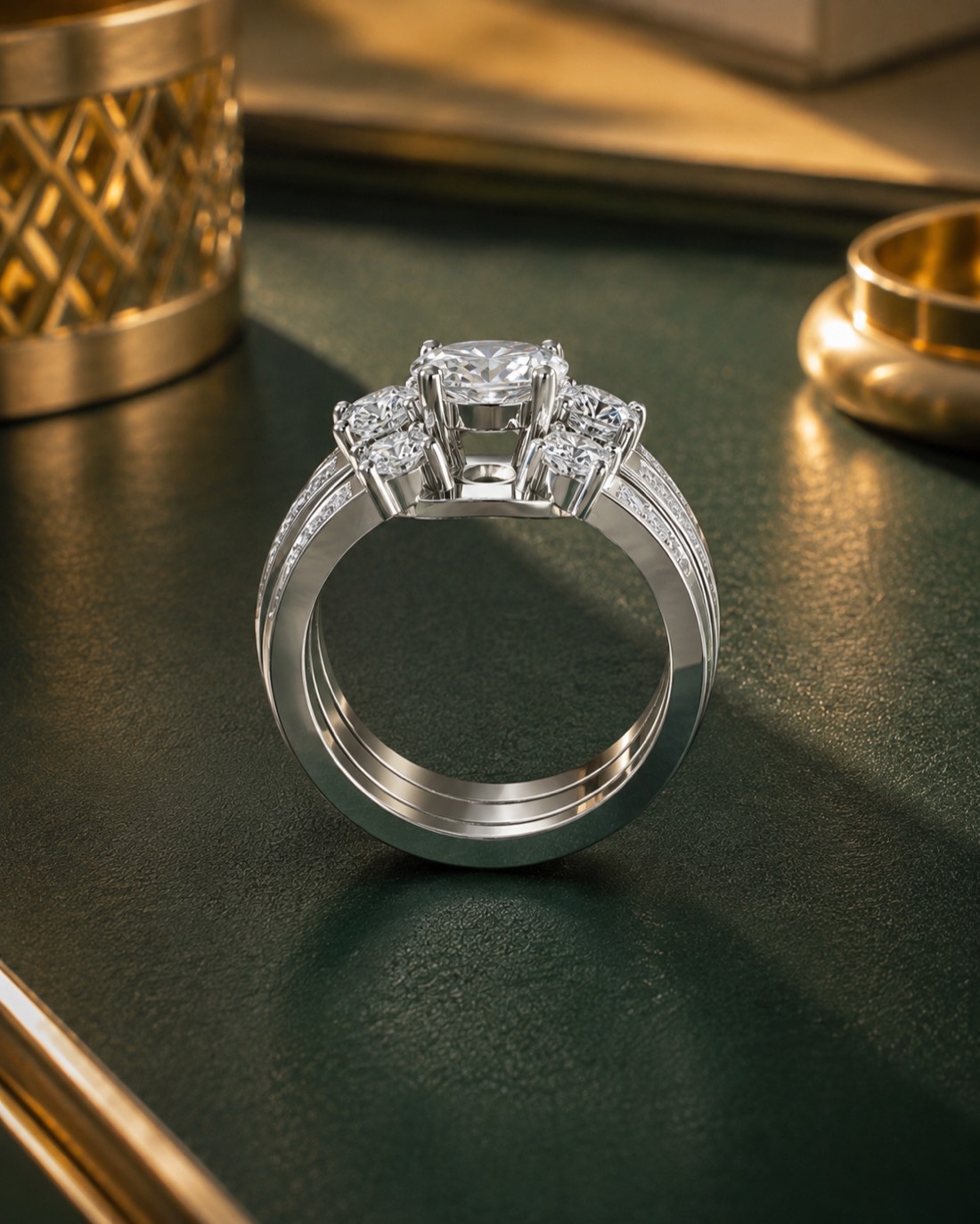
What makes a diamond "heart-shaped"
A heart-shaped diamond is essentially a pear shape with a cleft (indentation) cut into the rounded top, splitting it into two lobes. Like other fancy shapes, it's cut to maximize the visual impact of the rough stone rather than following a single universal cutting standard — which is part of why quality varies more between individual heart-shaped stones than it does between round diamonds.
It's a shape that leans hard into symbolism, which is exactly why people either love it or find it too on-the-nose for an everyday ring.
Symmetry is the single most important factor
For a heart shape, symmetry isn't a minor grading detail — it's the whole ballgame. The two lobes need to mirror each other, the cleft needs to be centered and defined (not shallow or lopsided), and the point at the bottom needs to line up with the center of the cleft. Any imbalance is immediately visible to the naked eye in a way it simply isn't on a round brilliant.
When you're evaluating a heart-shaped diamond, look at it straight on (not at an angle) and check:
- Are the two lobes the same size and shape?
- Is the cleft distinct and centered?
- Does the point sit directly opposite the cleft?
- Does the outline look like a heart at a glance, or does it read as an odd pear?
Length-to-width ratio matters for the "look"
Most heart-shaped diamonds fall in a length-to-width ratio of roughly 0.90 to 1.10 to read as a balanced heart shape — too long and narrow, and it can look more like an elongated pear; too short and wide, and the heart shape can look squat or muddled. There's some room for personal preference here, but extreme ratios outside that range are worth seeing in person before committing.
Cut quality still drives the sparkle
Just like every other fancy shape, cut quality determines how much light the stone returns to your eye. A well-cut heart-shaped diamond will show good brightness and fire across both lobes evenly. A poorly cut one can look dull in places or show a "bowtie" — a dark shadow-like band across the center of the stone caused by light leakage, which is common in elongated fancy shapes including hearts, pears, and marquise cuts. A visible bowtie isn't automatically a dealbreaker (some people like the added dimension), but it's worth seeing before you decide.
Clarity and color considerations
Heart shapes have a large, open table (the flat top facet) and pointed areas that can make inclusions near the point more visible or create a slightly higher risk of chipping at that point during setting or daily wear. Because of that, many buyers lean toward a clarity grade with no visible inclusions to the naked eye, and a protective setting style (like a V-tip prong at the point) to guard the most vulnerable part of the stone.
Color shows up similarly to other fancy shapes — heart-shaped diamonds can face up slightly warmer in color than a round of the same grade, so it's worth viewing the actual stone rather than deciding on color grade alone.
What settings work well with a heart shape
A heart-shaped center stone is often set with prongs positioned to emphasize the outline — commonly a V-prong or double-prong at the point to protect the tip, plus prongs cradling each lobe. It pairs well with a simple solitaire band that lets the shape speak for itself, or a halo that reinforces the outline and adds perceived size.
Frequently asked questions
Are heart-shaped diamonds more expensive than round diamonds?
Generally, fancy shapes like heart cuts can cost somewhat less per carat than round brilliants of similar quality, because the cutting process uses more of the rough stone. But well-executed heart shapes with excellent symmetry can be harder to source, which can offset some of that savings.
Do all heart-shaped diamonds have a bowtie effect?
Not all, but it's common in this shape due to how light travels through the elongated proportions. It's worth viewing the stone or a video of it before buying if a strong bowtie would bother you.
What carat size looks best as a heart shape?
There's no universal answer — it depends on ratio and finger size more than raw carat weight. A well-proportioned heart shape can look substantial even at a modest carat weight because of how the outline reads.
Is a heart-shaped diamond harder to resize or reset later?
Not inherently harder, but the pointed tip needs a protective setting to reduce chipping risk over time, which is a detail worth discussing with whoever sets it.
Can I see a heart-shaped diamond's symmetry from a certificate alone?
A grading report will list a symmetry grade, but for fancy shapes like hearts, actually viewing the stone (in person or on video) is the more reliable way to judge whether the outline reads as a balanced heart to your eye.
So where does this leave you?
A heart-shaped diamond is one of the most personal, meaningful shapes you can choose — but it rewards careful buying more than almost any other shape, because small asymmetries are so visible. If you love the shape, the move is to actually see the specific stone (not just its certificate) before you commit.
Why designing around a heart-shaped stone works well with a custom process
Because heart-shaped diamonds vary so much stone to stone, a custom design process makes more sense than picking a pre-made setting off a shelf and hoping a heart-shaped stone fits it well. When you design with Amana, we look at your actual center stone — its ratio, its symmetry, its cleft depth — and build the setting around that specific diamond, including protective prong placement at the point. Design plus the finished ring typically runs $1,500–$4,000 total, with larger or more complex stones running higher, and every step is priced transparently before you commit.
You'll meet with a designer (in person or virtually), see your concept visualized with AI in real time, get your CAD file about 3 days later to review and approve, and have your finished ring roughly 2 weeks after approval.
If you're drawn to a heart-shaped center stone, reach out and we'll help you evaluate the specific stone and build a setting that protects it and shows it off.