Best Diamond Shape for Your Hand
This is one piece of our full diamond education guide.
Start with what's actually true
A lot of "shape for your hand" advice online is confidently invented. There is no rule that short fingers can't wear a round diamond, or that long fingers ruin a marquise. People wear what they love and look great doing it.
What is true is optics. Certain outlines create the impression of length; others create the impression of width. Those effects are real, they're consistent, and they're worth understanding — as information, not as permission.
So read what follows as "here's what will happen visually," not "here's what you're allowed to buy."
The four variables
Finger length. The distance from knuckle to base. Shorter fingers benefit from anything that draws the eye lengthwise; longer fingers can carry shapes that would overwhelm a shorter finger.
Finger width. Slender versus fuller. Width determines how much stone the finger can visually support before the ring starts wearing the hand instead of the other way around.
Overall hand size. A small hand with slim fingers changes the scale of everything. The same 2-carat stone reads as elegant on one hand and enormous on another.
Knuckle prominence. Frequently the most impactful variable and almost never mentioned. If the knuckle is noticeably wider than the base of the finger, the ring sits below a wider point, which visually shortens the finger and can make the band look loose. Design compensates for this — more on that below.
These interact. "Short and slender" and "short and fuller" want different things, and neither is what "long and slender" wants.
Shapes that lengthen
Elongated outlines pull the eye along the length of the finger. The effect is real and reasonably strong.
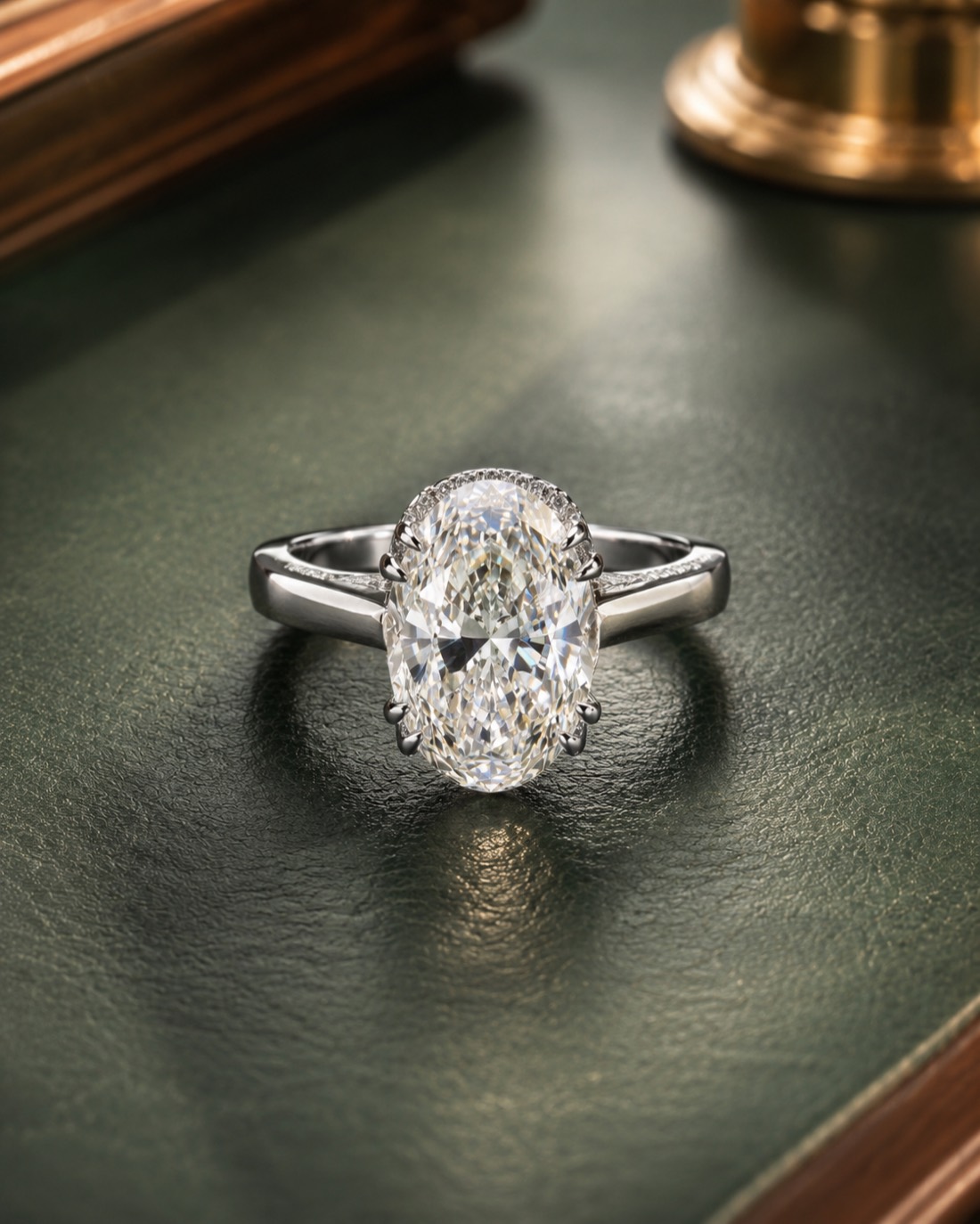
- Oval — the most popular finger-lengthening shape, for good reason. It's elongating without being severe, works on almost every hand, and is one of the most forgiving shapes to buy.
- Pear — strongly directional. Worn point toward the fingertip, it extends the line further than an oval. More dramatic, and pickier to buy well — see pear vs. oval.
- Marquise — the most elongating shape there is, with points at both ends. Very high impact, and it also spreads more face-up area per carat than almost anything.
- Emerald — lengthens with a clean architectural line rather than a curve. Reads elegant and restrained.
These are excellent on shorter fingers, on fuller fingers (the length breaks up the width), and on anyone who just likes the look. On very long, slender fingers a long ratio can occasionally tip into exaggerated — which is a taste question, not a mistake.
Shapes that balance width
Rounder or squarer outlines create a compact focal point rather than a line.
- Round — universally flattering, no strong directional effect. On a long slender finger it adds visual weight in a good way; on a short finger it doesn't lengthen, but it doesn't shorten either.
- Cushion — soft, wide, romantic. Reads compact for its carat weight, so it fills width nicely.
- Princess and Asscher — squared outlines, strong geometry. On a long finger they read as confident; on a very short finger the square shape can echo the finger's proportions rather than counteracting them.
These suit long, slender fingers particularly well, and they suit anyone who wants a classic center rather than a directional one.
Proportion beats shape
Here's the part that matters more than everything above, and it's the part that gets skipped.
Stone size relative to finger width. A center stone that spans most of the finger's width looks bold on a wider finger and overwhelming on a narrow one. The same stone can look perfect at 1.2 carats on one hand and top-heavy at 1.2 carats on another. This is why "how many carats should I get" has no universal answer — it's a proportion question, and it's answered by looking at her hand.
Band width. This is the most underused tool in the entire discussion. A narrower band (roughly 1.6–1.9mm) makes the center stone look larger and the finger look longer, because there's less metal competing with skin. A wider band (2.4mm+) grounds a large stone and suits fuller fingers, but shortens the visual line. Change the band width and the same stone reads completely differently. The metal and band guide has more on how band choices land.
Setting profile. How high the stone sits matters on hands of every size. A high-set solitaire adds presence and catches more light; a lower-profile setting sits closer to the finger and reads more integrated. On smaller hands, height can tip into looking precarious.
Elongating design tricks. Beyond the stone itself: a split shank, a tapered band, or a subtly narrowing profile toward the top draws the eye lengthwise, doing quietly what an elongated shape does obviously. If perceived size is the specific goal, how to make a diamond look bigger goes deeper.
Knuckles, specifically
If the knuckle is prominent, a few things help:
- A band with some presence (not the thinnest possible) balances the visual weight of the wider knuckle.
- A lower-profile setting stays put and doesn't spin, since a ring sized to pass the knuckle sits looser at the base.
- Sizing beads or a small internal fitting solve the looseness properly and are a normal, standard fix.
- Contoured or fitted wedding bands sit flush against the engagement ring and read as one intentional piece.
None of this restricts shape choice. It just means the setting should be designed with the knuckle in mind rather than discovered afterward.
A practical way to actually decide
The tidy chart in this article is a starting point, not an answer. What works:
- Try the shapes on, or at minimum look at photos of the shape on a hand genuinely similar to hers — not a model hand, not a product still on white.
- Try more than one band width with the same stone shape. The difference surprises people more than a shape swap does.
- Look at it at arm's length, not at reading distance. That's how everyone else will see it.
- Weight her taste over every rule above. If she's had an emerald cut saved on Pinterest for three years, the correct shape for her hand is an emerald cut. Our diamond shapes guide covers what each shape is actually like to own.
Frequently asked questions
What diamond shape makes fingers look longer?
Elongated shapes: oval, pear (point toward the fingertip), marquise, and emerald. They draw the eye along the length of the finger. A narrower band amplifies the effect.
What is the best diamond shape for short fingers?
Elongated shapes generally flatter shorter fingers most — oval and pear especially. But proportion matters more than outline: a stone scaled correctly to the finger will look right in almost any shape.
What diamond shape is best for wide fingers?
Elongated shapes break up width and read balanced, and a slightly wider band prevents the finger from looking pinched. Very small stones can emphasize width by contrast.
Does band width really change how the ring looks?
Yes, significantly. A narrower band makes the center stone look larger and the finger longer; a wider band grounds a big stone and suits fuller fingers. It's often a bigger visual lever than changing the stone's shape.
Do I have to follow shape rules for my hand?
No. These are optical tendencies, not requirements. Personal preference should outrank every guideline here — a shape someone loves will always look better on them than a shape a chart assigned.
So where does this leave you?
Elongated shapes lengthen. Compact shapes balance. Proportion and band width matter more than either. And what she actually wants outranks all of it.
Here's a quiet coincidence worth noticing. The shapes that flatter the widest range of hands — oval, pear, marquise, emerald — are the same elongated shapes that cost roughly 10–30% less per carat than a round, because they're cut more efficiently from rough. The most-flattering answer and the least-expensive answer overlap almost completely.
That's the pattern across all of diamond education, honestly. The real answers keep pointing down the price scale. Which raises the question of who benefits when the answers don't get shared.
Which is why we do it this way
Amana is a design studio, not a store. We don't have a case of inventory we need to move, and nobody here works on commission — so when we look at her hand and say "an oval on a 1.7 millimeter band is going to be perfect and it'll cost you less than the round," there's nothing in it for us but a client who's happy with the ring.
The money, straight. A comparable ring at a traditional retail jeweler runs about $12,000. That same finished ring bought wholesale still runs around $8,000. Our design and craftsmanship typically run $1,500–$4,000, and you still get a real certified diamond in a ring built to your design. Larger stones, or rarer and more complex ones, can run higher — and we'll explain exactly why before you commit to anything.
Natural diamonds set the price. Lab-grown brought it down. Designer-direct is the third era, and it's the one that only works when there's no showcase standing in between.
The process: we design together, in person or over video, with AI-assisted visuals so you can see the shape and the band width on the actual design before anything gets made. CAD file about three days later. You approve and pay the balance through an emailed link. Ring's ready roughly two weeks after that.
Earn your trust. Make your ring.