What Is a Bowtie in a Diamond?
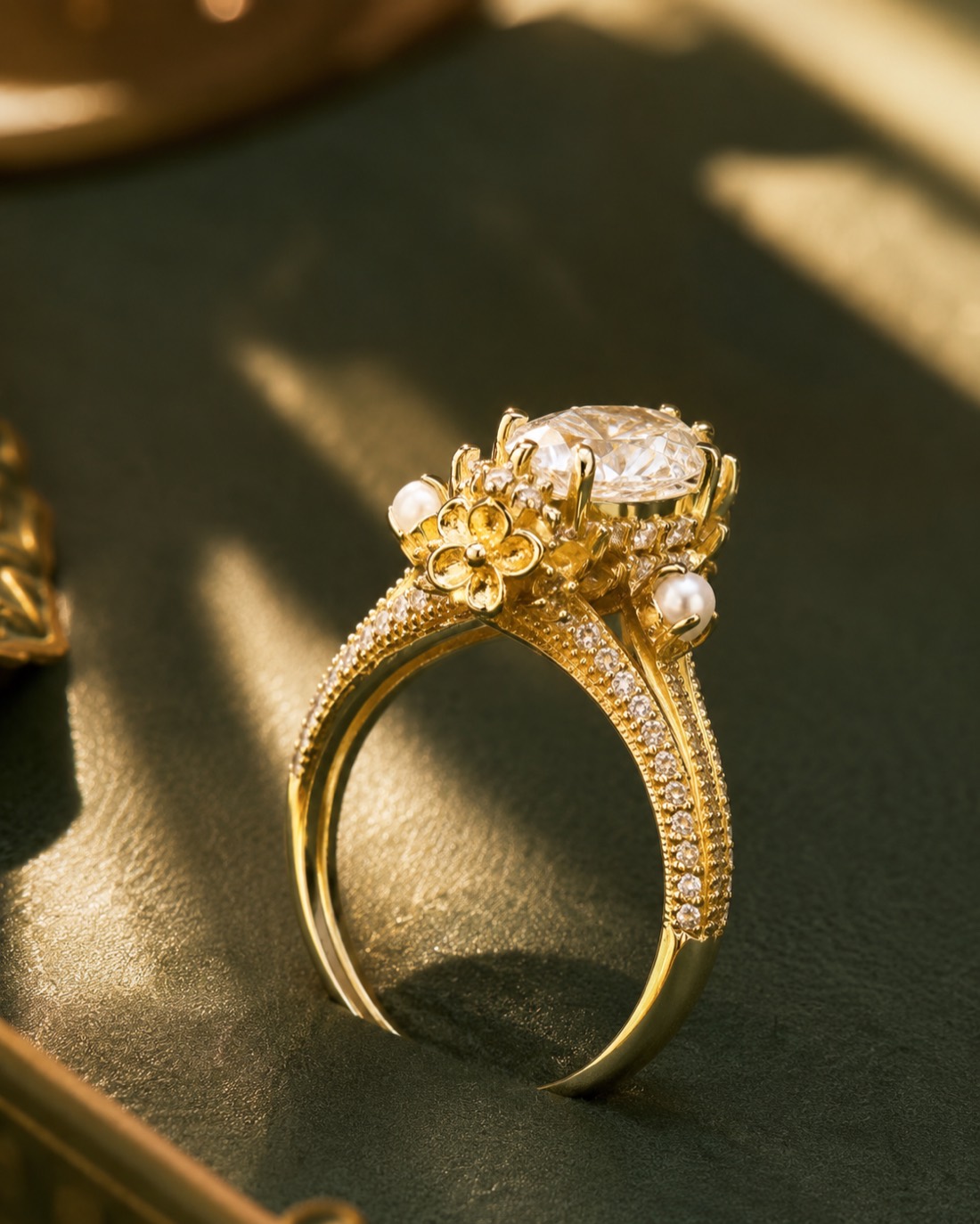
This is one piece of our full diamond education guide.
What it looks like
Hold an oval, pear, or marquise diamond face-up under normal light and look straight down into it. In many stones you'll see a darker band running across the width of the stone, through the middle — two rough triangles meeting in the center. Hence the name.
It's not an inclusion. It's not dirt. It's not a flaw in the material at all. It's a lighting effect, and it lives in the geometry of the cut.
Why it happens
A diamond returns light by catching it, bouncing it off the pavilion facets underneath, and sending it back up through the top at your eye. That only works if there's light available to catch in the first place.
When you look down into a diamond, your head and shoulders are between the stone and much of the light in the room. In a round brilliant, that doesn't matter much: the facets radiate outward in every direction from the center, so most of them are still angled to grab light from somewhere off to the side. Rotational symmetry means there's no single direction that goes dark.
In an elongated shape, the geometry changes. To fill a long, narrow outline, the pavilion facets along the center have to be angled differently from the ones toward the ends. Those center facets end up angled such that they're looking straight back at the viewer — which means they reflect the viewer. And the viewer is a dark, non-luminous object.
So the middle of the stone reflects you. That's the bowtie.
This is why the effect shows up in ovals, pears, marquises, and elongated cushions and radiants, and essentially never in rounds. It's a consequence of stretching a brilliant cut. Our oval vs. round comparison covers the trade-off that creates.
Good bowtie, bad bowtie
Not all bowties are a problem, and this is the distinction that matters when you're actually looking at stones.
A soft, shifting bowtie is fine — arguably good. Diamonds are beautiful partly because of contrast: the alternation of bright flashes and dark facets as the stone moves is what your eye reads as sparkle. A gentle bowtie that appears, moves, and breaks up as you tilt the stone is just part of that pattern. Plenty of gorgeous ovals have one.
A hard, dark, static bowtie is a defect. If the band is a solid dark stripe that stays in the same place no matter how you move the stone, that region isn't returning light at all. You've bought a diamond with a dead zone through the middle of it. In photographs it looks like a smudge; in person, like a gap.
The test is movement. Tilt the stone. Does the shadow break up and dance? Fine. Does it sit there? Pass.
What causes a severe one
Bowtie severity tracks a few cutting variables:
Pavilion angle mismatch. The main driver. If the pavilion facets along the length aren't angled to work together, the center leaks and darkens. This is craftsmanship, and it's the reason two ovals of identical weight, color, and clarity can look completely different.
Depth. Both too deep and too shallow worsen it. Too shallow leaks light straight out the bottom; too deep sends it out the sides.
Length-to-width ratio. Longer stones stretch the geometry further. Ovals above about 1.55 and marquises above about 2.00 need more scrutiny — the shape is working harder against itself.
Faceting style. Some cutters use additional or differently placed pavilion facets specifically to reduce bowtie. It costs yield, so it isn't universal.
Bowtie prominence roughly by shape: marquise tends to show it most, then pear, then oval, then elongated cushion and radiant. Round essentially never.
The certificate problem
Here's the thing that makes this worth an entire article.
No grading report grades a bowtie. Not GIA, not IGI, not anyone. There is no line item for it.
Worse, the grades that sound like they'd cover it don't:
- Cut grade would catch it — but GIA only assigns an overall cut grade to round brilliants. Ovals, pears, and marquises don't get one at all.
- Symmetry grades facet alignment precision, not light performance.
- Polish grades surface finish. Unrelated.
So an oval can carry a report reading Excellent polish, Excellent symmetry, G, VS1 and have a bowtie you'd hate. Every grade on the page is genuinely excellent. The document is entirely accurate. And it tells you nothing about the single most visible characteristic of the stone.
That's not a scandal — grading reports were built to describe material properties, and light performance in fancy shapes is hard to standardize. But it does mean that for every shape except round, the report is not the purchase decision. Looking at the stone is. Our certification guide covers what reports do and don't cover.
How to check one yourself
- View it face-up under diffuse light — normal room lighting, not a spotlight. Jewelry cases use intense directional lighting from above and behind, which is very good at washing out a bowtie. Ask to step away from the case, or to a window.
- Tilt it. Rock the stone slowly. Watch whether the shadow moves and breaks or stays anchored.
- Watch video, not stills. Any online listing worth buying from provides 360° video. A still photo of an elongated stone tells you almost nothing, and a still photo taken under a spotlight tells you less than nothing.
- Compare stones. Line up two or three ovals of similar specs. Bowtie severity is far easier to judge relatively than in isolation.
- Ignore your instinct to fix it with the setting. A halo or a busy band can distract from a mild bowtie, but it won't repair a severe one — the dead zone is still dead.
Frequently asked questions
Do all oval diamonds have a bowtie?
Effectively yes, to some degree — it's inherent to elongated brilliant cuts. What varies is severity. Faint and shifting is normal; hard, dark, and fixed is a stone to skip.
Is a bowtie in a diamond bad?
Only when it's severe. A soft bowtie adds contrast and reads as part of the sparkle pattern. A dark static band means the center of the stone isn't returning light.
Which diamond shapes have bowties?
Elongated brilliant cuts: marquise, pear, oval, and elongated cushions and radiants. Marquise typically shows it most. Round brilliants essentially never do, and step cuts like emerald don't produce it either.
Does the certificate show the bowtie?
No. No lab grades bowtie. Fancy shapes don't receive an overall cut grade at all, and polish and symmetry grades measure finishing and facet alignment, not light performance.
Can a setting hide a bowtie?
A halo or busier band can draw the eye and soften a mild one. It can't fix a severe bowtie, because the center of the stone still isn't returning light.
So where does this leave you?
If you want an elongated shape — and there are excellent reasons to want one — the bowtie is the one thing you have to evaluate with your eyes, because the paperwork structurally cannot help you.
That makes it a clean test of a seller. A bowtie is easy to hide: showcase lighting washes it out, and a still photo under a spotlight makes it disappear entirely. Selling a mediocre oval to someone who's only ever been shown the certificate takes no effort at all. Pointing at the center of the stone and saying "watch this shadow when I tilt it" is a choice.
Why we point at it
Amana designs rings. We don't own the stone before you say yes, nobody here works on commission, and there's no inventory that has to move this month. So there's nothing riding on you not noticing the bowtie — we'd rather rule out three ovals and find you the fourth one.
The numbers, straight. A comparable ring at a traditional retail jeweler runs about $12,000. That same finished ring bought wholesale still runs around $8,000. Our design and craftsmanship typically run $1,500–$4,000, and you still get a real certified diamond in a ring built to your design. Larger stones, or rarer and more complex ones, can run higher — and we'll show you exactly why before you commit to anything.
Natural diamonds set the price. Lab-grown brought it down. Designer-direct is the third era of the same drop.
The process: design together, in person or over video, with AI-assisted visuals. CAD file about three days later. You approve and pay the balance via an emailed link. Ring's ready roughly two weeks after that.
Earn your trust. Make your ring.