1 Carat Oval Diamond Guide: Size, Price, and Setting Tips
Why the oval is having a moment
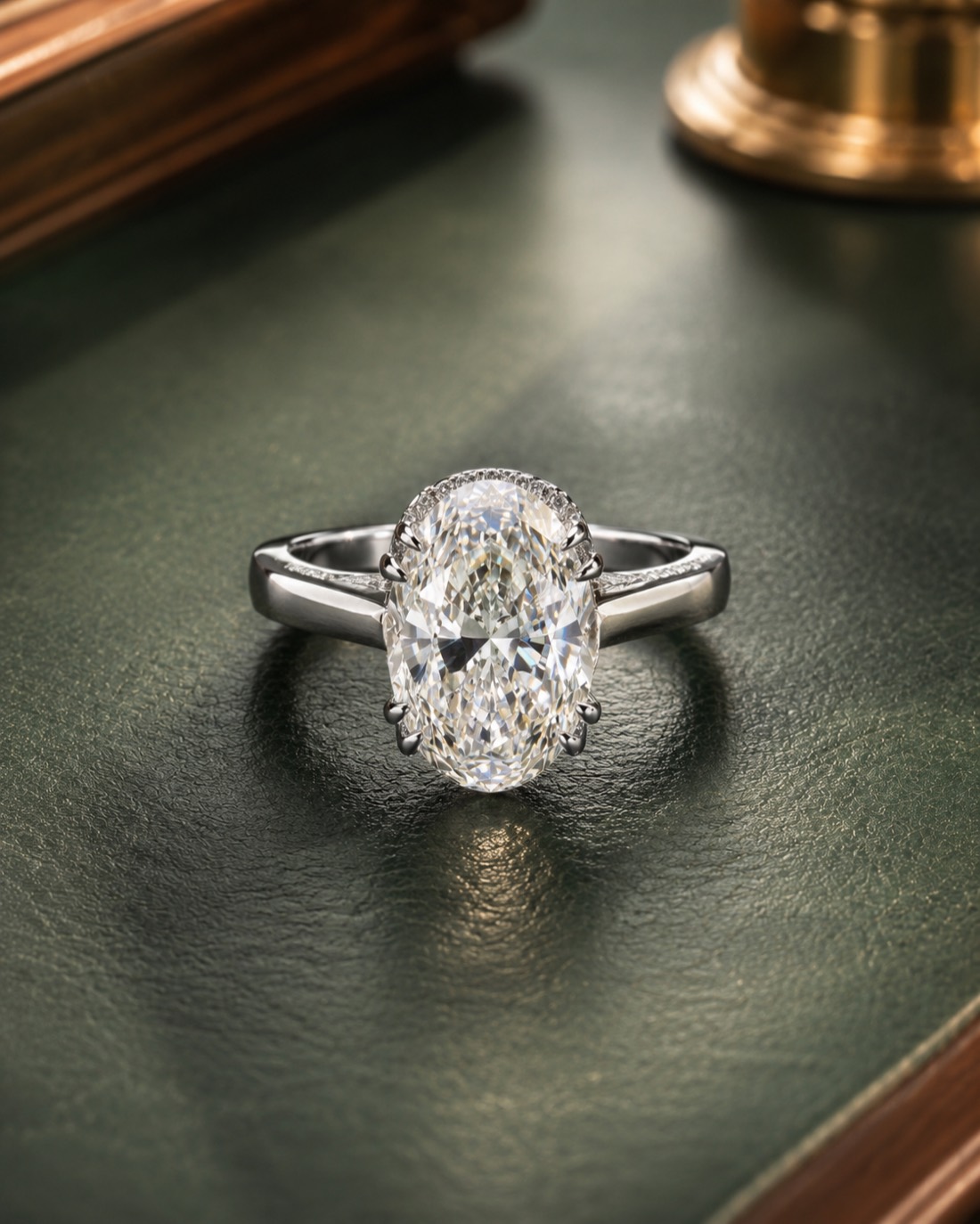
The oval has become one of the most requested diamond shapes for a reason: it combines the brilliance of a round cut with an elongated silhouette that visually elongates the finger and reads larger than its actual weight. It's not a trend built on nothing — the physics of the cut genuinely deliver more visible surface area per carat than a round.
What a 1 carat oval actually looks like
Size on paper doesn't always match size on the hand, so here's what to expect:
- Approximate dimensions: 7.7mm long x 5.7mm wide (this varies slightly by cutter and length-to-width ratio)
- Length-to-width ratio: most jewelers consider 1.35–1.50 the sweet spot for a classic oval look; below 1.3 starts to look rounder, above 1.5 starts to look narrow and "javelin"-shaped
- On the hand: because the stone runs lengthwise across the finger, a 1 carat oval typically appears 10-15% larger than a 1 carat round when viewed face-up
What drives the price of a 1 carat oval
Four factors matter, in roughly this order of visual impact:
- Cut quality. Ovals don't have a universal cut grade the way rounds do (GIA doesn't grade oval cut on the same 0–10 scale), so the length-to-width ratio, symmetry, and facet pattern matter more here than the grading report alone. A poorly cut oval can show a dark "bowtie" shadow across the center.
- The bowtie effect. Almost every oval shows some bowtie — a shadow that crosses the stone's width. A subtle bowtie is normal and often invisible in everyday light; a strong, dark bowtie noticeably dulls the stone's brilliance and should push the price down, not up.
- Color and clarity. Because ovals show off their table more openly than shapes with more facets (like cushion or radiant), color tends to be slightly more visible in an oval — many buyers go one grade higher on color than they would for a round of the same size.
- Natural vs. lab-grown. As with any shape, lab-grown ovals run significantly less per carat than natural ovals of comparable quality, often 60-80% less.
Realistic price ranges
At 1 carat, a well-cut oval with good color (G-H) and eye-clean clarity (VS2-SI1) typically runs:
- Lab-grown: roughly $700-$1,800 for the stone alone
- Natural: roughly $3,000-$6,500 for the stone alone
These ranges shift with market conditions and the specific cutter, and don't include the setting, labor, or certification — treat them as a starting point for conversations, not a fixed quote.
Best settings for a 1 carat oval
The setting you choose changes how the oval reads on the hand almost as much as the stone itself:
- Solitaire with a thin band: shows off the oval's full length and is the most classic, timeless choice
- Halo: adds visual size and helps camouflage a subtle bowtie by breaking up the eye's focus on the center
- East-west setting: turns the oval sideways across the finger for a modern, editorial look
- Three-stone: pairs the oval with two smaller side stones (trapezoids or half-moons work especially well with the elongated shape)
Prong placement matters too — ovals need protection at their pointed ends (the "points"), so look for settings with reinforced prongs there, since this is where an oval is most vulnerable to chipping.
What to actually check before buying
- Ask to see the stone's length-to-width ratio, not just the carat weight
- View it in person or on video under multiple lighting conditions to check bowtie severity
- Confirm the certification (GIA or IGI) matches the physical stone's measurements
- Ask how the prongs will protect the pointed ends in the final setting
Frequently asked questions
Does a 1 carat oval look bigger than a 1 carat round?
Yes, generally 10-15% larger face-up, because the elongated shape covers more visible surface area across the finger.
What's a "bowtie" on an oval diamond?
A bowtie is a dark shadow that crosses the stone's width, caused by the way facets block light in elongated cuts like oval, pear, marquise, and cushion. Some bowtie is normal; a heavy, obvious one is a quality issue.
Is a 1 carat oval diamond a good size for an engagement ring?
It's one of the most popular sizes and shapes combined — substantial enough to make a statement, versatile enough to pair with almost any setting style.
Should I get a natural or lab-grown 1 carat oval?
Both are the same diamond optically and physically. The choice comes down to budget and whether resale value or rarity matters to you — lab-grown lets the same budget buy more visible size.
What ring size works best with an oval stone?
Oval stones work at almost any finger size, but very petite fingers may want a slightly shorter length-to-width ratio (closer to 1.3-1.4) so the stone doesn't extend past the finger's width visually.
So where does this leave you?
You now know what a 1 carat oval actually looks like on the hand, what genuinely affects its price, and which settings bring out its best qualities. The harder part is finding someone who sources the exact stone you need and builds a setting around it — rather than trying to fit your oval into whatever's already sitting in a display case.
How Amana handles it
We don't sell from a case of finished rings, so when you want a 1 carat oval, we're not limited to whatever oval happens to be in stock. Design and craftsmanship for a ring like this typically run $1,500–$4,000 total — with an honest heads-up that larger or more complex stones (a bigger oval, an intricate halo, added pavé) can run past that range, and we'll tell you that before you commit, not after.
Through The Amana Method, we start with a conversation about her, her style, and your budget, and use AI to show you the actual design before you decide on anything — including exactly which oval, at which bowtie level, in which setting. Your CAD file follows about 3 days later; once you approve it and pay the balance through an email link, your ring is ready in roughly 2 weeks.
We've built close to 1,000 rings this way, working with certified gemologists and as members of the Jewelers Board of Trade. If you already know you want an oval and just need someone to get the stone and the setting right together, reach out and we'll walk you through it.