What Is a CAD Ring Design?
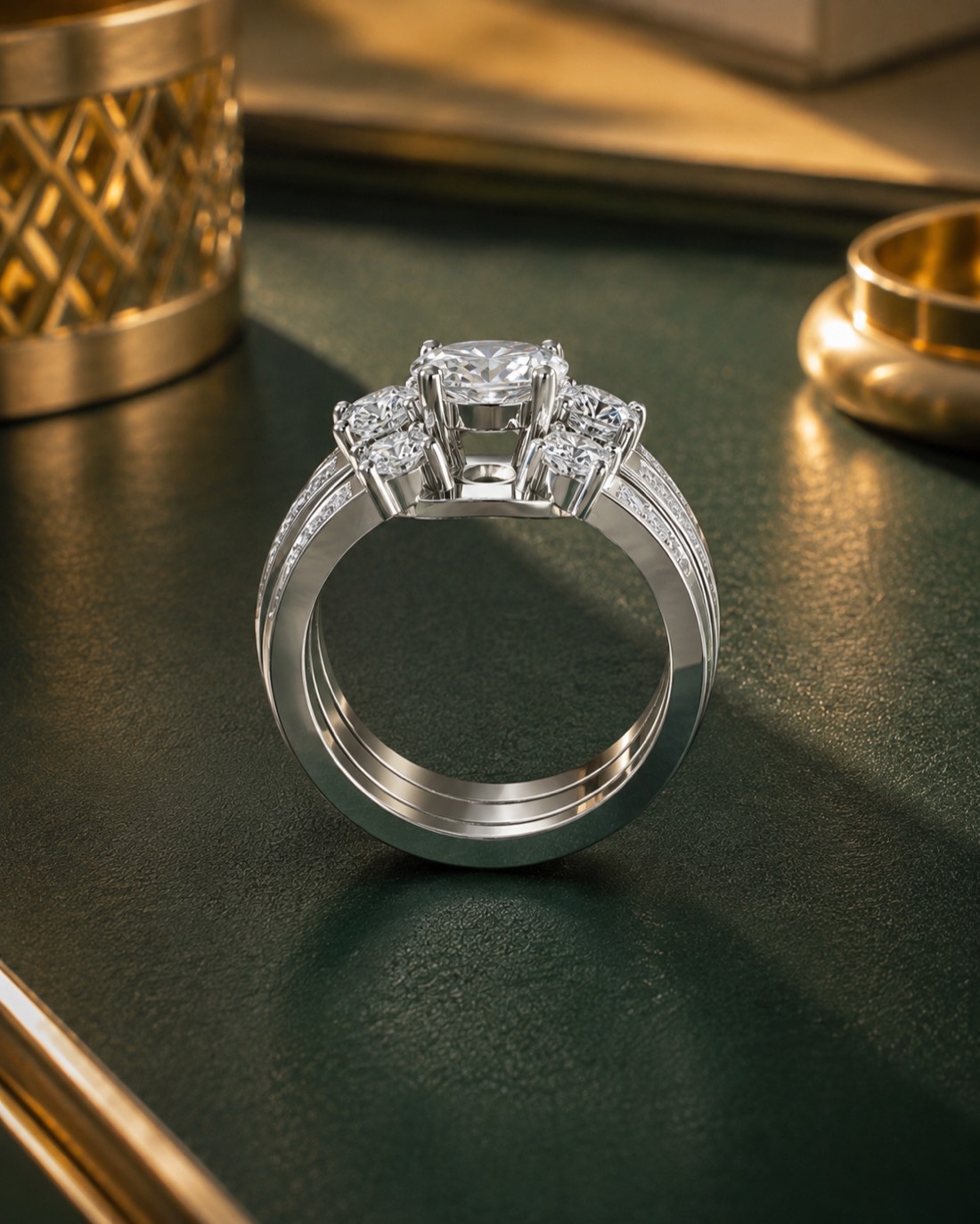
This sits underneath every one of the seven decisions in our complete guide to designing a custom engagement ring — it's how those decisions become a real object.
What CAD actually is
Before CAD, custom jewelry started with a hand sketch and a wax model carved by hand. Both are skilled crafts and both are still practiced. But a sketch is an interpretation, and a hand-carved wax exists in one place, can't be undone, and has to be recarved from scratch if you want a change.
A CAD model is a mathematical object. Every surface is defined by coordinates. The band is a specified width and thickness. The prongs are a specified diameter and length. The seat the diamond sits in is cut to the measurements on that diamond's certificate. The head sits a specified number of millimeters above the finger.
Because it's math, three useful things follow:
It's exact. Not "about 2mm wide." Exactly 2.1mm. When it's cast, that's what comes out.
It's revisable. Want the ring to sit 0.4mm lower? That's an edit, not a re-carve. The rest of the design stays untouched.
It's manufacturable directly. The file goes to a 3D printer that produces a resin or wax pattern, which gets cast into metal through lost-wax casting. There's no translation step where something gets lost.
What you actually receive
Usually a set of rendered images — photorealistic-ish views of the ring from the top, the side, at an angle, and often on a rendered hand or finger. Sometimes a short turntable video.
Read them knowing what renders are good and bad at.
Renders are extremely reliable for: proportion, shape, relative size of every element, how high the ring sits, band width, prong count and placement, how the center stone relates to accents, whether a hidden halo is visible from the angle you expected, and how the whole thing reads on a finger.
Renders are less reliable for: the exact color of the metal, the precise sparkle behavior of the diamond, and the visual weight of tiny details like milgrain. Rendering engines approximate how light moves through a faceted stone; a real diamond outperforms a render. Metal color depends on your screen. If a rendered white gold ring looks a little gray, that's the render, not the ring.
So: trust the geometry completely, and hold the finish loosely.
How to review a CAD like someone who's done it before
This is the step where you have all the leverage, so it's worth spending twenty minutes on rather than five.
Check the side profile first. This is what people skip and regret. The top-down view looks good on nearly every design. The side view tells you how high the ring sits, whether the stone perches or nestles, whether a wedding band could ever sit flush against it, and whether the whole thing looks proportional in three dimensions. Most revision requests come out of the side view.
Check the band width against her actual preference. 1.8mm and 2.4mm are both "thin," and they look genuinely different on the hand. If she wears a slim band now, measure it.
Count the prongs and look at where they land. Four prongs versus six is a real aesthetic difference. On pointed shapes — pear, marquise, princess — confirm there's a protective V-prong or a proper corner claw at the point. On a big center stone, double claws are worth asking about.
Look at the gallery. That's the open space under the center stone, viewed from the side. It affects how light gets in, how easy the ring is to clean, and how it feels against the finger.
Check where the accent stones stop. Pavé that runs all the way around the band looks different from pavé that stops three-quarters of the way. It also matters for resizing later — a fully paved band is harder and pricier to resize than one with a plain section at the bottom.
Ask what it weighs. Metal weight tells you whether the ring will feel substantial or delicate, and it's a fair thing to ask about.
Revisions are normal — say the small thing
The single most common mistake at this stage is politeness. People look at a CAD, notice something slightly off, decide it's a small thing not worth bringing up, and approve it. Then they wear that small thing forever.
Revisions are a built-in part of the process, not an inconvenience. And the requests that come back are almost always minor: double claws instead of single prongs. Sit the ring a millimeter lower. Make the band slightly narrower. Move the hidden halo down a touch. Thin the bezel. Each of those is a quick edit and adds a day or two, not a week.
If something looks off and you can't name why, say that too — "the head looks heavy to me" is completely usable feedback for a designer. Naming the fix is their job.
The rhythm should be: review, request, see the revised CAD, review again, and repeat until you genuinely like it. There's no cap on that. A CAD you approved reluctantly becomes a ring you wear reluctantly.
What happens after you approve
Once you sign off, the file goes to a 3D printer that produces a pattern in castable resin or wax. That pattern is invested in a plaster-like mold, the pattern is burned out, and molten metal fills the cavity — this is lost-wax casting, and it's been the method for thousands of years. Only the pattern-making changed.
The raw casting comes out rough. It gets cleaned, filed, sanded, and pre-polished by hand. Then a setter mounts your center stone and any accents, which is skilled handwork that no software does. Then final polish, and rhodium plating if it's white gold.
So CAD doesn't replace craftsmanship. It replaces guessing about what the craftsmanship is aiming at.
Frequently asked questions
How long does a CAD take?
Typically a few days from the design conversation to the first rendering. Revisions usually add a day or two each. The variable is how many rounds you want, not the software.
Will the finished ring look exactly like the CAD?
Geometrically, yes — that's the point, and it's why the file is what gets manufactured. The real ring will usually look better than the render, because a real diamond throws light in a way rendering software only approximates.
Can I request changes after I approve the CAD?
Once it's cast, changes mean re-casting, which means starting over on the metal. That's why approval is a real decision point and why it's worth taking your time there. Before approval, changes are cheap. After, they aren't.
Do I own the CAD file?
Policies vary by studio, so ask. It's a reasonable thing to want, especially if you might ever need the ring reproduced or repaired to spec.
Is a CAD-designed ring less "handmade"?
The design is digital; everything after it is hand labor. Casting cleanup, stone setting, and polishing are all done by people. CAD makes the design precise. It doesn't make the ring.
So where does this leave you?
Here's the useful reframe: a CAD isn't paperwork on the way to a ring. It is the ring, in the only form where changing it is still free. Once metal is cast, every change is expensive. Before that, every change is a conversation.
Which points at the real difference between designing a ring and buying one. When you buy a finished ring, you're seeing the only version that will ever exist. There's no earlier stage to intervene at, because that stage already happened — months ago, in a factory, for a generic customer whose hand and preferences were an average.
That's not retail being dishonest. It's just what volume manufacturing is. A finished ring in a case had to be made before anyone knew who'd buy it, which means every choice in it was made on a guess. And every variation on that guess — lower profile, different prongs, narrower band — would have to be a separate item on a shelf that might never sell. So it doesn't get made.
A CAD is simply what it looks like when those choices get made after somebody knows who the ring is for.
This is exactly how we work
At Amana, the CAD isn't an upsell or a special request — it's the process, every time, for everyone.
You sit down with us in person or over video and we design the concept with you in the room, using AI-assisted visuals so you're reacting to something real instead of describing it into the air. About three days later, you get your CAD by email. You look it over. If the ring should sit lower, or you want double claws instead of single prongs, you tell us and we revise — that's normal, it's usually small stuff, and we keep going until you actually approve it. When you do, you approve and pay the balance through a link in your email; you don't have to come back in. The ring is ready about two weeks later.
Our design and craftsmanship typically runs $1,500 to $4,000, and you end up with a real, certified diamond ring. Larger or rarer stones, or a genuinely complex build, can run higher — and if yours does, we explain why before you commit to anything.
Meanwhile, a comparable ring at a traditional retail jeweler runs about $12,000, and the same finished ring bought wholesale still runs roughly $8,000. We charge for the design and the craftsmanship, because that's the actual work — and the CAD is where you can see exactly what you're paying for before you pay for it.
Amana means "Trust" in Arabic. Earn your trust. Make your ring.