What Actually Drives Custom Ring Cost?
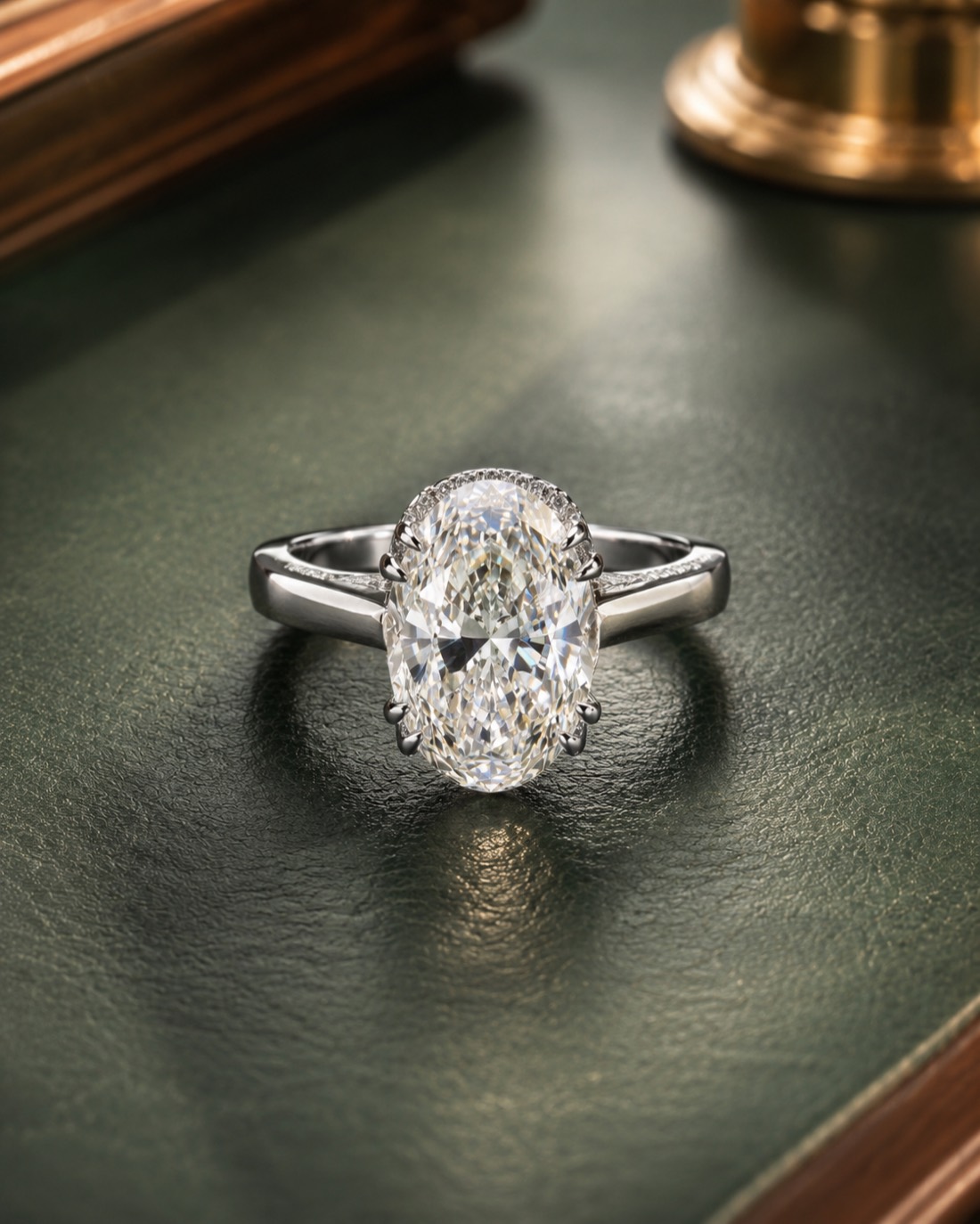
If you've gotten three quotes for "basically the same ring" and landed on three very different numbers, this is why. You're not being scammed — you're seeing five separate cost inputs get weighted differently by three separate businesses. For the bigger picture on why custom rings are priced the way they are at all, see our guide on why custom doesn't cost more. Here's what's actually inside that number, so you can ask better questions and read a quote with confidence.
The center stone is usually the biggest single variable
The stone at the center of the ring almost always makes up the largest share of the total cost, and it moves on more than just "how big." Four things about the stone change the price independently of each other:
- Carat weight. Bigger stones cost more per carat, not just more in total — the price curve gets steeper as you cross whole and half-carat marks.
- Shape. Round brilliant diamonds are cut from more of the rough stone that's lost in cutting, so they typically cost more per carat than fancy shapes like oval, cushion, or pear of the same weight and quality.
- Cut, color, and clarity grades. A 1-carat diamond graded excellent-cut, colorless, and eye-clean can cost meaningfully more than a 1-carat diamond with a lower grade in any one of those categories — even though they're both "1 carat."
- Lab-grown vs. natural. Lab-grown diamonds of comparable size and grade typically cost a fraction of natural diamond prices, which is one of the single biggest levers on a final quote — see our full lab-grown vs. natural diamonds comparison for the details.
Because the stone is usually 50–70% of a ring's total cost, small decisions here move the final number more than almost anything else on this list. For a full line-item look at where every dollar goes, see our engagement ring price breakdown.
Metal type and total weight
The metal itself is priced by weight and by type. Platinum costs more than white gold per gram both because the raw metal is pricier and because it's denser — a platinum ring of the same design will simply weigh more than the same design in gold. Yellow, white, and rose gold are usually similar in raw cost since they're all built on a gold base with different alloys, though white gold sometimes carries a small added cost for its rhodium plating.
Total metal weight is also a design decision. A wide band, a thick shank, or a substantial gallery under the stone uses more metal than a slim, low-profile design — and that weight is priced whether the ring is simple or ornate.
Setting complexity and stone count
This is where "the same size diamond" can turn into very different quotes. A simple solitaire uses minimal metal and a handful of prongs. A halo setting adds a ring of small accent stones and the labor to set each one individually. A pavé band might have 40, 60, or more tiny stones, each one drilled, seated, and secured by hand. Every additional stone is both a material cost (the stone itself, however small) and a labor cost (the time it takes a setter to place it correctly).
Design details add up the same way: hand-engraving, milgrain edging, a hidden halo underneath the center stone, a filigree gallery, or a two-tone metal combination all require more skilled hours than a plain band — and skilled hours are priced accordingly.
Labor: casting, setting, and finishing
Every ring goes through the same broad stages — the design is turned into a physical mold or 3D-printed pattern, the metal is cast, the stones are set, and the piece is polished and finished. How much of that work is done by a trained human versus a machine, and how many pieces a shop is running through that process at once, changes the labor cost per ring. A one-off custom piece, made and finished individually, carries different labor economics than a setting pulled from inventory and produced by the thousand.
Design and consultation time
The last variable is the one that's easiest to overlook: the time it takes to actually arrive at the design. A ready-made setting off a shelf has zero design time built into its price — someone already decided what it looks like. A fully custom ring starts with a conversation and a CAD design process that lets you see and adjust the ring before it's ever cast, and often goes through a round or two of changes before it's approved. That time has real value, and it's part of why two rings that end up looking similar can be priced differently: one started as a decision, the other started as a conversation.
If you're weighing whether that process is worth it compared to a bigger budget alone, our piece on are designer rings worth it digs into that tradeoff directly.
Frequently asked questions
Is a custom ring always more expensive than a store ring?
Not necessarily. A custom ring skips the retail markup, in-store overhead, and multiple middlemen that a traditional jewelry store bakes into its price — so a custom piece with comparable stone quality and craftsmanship often lands at or below store pricing, even though it was made specifically for you.
Why did I get three different quotes for what seemed like the same ring?
Because each jeweler is weighting these five variables differently — a different stone source, a different metal markup, a different amount of hand-labor, or a different amount of built-in margin. Ask each quote to break down the stone, metal, and labor separately so you're comparing apples to apples.
Does a bigger budget always mean a "better" ring?
It means more room on one or more of these five levers — typically a larger or higher-grade stone, since that's usually the biggest cost driver. It doesn't automatically mean better craftsmanship; a smaller, well-designed ring from a skilled setter can outperform a larger stone in a rushed setting.
What's the single fastest way to lower a custom ring's cost without lowering quality?
Consider a lab-grown center stone. It's the one variable that can cut a large percentage off the total cost while keeping the same size, shape, and grade you'd get with a natural diamond.
Do simpler settings always cost less?
Usually, yes — fewer stones and less hand-shaping means less labor and material. But a very plain design in platinum can still cost more than an elaborate one in gold, because metal type and weight are their own separate variable.
So where does this leave you?
You now know the five things that actually move a custom ring's price: the stone, the metal, the setting's complexity, the labor behind it, and the design time it took to get there. That's a much more useful way to read a quote than comparing sticker prices, because it tells you why two numbers differ instead of just that they do.
The next step is finding a designer who'll walk through those five variables with you honestly, so you understand exactly what you're paying for at each stage — not after you've already committed.
Where Amana fits in
This is exactly the conversation we have with every client. When you sit down with us — in person or virtually — we go through each of these five variables together: the stone, the metal, the setting, the labor, and the design itself, and we price the ring against your actual budget instead of handing you a number and asking you to trust it.
Because we design and produce every ring ourselves, without a retail markup or a middleman jeweler marking up someone else's work, a fully custom ring from Amana typically runs $1,500–$4,000 total for the design and the finished piece — compared to roughly $8,000 for the same ring built by a traditional jeweler, or $12,000 through a retail store. Larger center stones or more complex, heavily-set designs can run past that range, and we'll always tell you that upfront, before you're ever asked to commit to anything.
If you want to see exactly where your ring's cost is coming from before you spend anything, book a consultation and we'll walk through it together.