The Ultimate Engagement Ring Buying Guide
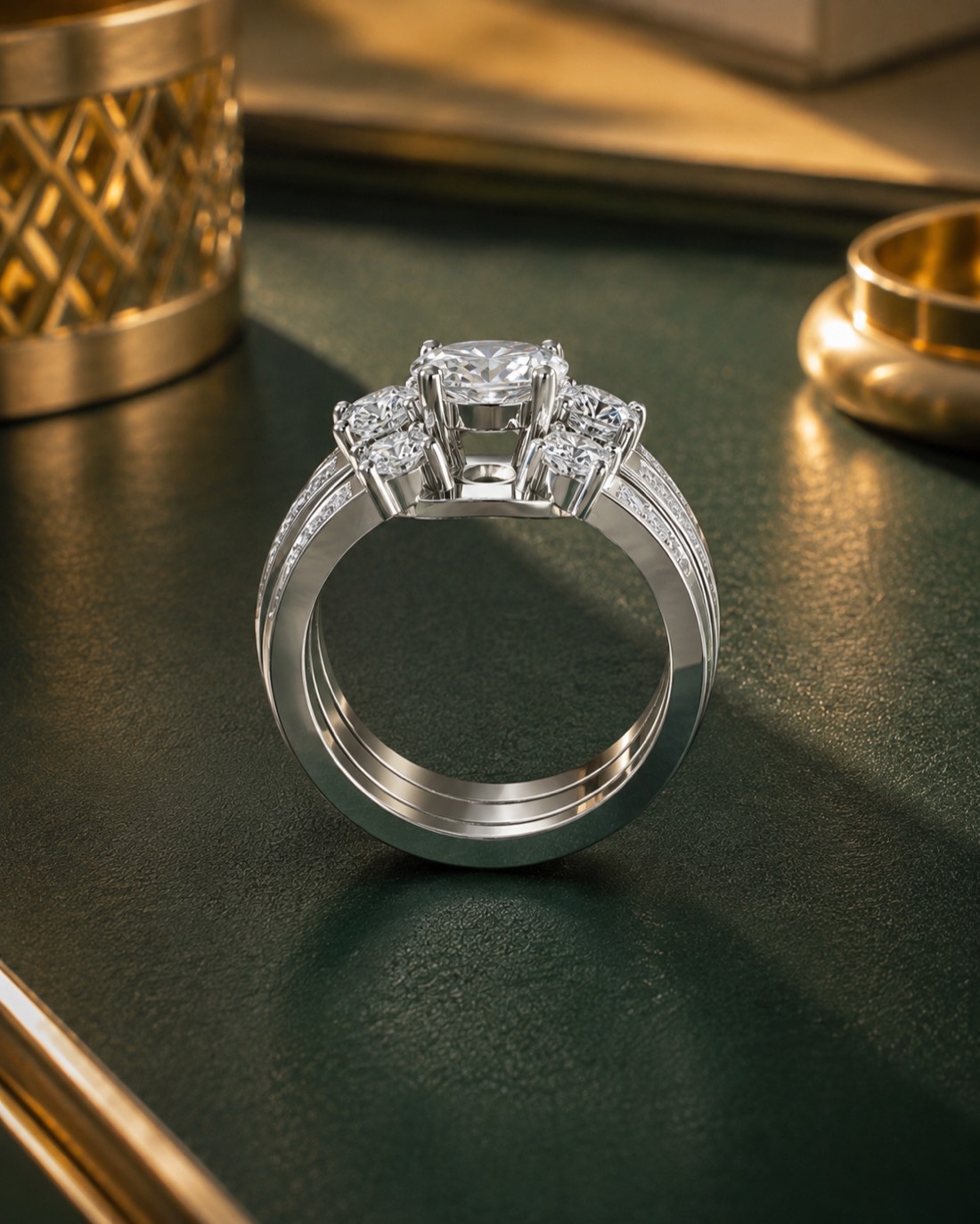
This is the whole process, start to finish, for someone who's never done it before.
Step 1: Set a real budget (before anything else)
Not a percentage of your salary. Not an average. A number you can pay without debt or strain.
The "two months' salary" rule is worth naming and dismissing directly: it originated as a De Beers advertising campaign in the 1930s and 40s. It is not, and never was, financial guidance. It exists because it sold diamonds.
A better approach:
- Decide the maximum you can comfortably spend today.
- Treat that as a ceiling, not a target.
- Assume you'll spend less than the ceiling if you shop well — because you will.
📖 Go deeper: How Much Should You Spend on an Engagement Ring?
Step 2: Learn the minimum viable diamond knowledge
You don't need to become a gemologist. You need about five facts, and they're all in our Diamond Education Hub:
- Cut is the only C that controls sparkle. Never compromise it.
- G-H color and VS1-VS2 clarity are the value sweet spot — higher grades are invisible without a loupe.
- Lab-grown diamonds are real diamonds, chemically identical, 60-85% cheaper.
- Buy just under a carat threshold — 1.9ct, not 2.0ct.
- Insist on GIA or IGI certification. In-house certification isn't verification.
Those five facts will save most buyers thousands of dollars. That's the entire syllabus.
📖 Go deeper: The 4Cs Explained in Plain English · Lab-Grown vs. Natural Diamonds
Step 3: Figure out their style (without ruining the surprise)
The reliable methods, in order of usefulness:
- Look at the jewelry they already wear. Gold or silver tone? Delicate or bold? Ornate or minimal? Vintage or modern? This is the highest-signal data available and it's sitting on their hand right now.
- Check what they've saved. Pinterest boards and saved Instagram posts, if you have access.
- Ask their close friend or sibling. People overwhelmingly tell someone what they want. Find that someone.
- Bring it up hypothetically. Comment on a ring in a movie or on someone's hand and see what they say.
- Or — just ask them. Increasingly common, entirely valid, and eliminates the biggest risk in the process.
📖 Go deeper: How to Find Out Their Ring Style Without Spoiling It · Surprise Proposal vs. Shopping Together
Step 4: Get their ring size
The most common quiet source of stress in this whole process. Options that actually work:
- Borrow a ring they already wear on the correct finger and have it measured.
- Ask a friend or family member who might know or can find out.
- Trace an existing ring's inner circle — imperfect, but a usable starting point.
- Guess slightly large. A ring that's too big can be worn temporarily and resized. A ring that won't go on can't be worn at all — and the proposal photo matters.
Average sizes, if you're truly guessing: roughly size 6-6.5 for women, 9-10 for men in the US. Use only as a last resort.
Important: some designs resize easily (plain bands), and some don't (full pavé eternity-style bands, tension settings). Ask before you commit if size is uncertain.
📖 Go deeper: How to Get Their Ring Size Secretly · Which Rings Can and Can't Be Resized
Step 5: Decide where to buy — the biggest decision in this guide
More than the stone, more than the setting, this determines what you pay. Your realistic options:
Chain / mall jewelers
Convenient, immediate, recognizable brand. Highest markup in the category, limited selection, commissioned sales.
Independent local jewelers
More personal, often better pricing than chains, quality varies significantly by shop. Worth checking reviews carefully.
Online-only retailers
Lowest overhead of the traditional options, large selection, competitive pricing. The trade-off: you're buying without seeing it, and service quality varies.
Independent designers (designer-direct)
You work directly with the person designing your ring. No storefront network, no national ad budget, no commissioned sales floor in your price. You see a CAD or AI-assisted preview before it's built. Turnaround is a few weeks rather than immediate.
Why this matters so much: the same diamond, in the same style setting, can differ by many thousands of dollars across these four channels — not because the ring is different, but because the overhead structure behind it is.
📖 Go deeper: Designer vs. Jewelry Store · Where to Buy an Engagement Ring in 2026
Step 6: The practical stuff people forget
- Insurance. Get the ring insured before you propose, not after. Options include a rider on renters/homeowners insurance or a dedicated jewelry policy. You'll need an appraisal.
- Appraisal. Separate from certification. Certification grades the stone; appraisal establishes replacement value for insurance.
- Warranty and service. Ask what's covered — prong re-tipping, stone tightening, resizing, cleaning. Prongs genuinely do need periodic checking.
- Return and resize policy. Get it in writing, and understand the window.
- Care. Regular cleaning, periodic prong inspection, and removing it for heavy manual work will keep a ring looking new for decades.
📖 Go deeper: Do You Need Engagement Ring Insurance? · How to Care for an Engagement Ring
The timeline
| When | What |
|---|---|
| 8 weeks out | Set budget, start learning, begin observing their style |
| 6 weeks out | Decide where to buy; first consultation if designing |
| 5 weeks out | Nail down ring size; approve design/CAD |
| 3 weeks out | Ring in production |
| 1 week out | Ring in hand; get it appraised and insured |
| Proposal day | Everything's handled. Enjoy it. |
Rushing is where mistakes and overpaying happen. Six to eight weeks is comfortable. Under three weeks limits your options significantly — though it's not impossible.
Red flags to walk away from
- No independent certification, or "our own" certification only.
- Refusal to itemize the price into stone, metal, setting, and labor.
- Pressure tactics — "this price is only good today," a stone someone else is supposedly about to buy.
- Vague origin disclosure on natural vs. lab-grown. This is legally required.
- No written total before you commit.
- Unclear return, resize, or warranty terms.
- A price that changes between the quote and the invoice.
📖 Go deeper: Red Flags When Ring Shopping
Frequently asked questions
How far in advance should I buy an engagement ring?
Six to eight weeks is comfortable for a custom or semi-custom ring, allowing time for design, revisions, production, and insurance. Ready-made rings can be bought immediately, but rushing usually costs more.
How do I find out their ring size without them knowing?
Borrow a ring they already wear on the correct finger and have it measured, ask a close friend or family member, or trace the inner circle of an existing ring. If you must guess, guess slightly large — resizing down is easier than not being able to wear it at all.
Where is the cheapest place to buy an engagement ring?
Cost varies most by business model rather than by specific store. Channels with less overhead — online retailers and independent designers — generally price well below chain and mall jewelers for a comparable stone and setting.
Do I need engagement ring insurance?
It's strongly recommended, and should be arranged before the proposal. You can typically add a rider to renters or homeowners insurance, or buy a dedicated jewelry policy. Most insurers require an appraisal.
What's the difference between a diamond certificate and an appraisal?
A certificate (GIA or IGI) grades the diamond's characteristics. An appraisal establishes a replacement value for insurance purposes. You need both, and they serve different functions.
Is it okay to shop for the ring together?
Absolutely, and it's increasingly common. It eliminates size and style risk entirely, and the proposal itself can still be a complete surprise.
So where does this leave you?
Six steps, one timeline, and a short list of things to avoid. The most consequential decision on that list isn't the stone or the setting — it's step five, where you buy, because that single choice can swing the price by thousands without changing anything on your partner's finger.
Why we'd point a first-time buyer toward a designer
We'll be upfront that we're not neutral here — we're designers, so of course we think designing is the better route. But here's the case on its merits, and you can weigh it yourself.
Every risk in this guide gets smaller when someone designs your ring with you. Style risk shrinks because you see AI-assisted concepts during the consultation and a real CAD file before anything is built. Size and resizing risk shrinks because we plan the design around it instead of discovering the problem afterward. Overpaying risk shrinks because there's no storefront, no national ad campaign, and no commissioned sales floor sitting inside the number we quote you. And the "I don't know what I'm doing" feeling — which is the real reason first-time buyers overspend — shrinks because you're sitting with the person actually making your ring rather than someone paid to move inventory.
The numbers, plainly: a comparable ring at a traditional retail jeweler runs around $12,000. That same finished ring bought wholesale still runs roughly $8,000. At Amana you're paying for design and craftsmanship — typically $1,500–$4,000, depending on your stone and design complexity — and you leave with a real, certified diamond ring. When a larger or rarer stone pushes past that range, we show you exactly why before you commit to a thing.
The process from your side: one consultation, a CAD file a few days later, revisions until it's right, and your ring about two weeks after you approve it.
Amana means trust. That's the sequence, and it's in that order on purpose. Earn your trust. Make your ring.