Step Cut vs. Brilliant Cut Diamonds: What's the Difference?
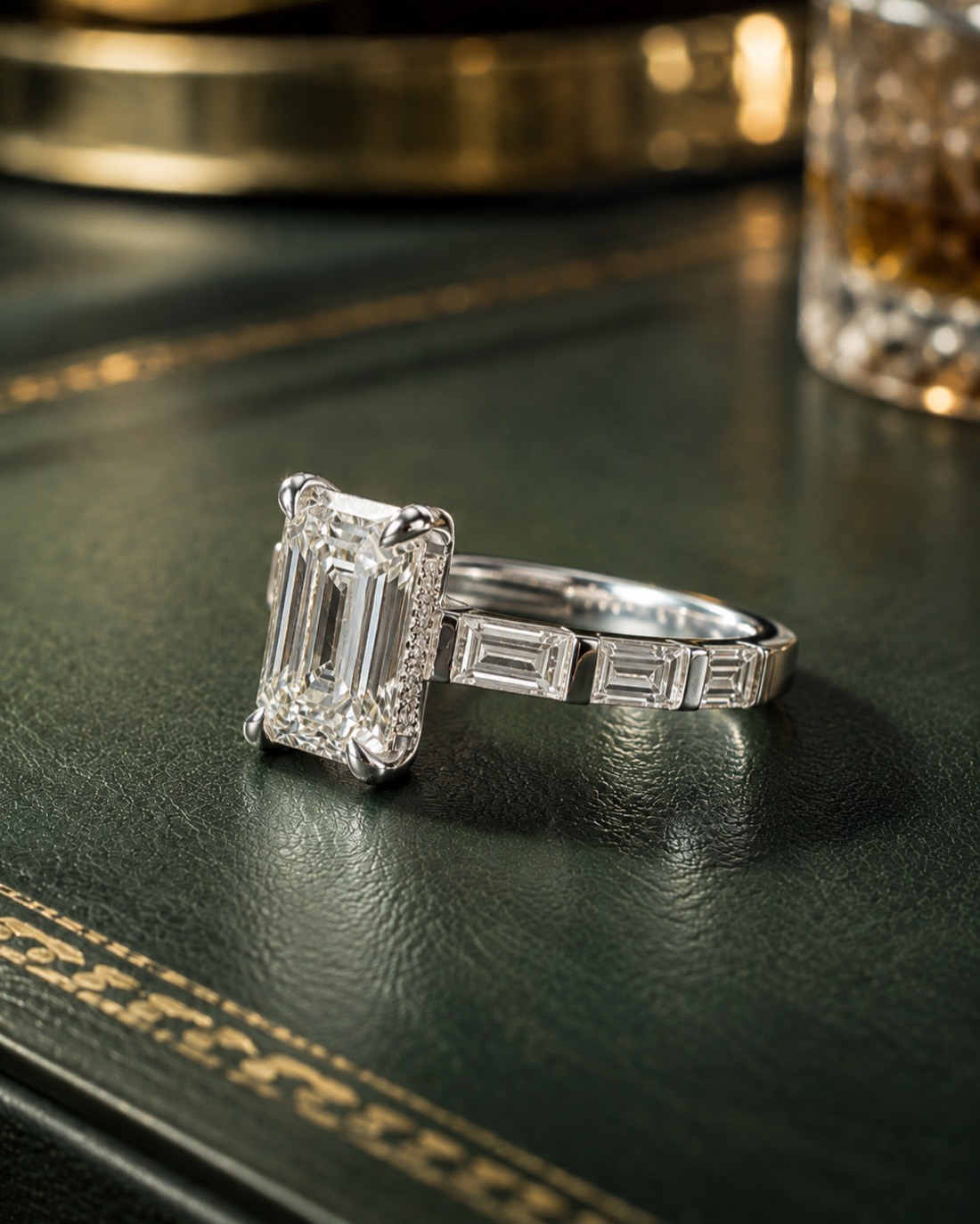
The terms "brilliant cut" and "step cut" describe facet arrangement, not just outline shape — and understanding the difference explains a lot about why certain diamond shapes sparkle differently than others.
How Brilliant Cuts Work
Brilliant-cut diamonds arrange facets — usually 57 or 58 of them — in triangular and kite shapes radiating from the center. This pattern is engineered to bounce light around inside the stone and send it back out through the top in small, scattered flashes. That's the classic diamond "sparkle" most people picture. Round brilliants are the most common example, but princess, cushion, radiant, and oval cuts are also brilliant-style cuts, each with a shape-specific facet pattern built on the same light-scattering principle.
How Step Cuts Work
Step-cut diamonds use long, flat, rectangular facets arranged in parallel rows, like steps (hence the name). Instead of scattering light into small flashes, this pattern creates broad, wide flashes of light and dark as the stone moves — often called a "hall of mirrors" effect. Emerald and asscher cuts are the defining step cuts. Because the facets are larger and flatter, step cuts also show off clarity differently: inclusions are more visible in a step cut than in a brilliant cut, which is one reason clarity matters more when buying a step-cut diamond.
Key Visual Differences
- Sparkle style: Brilliant cuts scatter light into small, scattered flashes; step cuts produce broader, slower flashes of light and dark.
- Clarity visibility: Step cuts are less forgiving of inclusions since their open facets act like windows into the stone; brilliant cuts hide small inclusions more easily behind their scattered pattern.
- Overall look: Brilliant cuts read as more "sparkly" and traditional; step cuts read as more architectural, vintage, or Art Deco in feel.
Which Shapes Fall Into Each Category
- Brilliant cuts: round, princess, cushion, oval, pear, marquise, radiant, heart.
- Step cuts: emerald, asscher, baguette (usually used as an accent stone rather than a center stone).
Radiant cut diamonds are sometimes described as a hybrid, since they combine a step-cut outline (cut corners, rectangular shape) with brilliant-style faceting for extra sparkle.
Which Should You Choose?
This comes down entirely to personal taste and how much you value sparkle versus clarity of line. If you want maximum light performance and forgiveness for lower clarity grades, a brilliant cut is the safer choice. If you're drawn to a cleaner, more geometric look and don't mind (or actively want) a diamond with fewer visible facets, a step cut like emerald or asscher is worth considering — just budget for slightly higher clarity to keep the stone looking clean.
Frequently asked questions
Is a step cut diamond less sparkly than a brilliant cut?
It's not "less" sparkly, it's differently sparkly — step cuts produce broad flashes of light rather than the scattered sparkle of a brilliant cut. Some people prefer the step-cut look specifically for that reason.
Do step-cut diamonds need higher clarity than brilliant cuts?
Generally yes. The open, flat facets of a step cut show inclusions more clearly, so most buyers aim for VS2 clarity or better in an emerald or asscher cut, compared to what might be acceptable in a round brilliant.
Is radiant cut a step cut or a brilliant cut?
It's a hybrid — a step-cut-style rectangular or square outline combined with brilliant-style facets for extra sparkle.
Which cut style is more expensive?
Neither style is inherently pricier — cost depends more on carat weight, clarity, and color than on cut style itself, though step cuts often show a larger face-up size for the same carat weight than round brilliants.
So Where Does This Leave You?
Once you understand that "step cut" and "brilliant cut" describe how light moves through the stone — not just its outline — the choice becomes about which look you actually want on your hand every day, not which one is "correct."
Why This Is Where Amana Fits In
Whichever cutting style you're drawn to, the clarity and color grade needed to make it look its best is a real conversation, not a guess — and that's exactly the kind of decision your Amana designer walks through with you before you commit to a stone.
Design and craftsmanship for a ring built around either cut style typically runs $1,500-$4,000 total, with the specific stone you choose (and its size) shaping where you land in that range — larger or higher-clarity stones, especially in step cuts where clarity matters more, can run above it. Your designer will help you match the stone quality to the cut style so you're not overpaying for clarity a brilliant cut would have hidden anyway, or underpaying for clarity a step cut needs.
The process runs the same regardless of which cut you choose: a design consultation with AI-assisted visuals, a CAD file about 3 days later, approval and balance payment via an email link, and pickup roughly 2 weeks after that. Reach out if you want help deciding between a step cut and a brilliant cut for your ring.