Oval vs. Round: Which Looks Bigger?
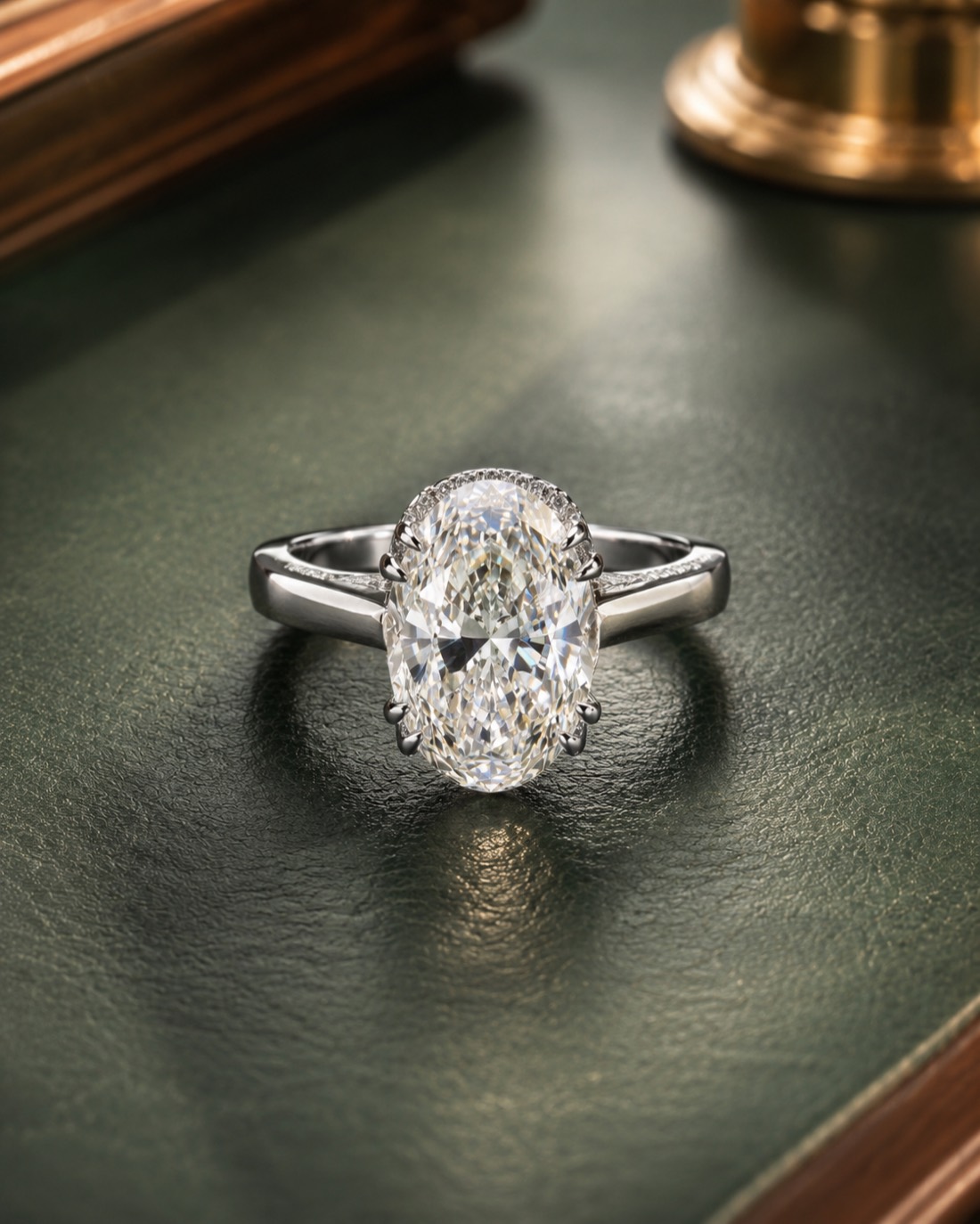
This is one piece of our full diamond education guide.
The size question, with actual numbers
This is the whole reason most people put these two shapes next to each other, so let's start there.
At 1.00 carat, a well-proportioned round brilliant measures about 6.4–6.5mm across. A 1.00ct oval at a common 1.40 length-to-width ratio measures roughly 7.7mm × 5.7mm.
The round is a circle 6.5mm wide. The oval is 7.7mm long. That's more than a full millimeter of extra length, and on a finger a millimeter is a lot more visible than it sounds.
Run it up the scale and the pattern holds:
| Carat | Round (mm) | Oval (approx. mm) |
|---|---|---|
| 0.50 | 5.2 | 6.5 × 4.5 |
| 0.75 | 5.8 | 7.0 × 5.0 |
| 1.00 | 6.5 | 7.7 × 5.7 |
| 1.50 | 7.4 | 8.5 × 6.5 |
| 2.00 | 8.1 | 9.3 × 7.0 |
Two separate effects are stacking here. First, an oval spreads its weight over a wider face-up footprint — a round packs more of its carat into depth. Second, elongated shapes simply take up more of the length of a finger, and the eye reads "long" as "big." Both are real, and together they're why an oval will out-present a round of the same weight nearly every time.
And it costs less
Round brilliants carry the highest price per carat of any shape, and the reason is unglamorous: yield. Cutting a round from rough diamond wastes more material than almost any other shape — often over half the original stone. Somebody pays for that waste, and it's whoever buys the round.
Ovals are cut from rough more efficiently, so more of the original crystal survives into the finished stone. That efficiency shows up as a lower price per carat — generally 10–25% less than a comparable round.
So the oval is bigger-looking and cheaper. Which sounds like it should end the conversation. It doesn't, because of one thing.
The bowtie
Look down into an oval under normal room light and you may see a dark band running side to side through the middle, roughly shaped like a bowtie. That's light obstruction: as your head leans over the stone, your own shadow blocks the light that those center facets need, and elongated brilliant cuts are geometrically prone to it.
Here's what matters about it:
Every oval has one to some degree. It's a byproduct of the shape. The question is never "does it have a bowtie" — it's "how visible is it, and does it move."
A faint one is harmless. A soft shadow that shifts and flashes as the stone moves reads as contrast, and contrast is part of why a diamond looks alive.
A severe one kills the stone. A hard, dark, static band that stays put no matter how you tilt it takes a chunk out of the middle of the diamond and doesn't give it back. In photos it looks like a smudge. In person it looks like a hole.
No certificate grades it. GIA doesn't give fancy shapes an overall cut grade at all — ovals get polish and symmetry only. Bowtie is not a graded characteristic anywhere. Which means a report can say Excellent polish, Excellent symmetry, VS1, G, and the stone can still have a bowtie you'd hate. The only way to know is to look at the actual stone, in video or in person. We wrote a whole piece on it: what is a bowtie in a diamond.
Rounds don't have this problem. Their symmetry is rotational — there's no long axis for a shadow to stretch across. That's the thing you're buying when you buy round.
What round actually gives you
It's worth saying plainly, because the value case for oval can make round sound like a mistake. It isn't.
The round brilliant is the most optically optimized shape in existence. Its 57 or 58 facets were mathematically worked out to maximize light return, and nothing else comes closer. It's also the only shape GIA assigns a full cut grade to — so you can buy a round on paper with real confidence, which you can't do with any fancy shape.
That combination — peak brilliance plus a gradeable, verifiable cut — is what the premium buys. If you want the least uncertainty available in a diamond purchase, round is it.
Ratio: the oval decision inside the oval decision
If you go oval, length-to-width ratio changes the look more than most people expect.
- 1.30–1.35 — rounder, plumper, reads closer to a cushion
- 1.35–1.45 — the classic oval most people picture; the safest middle
- 1.45–1.55 — noticeably elongated, more dramatic, more finger-lengthening
- 1.55+ — long and narrow, and increasingly prone to a pronounced bowtie
Longer ratios exaggerate the shape's length advantage, but they also stretch the geometry that creates the bowtie. Past about 1.50 you need to look harder.
Setting and durability
Rounds sit in nearly any setting without adjustment. Ovals need their tips considered — the two ends are the thinnest points and want prongs placed to protect them. It's routine, not a problem, but it's a real design decision rather than an afterthought. If you're comparing how shapes behave inside different settings, our diamond shapes guide covers the whole field.
Frequently asked questions
Does an oval diamond look bigger than a round?
Yes. At equal carat weight an oval shows roughly 8–12% more surface area face-up, and its elongated outline covers more of the finger, so the perceived difference is larger than the measured one.
Is an oval cheaper than a round diamond?
Generally yes — about 10–25% less per carat. Round brilliants waste more rough diamond during cutting, and that waste is priced into the finished stone.
Do all oval diamonds have a bowtie?
Effectively yes, to some degree — it's inherent to elongated brilliant cuts. What varies is severity. A faint bowtie that shifts as the stone moves is normal and fine; a hard dark band that stays fixed is a stone to pass on.
Why don't oval diamonds get a cut grade?
GIA only assigns an overall cut grade to round brilliants. Fancy shapes, including ovals, receive polish and symmetry grades but no cut grade, which is why an oval has to be evaluated visually rather than on paper.
What's the best length-to-width ratio for an oval?
Most people land between 1.35 and 1.50. Below that the stone reads plump and less distinctly oval; above 1.55 it gets dramatic but bowtie risk climbs.
So where does this leave you?
Oval: more face-up size, more finger coverage, less money per carat, and one flaw you have to check with your eyes because no document will check it for you.
Round: maximum brilliance, a real cut grade you can verify on paper, no bowtie, and a premium for both.
Neither is the right answer in the abstract. But notice which way the money runs. The shape that costs less is also the shape that looks bigger — and the only reason it isn't the obvious default is a flaw that requires someone to actually show you the stone and point it out.
That's the part that depends entirely on who's helping you.
Why this is easier when nobody's on commission
Amana is a design studio, not a store. We don't keep a case of ovals we need to move this quarter, and no one here gets paid more if you buy round instead. So when we pull up a stone and say "look at the center of this one, see how that shadow sits" — we have no reason to say anything but what's there.
The numbers, plainly. A comparable ring at a traditional retail jeweler runs around $12,000. The same finished ring bought wholesale still runs about $8,000. With us, design and craftsmanship typically run $1,500–$4,000, and you still walk out with a real certified diamond in a ring built from your design. Larger stones, or rarer and more complex ones, can push higher — and we'll explain exactly why before you commit to anything.
Natural diamonds set the price. Lab-grown brought it down. Designer-direct is the third era, and it's the one that only works if there's no inventory pushing back.
The process: we design together, in person or by video, with AI-assisted visuals so you're seeing the ring as it forms. CAD file about three days later. You approve and pay the balance through an emailed link. Ring's ready roughly two weeks after that.
Earn your trust. Make your ring.