Accent Stones 101: Do Side Stones and Pavé Actually Add Value?
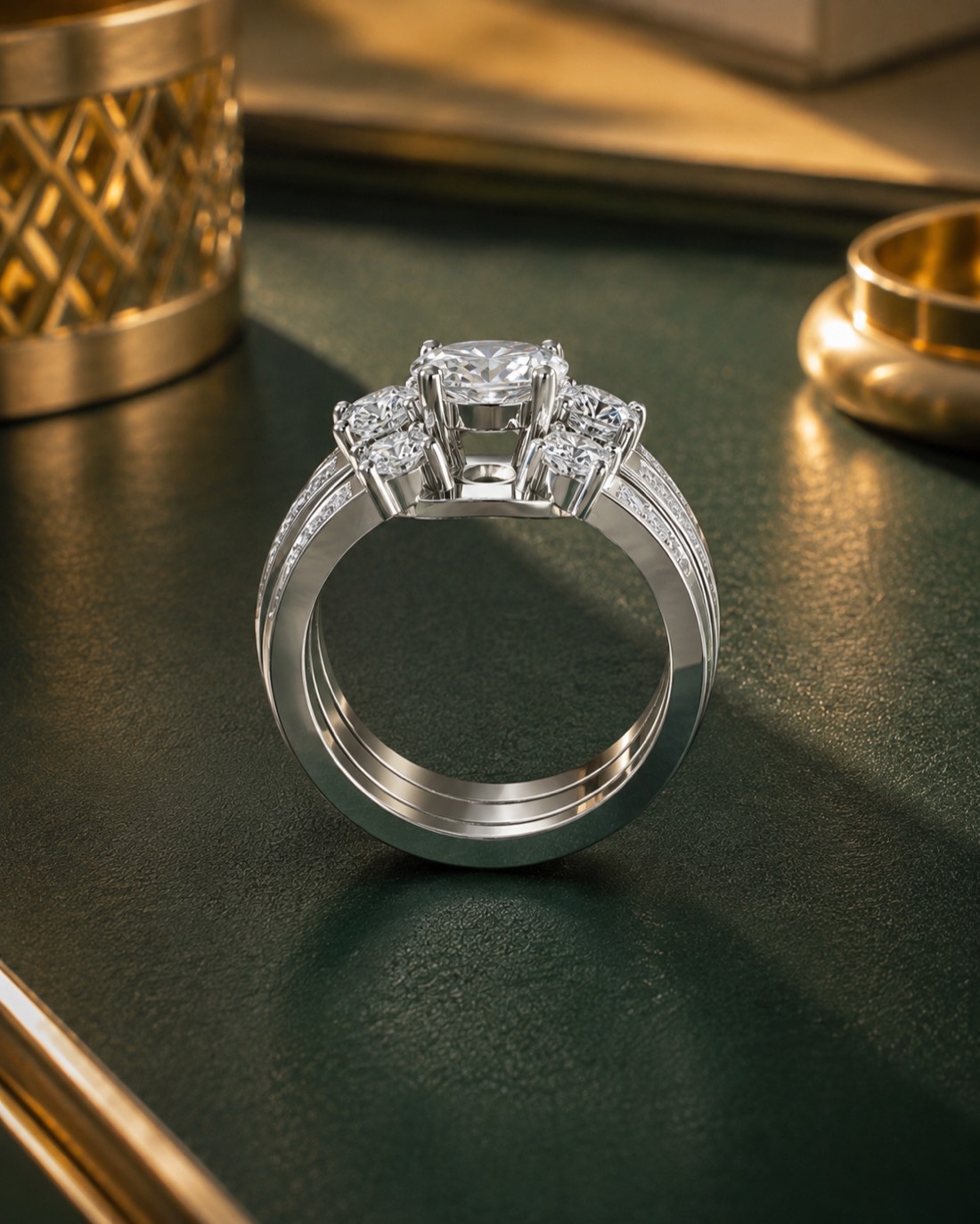
Accents are decision six of seven in our complete guide to designing a custom engagement ring.
What counts as an accent stone
- Pavé: Tiny diamonds set closely together along the band or halo, creating a continuous sparkle line (French for "paved")
- Side stones: Larger accent diamonds set directly beside the center stone (as in a three-stone or two-stone design)
- Hidden accents: Small stones tucked into the gallery (the underside of the setting) or basket, visible only from certain angles
- Milgrain/bead detailing: Not stones themselves, but tiny decorative metal beading often used alongside accent stones for a vintage texture
What accent stones actually do for your ring
- Increase perceived size — a halo or pavé band draws the eye outward, making the whole ring read as larger and more detailed than the center stone alone
- Add total sparkle — more facets catching light, especially noticeable in motion or under changing light
- Add texture and dimension — particularly hidden accents and milgrain, which reward a closer look
What accent stones don't do
- They don't multiply your ring's value. A ring with $500 worth of pavé diamonds is worth roughly the value of its parts (center stone + accent stones + metal + labor) — not some dramatically higher number because it "looks fancier."
- They don't replace a well-cut center stone. No amount of accent sparkle fixes a poorly cut center diamond; accents complement, they don't compensate.
The real cost trade-off
Every dollar spent on accent stones is a dollar not spent on the center stone. This is a genuine trade-off, not a trick:
- More accents, smaller center stone: More overall sparkle and visual detail, but a smaller focal diamond
- Fewer/no accents, larger center stone: A bolder, more prominent center stone with a cleaner, more minimalist look
Neither is "better" — it depends on whether your partner's style leans toward maximalist detail or minimalist simplicity.
Practical considerations
- Maintenance: More small stones means more prongs and more surface area that can catch on things or need periodic inspection to make sure nothing's loosened.
- Resizing: Pavé bands, especially, can be more difficult (and pricier) to resize than a plain band, since the stones run the full circumference.
- Durability: Well-set accent stones from a skilled setter hold up fine to daily wear — but poor-quality mass-produced pavé settings are more prone to stones loosening or falling out over time.
Frequently asked questions
Do pavé diamonds make a ring more expensive than a plain band?
Yes, proportionally — you're paying for the additional diamond carat weight and the extra labor of setting many small stones precisely.
Are accent stones a good way to make a small center stone look bigger?
Yes — a halo or pavé shank is one of the most effective, budget-conscious ways to visually increase a ring's presence without paying for a larger center stone.
Do accent stones fall out more easily than a center stone?
Not if properly set by a skilled jeweler — but low-quality settings with thin prongs and mass-produced pavé are more prone to loosening over time than a well-crafted setting.
Is a hidden accent stone worth the extra cost if no one can see it?
That's entirely personal — some people love a detail meant just for them, even one no one else notices. There's no functional downside beyond the added cost.
So what does this actually mean for your design?
Accent stones are a genuine style and budget lever, not a value hack — the real decision is how you want to split your budget between "one stone that does all the talking" and "a ring that sparkles from every angle." That's a decision best made by actually seeing both options, not guessing from a photo.
Why accent decisions work better with a designer
At a retail store, accent stone options are usually locked into whatever setting is already built — if you want more pavé or a hidden accent added, you're often out of luck, since the ring already exists. With a designer, every accent decision is part of the build from the start, which means you can actually compare "more center stone, no accents" against "smaller center stone, full pavé halo" before committing to either.
At Amana, we walk through this trade-off with you directly during your design consultation, using AI-assisted visuals to show both options side by side on your actual ring concept. And because our pricing is based on the design and craftsmanship rather than retail markup, adding accent stones is priced honestly as what it actually costs — not used as an upsell tactic. Design and craftsmanship typically runs $1,500–$4,000 depending on your total design, including any accent stones you choose (larger or more elaborate accent work can shift that number, and we'll always explain exactly why).
Book a free design consultation and we'll show you your ring with and without accents before you decide what's actually worth it to you.