Emerald Engagement Rings: What You Need to Know Before You Choose One
What Makes Emerald Different From Diamond
Emerald is a variety of the mineral beryl, colored green by trace amounts of chromium and vanadium. Diamond and emerald are graded on completely different scales because they're different materials with different jobs to do on a ring. Diamond's whole appeal is brilliance and fire — how it bends and scatters light. Emerald's appeal is color — a deep, saturated green that diamond simply doesn't produce naturally in any stable, common way.
That difference in purpose comes with a difference in physical properties, and that's the part most people researching emerald rings haven't fully thought through yet.
Durability: The Honest Comparison
Diamond ranks a 10 on the Mohs hardness scale, the hardest natural material there is. Emerald ranks 7.5 to 8 — still reasonably hard, but meaningfully softer, and more importantly, emerald is almost always more included (has more internal fractures and inclusions) than a comparable diamond. Jewelers in the trade have a saying: emeralds are included by nature, not by exception. Those inclusions create natural planes of weakness, which is why emeralds are more prone to chipping or cracking from a hard knock than a diamond is.
This doesn't mean an emerald engagement ring is fragile or a bad idea. It means the setting matters more than it would for a diamond. A bezel or half-bezel setting, which wraps metal around the stone's edge for protection, is a common and smart choice for an emerald center stone. A low profile also helps, since it keeps the stone closer to the hand and less exposed to impact.
Oiling: The Thing Nobody Tells You Upfront
Nearly all emeralds are treated with oil (or sometimes resin) to fill surface-reaching fractures and improve clarity and color. This is standard industry practice, disclosed on a gemological report, and not a defect — but it does mean an emerald can need re-oiling every so often, especially if it's exposed to harsh chemicals, extreme heat, or ultrasonic cleaning, all of which can dry out or strip the oil. If you choose emerald, it's worth knowing this is part of the ongoing care, not a one-time purchase decision.
Color Grading: What "Good" Emerald Color Looks Like
Emerald color is judged on hue, tone, and saturation, similar in concept to diamond color grading but with its own vocabulary. The most prized emeralds show a pure, vivid green with slight blue undertones (sometimes called "emerald green" or "grass green" in the trade) and medium-to-medium-dark tone — not so light it looks washed out, not so dark it looks black in low light. Overly yellow-green or overly blue-green stones are generally valued lower. Unlike diamond, where "colorless" is the goal, emerald's entire value proposition is its color, so this grading dimension matters more here than almost anywhere else in gemstone buying.
Where Emeralds Come From
Colombia is the source most associated with top-tier emerald, prized for a slightly bluish, saturated green. Zambia produces stones often described as a cooler, more bluish green. Brazil also produces significant emerald material, generally in a lighter, brighter green range. Origin doesn't determine quality on its own — a great Zambian stone can outclass a mediocre Colombian one — but origin is often disclosed on a certificate and does influence price, since Colombian emerald carries the strongest market reputation.
Lab-Grown Emerald: A Real Alternative
Lab-grown emerald exists and is chemically identical to natural emerald, grown using methods like flux or hydrothermal processes rather than mined from the earth. It typically shows fewer inclusions (because it isn't fighting through a few hundred million years of geological pressure) and costs meaningfully less than a comparable natural stone. For someone who loves the look of emerald but wants to spend less or minimize the durability trade-offs that come with heavy natural inclusions, lab-grown is worth a serious look.
Frequently asked questions
Can you wear an emerald engagement ring every day?
Yes, with the right setting. A protective bezel or half-bezel, a slightly lower profile, and some care around hard labor, gym work, and harsh chemicals go a long way. Plenty of people wear emerald rings daily for decades.
Is emerald cheaper or more expensive than diamond?
It depends entirely on quality and size. A fine, highly saturated natural emerald of several carats can cost more per carat than a comparable diamond. A smaller or more included emerald can cost considerably less. There's no universal answer — it comes down to the specific stone.
What's the difference between an emerald and an emerald-cut diamond?
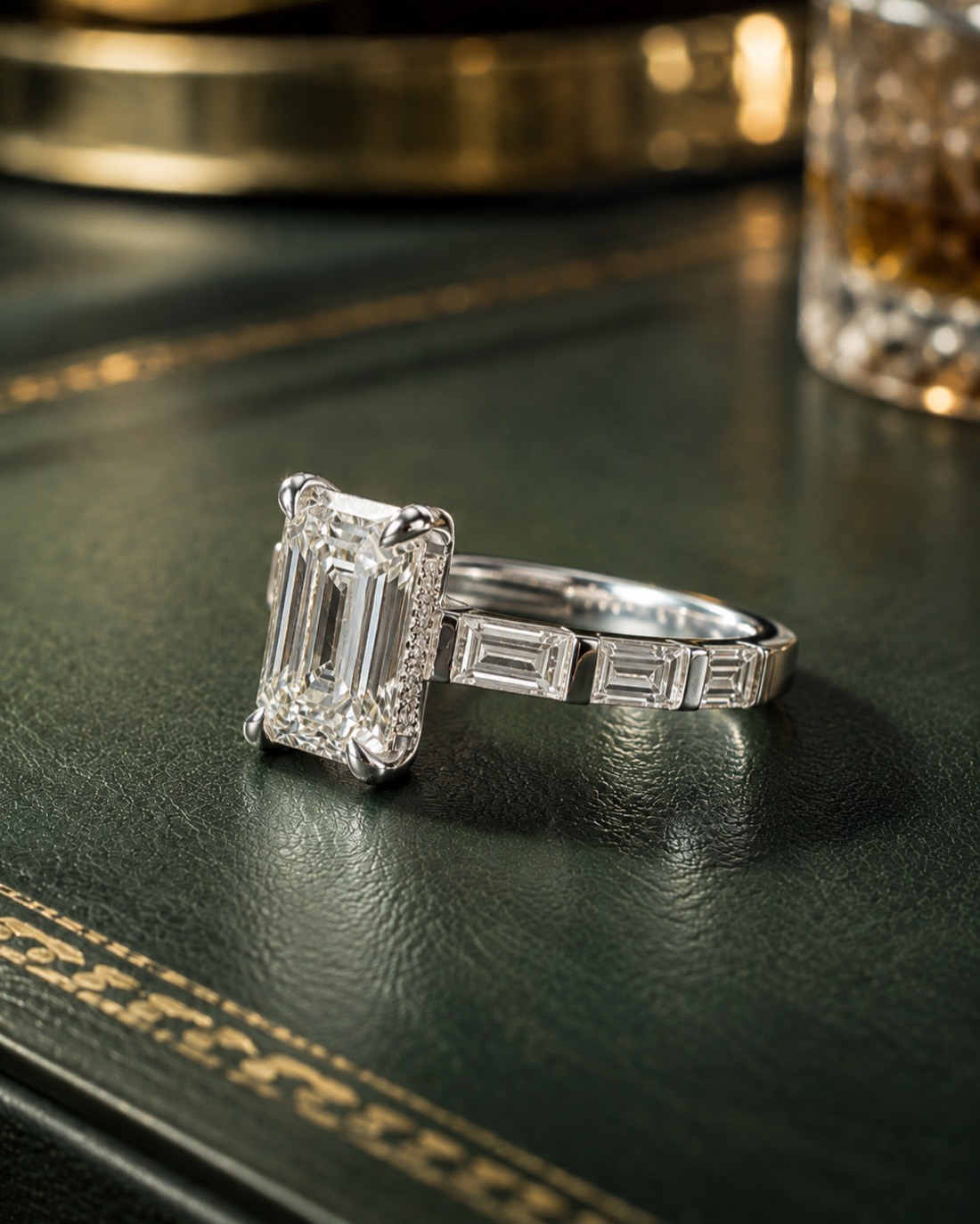
These are two completely different things that just share a name. Emerald is a green gemstone. "Emerald cut" is a rectangular step-cut shape that can be applied to a diamond, emerald, or many other stones. You can have an emerald-cut diamond with no actual emerald gemstone involved at all.
Does an emerald engagement ring need special insurance?
It's worth insuring any center stone with a jewelry-specific policy or a rider on homeowner's/renter's insurance, and worth mentioning the oiling and durability notes to your insurer or appraiser so your coverage reflects the stone accurately.
Can emerald be used as an accent stone instead of the center stone?
Absolutely, and it's a popular way to get the color without putting a softer stone in the most exposed position on the ring. Emerald accents alongside a diamond center stone is a common, durable combination.
So Where Does This Leave You?
Emerald is a real, legitimate choice — not a lesser diamond substitute, but its own thing, with its own beauty and its own care requirements. If the color speaks to you and you go in with clear eyes about the setting and maintenance it needs, it can be a ring you're genuinely happy with for a lifetime. If you're on the fence purely because of the durability trade-off, that's worth a direct conversation about your specific lifestyle before you commit either way.
This Is Where the Amana Method Helps
Choosing a center stone isn't a decision you should have to make from a product grid, especially with a stone like emerald where the right setting changes the whole durability equation. The Amana Method starts with a real conversation — about her, her style, your budget, and yes, how hard her hands go on any given week — and builds the ring around the honest answer to all of it.
If emerald is right for her, we'll design the setting to protect it properly, using AI-assisted visuals so you see the finished look before anything is made. If a lab-grown emerald or a different stone entirely makes more sense once we talk it through, we'll tell you that too. Design and craftsmanship together typically run $1,500 to $4,000 total, well under the roughly $12,000 a comparable ring runs at retail — though rarer or larger center stones, emerald included, can run past that range, and we'll always walk you through why before you commit to anything. Approve your CAD design, pay the balance through a simple email link, and your ring is typically ready about two weeks later.
Earn your trust. Make your ring. Talk to us about whether emerald is the right call for yours.