The 4Cs Explained in Plain English
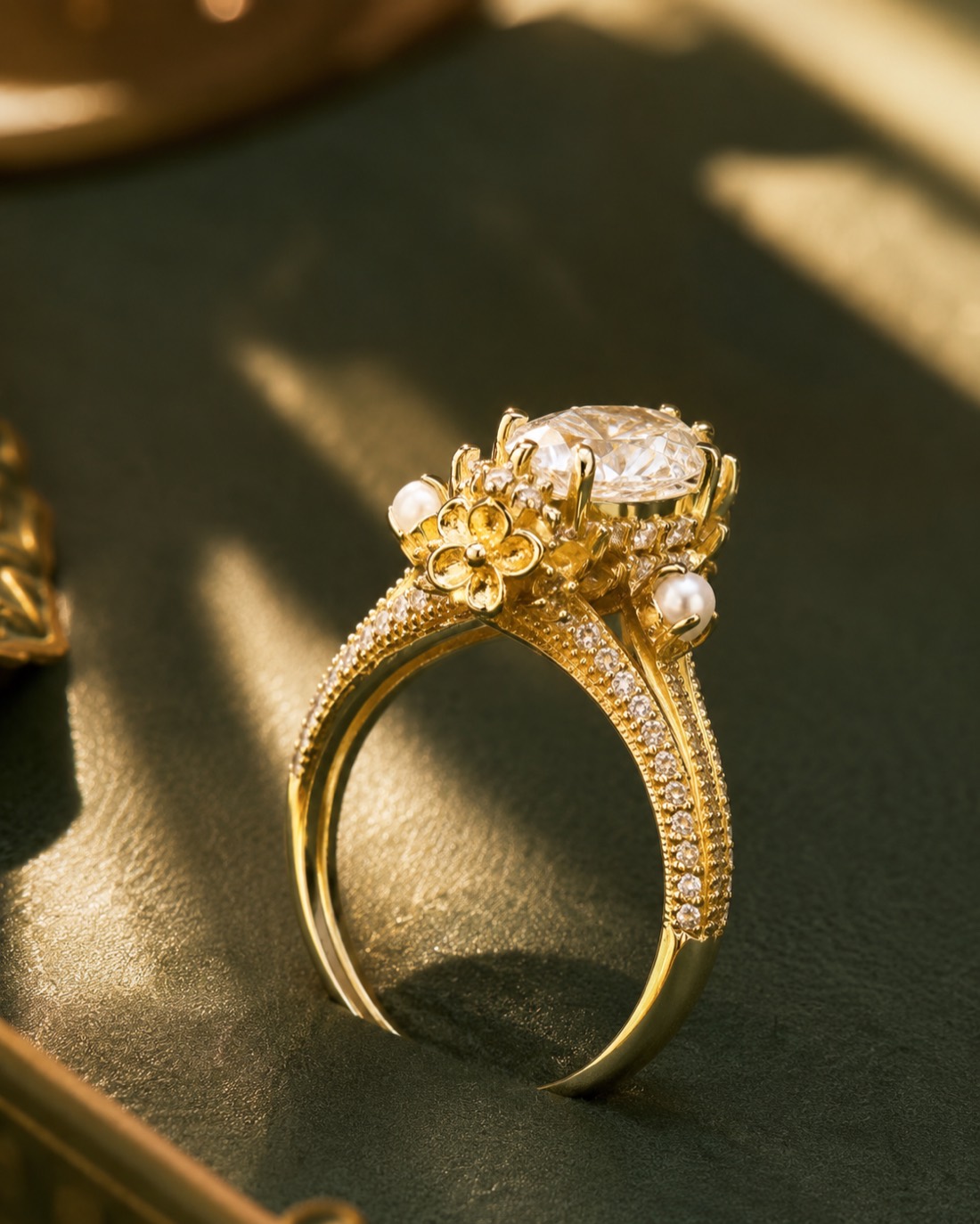
This is one piece of our full diamond education guide.
Where the 4Cs came from
The 4Cs aren't a law of nature. They're a grading framework the Gemological Institute of America standardized in the middle of the last century so that two people in two cities could describe the same stone the same way. Before that, "quality" was whatever the person across the counter said it was.
That standardization was genuinely good for buyers. But it also created a scale with a lot of rungs on it — and every rung has a price. Knowing which rungs your eye can actually see is the difference between buying a diamond and buying a grading report.
Cut: the only C a human controls
Color, clarity, and carat are decided in the ground or in the growth chamber. Cut is decided by a person with a wheel.
Cut is not the shape. "Round," "oval," "emerald" — those are shapes. Cut is how precisely the facets are angled and aligned so light enters the top, bounces off the internal walls, and comes back out at your eye instead of leaking out the bottom.
A well-cut diamond returns light. A poorly cut one — usually cut deep or shallow on purpose to hold more weight — leaks it, and looks glassy or dark in the middle no matter how flawless the rest of its grades are.
GIA grades cut on round brilliants only: Excellent, Very Good, Good, Fair, Poor. Fancy shapes (oval, pear, cushion, emerald) don't get an overall cut grade — they only get polish and symmetry grades, which is why judging a fancy shape means looking at it rather than reading it. That's covered in more depth in why cut matters more than everything else.
Practical version: an Excellent-cut G VS2 will out-sparkle a Poor-cut D IF every single time, and cost less.
Color: a scale that starts invisible
Diamond color runs D (completely colorless) to Z (light yellow or brown). It's a measure of the absence of color, and it's graded face-down against master stones under controlled lighting — which is nothing like how anyone will ever see the ring.
Here's what the scale looks like in the real world:
- D–F (colorless): A real difference exists, but you'd need the stones side by side, unmounted, to see it. Priced at a premium for that fact alone.
- G–J (near colorless): Faces up white in a ring. G and H are the widely accepted value sweet spot — visually colorless to a normal person, priced meaningfully below D–F.
- K and below (faint): Warmth becomes visible, especially in larger stones. Some people love it in yellow or rose gold. In white metal it usually reads yellow.
Two things shift where you should land. Metal: yellow and rose gold reflect warmth into the stone, so a J can look perfectly at home there while a G in platinum has nowhere to hide. And shape: step cuts like emerald and Asscher show body color more than brilliant cuts do, because their long open facets don't scramble the light. The full breakdown is in our diamond color guide.
Clarity: how much you need depends on the shape
Clarity grades the internal features — inclusions — and surface marks. The scale runs FL, IF, VVS1, VVS2, VS1, VS2, SI1, SI2, I1, I2, I3.
The critical thing nobody tells you at the counter: clarity is graded at 10x magnification. FL through VS2 means nothing visible to your eye. Most SI1 stones are also invisible to your eye. The grade is describing a world you will not be living in.
So the useful question isn't "what grade?" It's "is it eye-clean?" — meaning you can't spot an inclusion at normal viewing distance. VS1 and VS2 are the reliable value zone: eye-clean essentially every time, without paying the VVS premium for perfection you can't perceive.
Where you can't cut corners is step cuts. An emerald or Asscher is a hall of mirrors with big open facets and nothing to hide behind. Those want VS2 or better. A busy brilliant cut — round, oval, cushion — camouflages far more, and SI1 becomes worth a look. More on the gamble in our diamond clarity guide.
Carat: weight, not size
Carat is weight — one carat is 0.2 grams. It is not a measurement of how big a diamond looks, though it gets treated that way constantly.
Two facts do most of the damage here.
Price jumps at round numbers. Diamonds are priced in tiers, and the tier boundaries sit at the numbers people ask for: 0.50, 0.75, 1.00, 1.50, 2.00. A 0.95ct and a 1.00ct are visually identical — about a tenth of a millimeter apart in diameter — but the 1.00 can cost noticeably more purely because it crosses the line people shop for.
Weight can hide where you can't see it. A stone cut deep carries carat weight in its belly, below the girdle, where it does nothing for face-up appearance. Two 1.00ct rounds can measure 6.3mm and 6.5mm. Same weight, different ring. We get into the numbers in carat weight vs. visual size.
The part that adds up
Notice the pattern in everything above. Cut is where the money should go. Color can drop to G–H. Clarity can drop to VS. Carat can sit just under the round number. Fancy shapes run roughly 10–30% less per carat than round because round wastes more rough. Lab-grown runs 60–85% below natural for a chemically identical stone.
Every one of those is a real, defensible, gemologically accurate fact — and every one of them lowers the price of the ring.
Frequently asked questions
Which of the 4Cs is most important?
Cut. It determines how much light the diamond returns, which is the thing people actually respond to when they look at a ring. A top-grade stone with a mediocre cut looks dull; a well-cut stone with mid-range color and clarity looks alive.
What are the best 4C grades for the money?
For most buyers: Excellent cut, G–H color, VS1–VS2 clarity, and a carat weight just under a round threshold. That combination looks colorless and eye-clean while avoiding the three biggest premiums on the report.
Can you see the difference between VS2 and VVS1?
Not with your eyes. Both are clean at normal viewing distance — the distinction only exists under 10x magnification. You're paying for a number on a report, not a visible difference.
Do the 4Cs work the same way for lab-grown diamonds?
Yes. Lab-grown diamonds are graded on the same four criteria by the same labs, because they're the same material with the same optical properties. The scale is identical; the price per carat is not.
Does a higher carat weight always mean a bigger-looking diamond?
No. Carat is weight, and cut proportions decide how much of that weight shows face-up. A shallow-cut stone can look wider than a deeper stone of the same weight, and elongated shapes cover more finger than a round of equal carat.
So where does this leave you?
If you actually apply the 4Cs the way the science supports — cut first, G–H color, VS clarity, weight just under the threshold — you land on a ring that looks exactly like the one at the top of the counter and costs a fraction of it.
Which raises a fair question: if all of this is standard gemology, why did nobody walk you through it?
Because on a retail sales floor, the person explaining the 4Cs is usually paid a percentage of what you spend, from inventory that's already been bought and needs to move. That doesn't make them dishonest. It just means the incentive points at the higher grade, not at the smarter one.
Why we tell you all of this
Amana is a design studio. We don't have a showcase full of stones we need to sell, and nobody here earns a commission on your grade choices. We get paid to design your ring and build it — which means when we tell you a G VS2 is the smart buy, there's nothing in it for us either way.
Here's the shape of the money. That ring at a traditional retail jeweler runs somewhere around $12,000. Buy the exact same finished ring wholesale and you're still near $8,000. With us, the design and craftsmanship typically run $1,500–$4,000, and you still get a real, certified diamond in a ring built to your design. Larger stones or unusually rare or complex ones can run higher — and if yours does, we'll show you exactly why before you commit to anything.
Think of it as the third era of ring pricing. Natural diamonds set the price. Lab-grown diamonds brought it down. Designer-direct is the next step down, and it's the one nobody with inventory wants to explain to you.
How it works: we sit down together, in person or over video, and design the ring with AI-assisted visuals so you see it as we go. About three days later you get the CAD file. You approve it and pay the balance through an emailed link. Roughly two weeks after that, the ring is ready.
Earn your trust. Make your ring.