What Does a Hidden Halo Actually Cost?
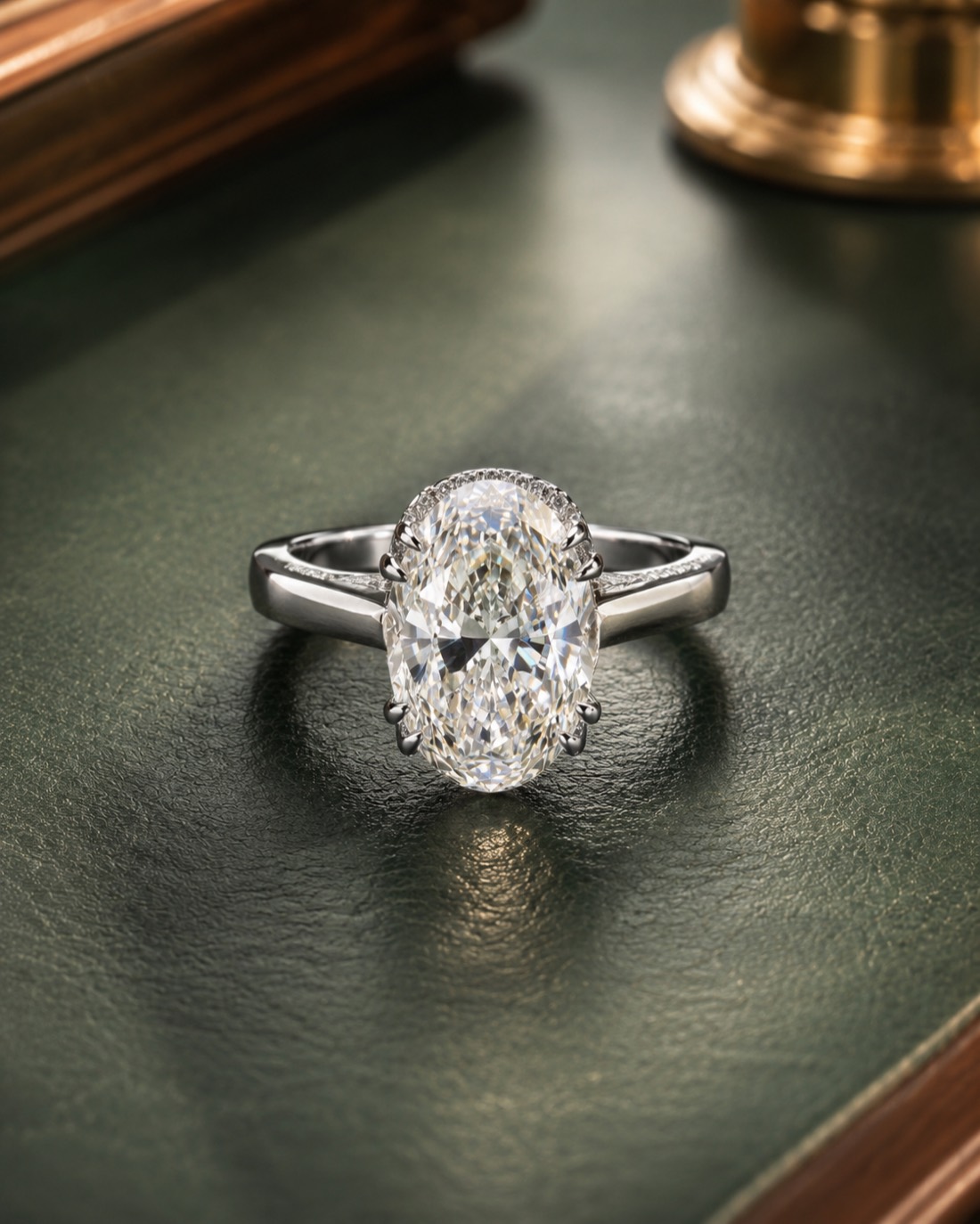
What a Hidden Halo Actually Is
A hidden halo is a ring of small diamonds set underneath the center stone, right where the gallery meets the head, instead of around the visible top edge like a traditional halo. From straight on, the ring looks like a clean solitaire. Tilt it, and a hidden ring of sparkle shows up along the side. It's a design choice people make specifically because they want extra brilliance without the bigger, more obvious look of a traditional halo.
What You're Actually Paying For
The price of a hidden halo breaks into three real cost drivers, and none of them are mysterious.
The stones themselves. A hidden halo usually uses somewhere between 10 and 20 small round diamonds, each often in the 0.01 to 0.02 carat range. Individually they're inexpensive — melee diamonds (the industry term for these small accent stones) cost a fraction of what a comparable center stone costs per carat. But they add up, and more stones means more material cost, however small each one is.
The metalwork. Setting a hidden halo means building a secondary gallery structure under the center stone — essentially a small basket of prongs or a channel sized to hold a dozen-plus tiny stones in a tight, even ring. That's more metal, more machining or hand-fabrication time, and more precision than a four-prong solitaire head.
The labor. This is usually the biggest piece of a hidden halo's added cost. Setting stones that are both tiny and hidden under the center diamond takes a steadier hand and more time than setting stones in plain view. A setter has to work at an angle, often without a direct line of sight to the prongs they're pushing, and a slip can mean a chipped melee stone or a scratched center stone. That skill and care costs something, and it should.
Hidden Halo vs. Traditional Halo: Which Costs More?
A traditional halo — the visible ring of diamonds around the top of the center stone — usually costs a bit more than a hidden halo, for a simple reason: it's bigger. A traditional halo typically needs more stones, larger ones, and a wider band of metal to carry them, because the whole point is for it to be seen. A hidden halo, by contrast, is intentionally scaled down, since its job is to add a flash of light at an angle, not to double the visual size of the ring.
If you're choosing between the two purely on a dollar basis, hidden halos are usually the lighter lift. If you're choosing on look, that's a different question — a traditional halo makes the center stone appear noticeably larger, while a hidden halo keeps the ring looking more minimal with sparkle as a bonus rather than the headline.
Does the Center Stone's Shape Change the Cost?
Somewhat. Round and cushion center stones pair naturally with a round hidden halo, which is the most common and typically most efficient configuration to build. Oval, pear, and emerald-cut center stones need a hidden halo shaped to match the stone's silhouette, which can mean a slightly more custom gallery and marginally more setting time. It's not a dramatic cost difference, but it's a real one, and it's worth asking about if you're comparing quotes across different center stone shapes.
Does Metal Choice Matter Here?
Yes, in a small but real way. Platinum is denser and more expensive by weight than gold, so a hidden halo's extra metal structure costs a bit more to build in platinum than in 14k or 18k gold. It's a secondary factor behind the stone count and labor, but on a close comparison between two otherwise identical designs, the metal is where you'll see the next-biggest swing.
Frequently asked questions
Is a hidden halo worth the extra cost?
That depends on what you're trying to achieve. If you want noticeably more sparkle without changing the ring's overall size or silhouette, a hidden halo delivers a lot of visual return for a relatively modest cost increase. If your priority is pure budget efficiency, a well-cut solitaire alone still throws plenty of light.
Can I add a hidden halo to a ring later instead of paying for it upfront?
In many cases, yes — a jeweler can retrofit a hidden halo onto an existing solitaire setting, though it depends on the design of the existing gallery. It's usually more efficient, cost-wise, to build it in from the start if you already know you want one.
Do hidden halos use the same diamonds as a pavé band?
They're both made of small melee stones, but they're not interchangeable features — a hidden halo sits under the center stone, while pavé stones run along the band itself. Many rings use both.
Does a hidden halo make the ring harder to clean or maintain?
Slightly. Because the stones sit close together and partly hidden, they can trap more lotion, soap residue, and everyday buildup than an open solitaire setting. A regular at-home soak and a periodic professional cleaning handle it fine.
Will a hidden halo need more maintenance checkups over time?
Any setting with more prongs holding more stones benefits from a yearly check to make sure nothing has loosened. It's a good habit regardless of setting style, and a hidden halo just makes it slightly more worth keeping to schedule.
So Where Does This Leave You?
A hidden halo is a genuinely practical upgrade — a few hundred dollars for a feature that changes how the ring catches light every time it moves. The real question isn't whether it's "worth it" in the abstract. It's whether it fits the budget and the look you're actually going for, once you know what you're paying for and why.
That's a hard thing to figure out from a product photo or a price list alone, because so much of it depends on your specific center stone, your specific band, and your specific taste. Which is exactly the kind of decision that goes better in conversation than in a vacuum.
This Is Exactly What the Amana Method Is For
We built the Amana Method around conversations like this one — not because a hidden halo is complicated, but because knowing whether it's right for your ring is a judgment call, and judgment calls deserve a real back-and-forth, not a checkbox on a configurator.
Here's how it works: you tell us about her, her style, and your budget. We design the ring with you in that same conversation, using AI-assisted visuals so you can see the hidden halo (or any other feature) on your exact ring before anything is made. If it adds the sparkle you wanted, it stays. If it doesn't earn its place, it goes, and nobody talks you into a feature you don't need.
Design and craftsmanship together typically run $1,500 to $4,000 total — nowhere near the roughly $12,000 a comparable ring runs at retail, or even the $8,000 a traditional jeweler charges for the finished piece alone. Larger center stones or more complex combinations of features can run past that range, and we'll always tell you that upfront rather than surprise you with it later. Once you approve your CAD design and pay the balance through a simple email link, your ring is typically ready about two weeks later.
Earn your trust. Make your ring. Start the conversation and we'll figure out, together, whether a hidden halo belongs on yours.