Cathedral vs. Basket Settings
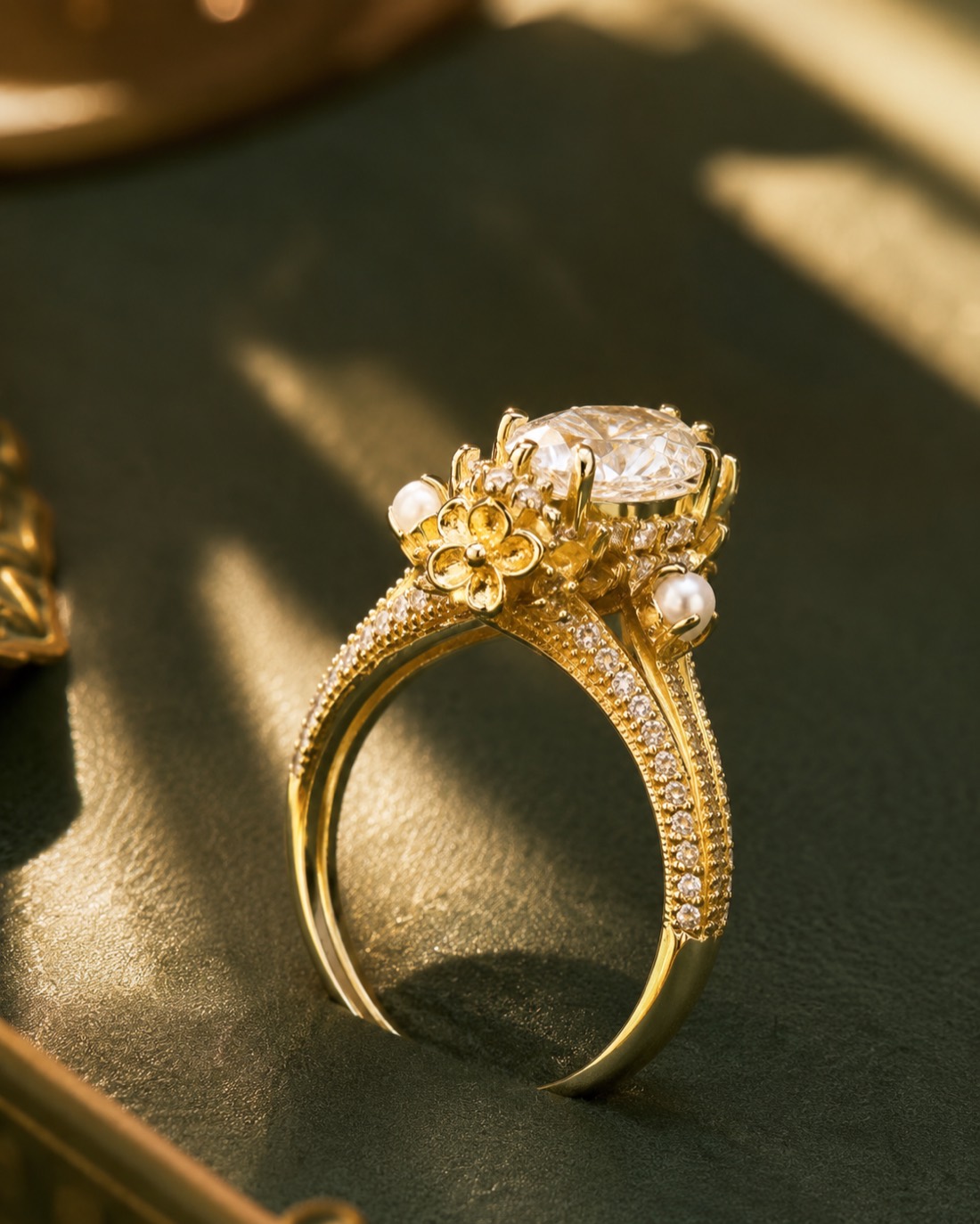
This is decision three of seven — setting style — in our complete guide to designing a custom engagement ring, viewed from the angle almost nobody thinks about: the side.
Why the side profile is the view that matters
Most ring shopping happens from directly above. Photos are shot from above, display cases are viewed from above, and the top-down view is where the diamond looks best.
But the person wearing the ring almost never sees it from directly above. She sees it at an angle, with her hand in front of her, dozens of times a day. And everyone else sees it in profile when she's holding a coffee cup or gesturing.
The side profile is also where every practical question about a ring lives. How much does it snag? Does it catch on gloves? Will a wedding band sit flush? Does it feel bulky between her fingers? Does it rock when she makes a fist?
Cathedral versus basket is fundamentally a side-profile decision. Which is why it's the design choice most often discovered too late.
What a cathedral setting is
In a cathedral setting, the shoulders of the band sweep upward in arches to meet the head that holds the stone. The metal continues from the band up along the sides of the setting, forming a visible arc from the side view.
What it gives you:
Height and drama. The stone sits elevated, and there's visible architecture underneath it. The ring looks substantial in profile, and light can pass under the stone, which some people love — a cathedral setting reads as light and airy rather than solid.
A larger apparent stone. Lifting a diamond away from the finger makes it read slightly bigger, because there's air and shadow separating it from the hand rather than the finger crowding it.
More surface for detail. Those arches are real estate. Cathedral shoulders are frequently paved with small diamonds, milgrained, or carved with detail. If she wants an ornate ring, a cathedral gives the design somewhere to happen.
Some prong protection. The arches rise partway up the sides of the head, which can shield prongs from side impacts — a real if modest benefit.
What it costs you:
Snagging. A tall setting catches on sweaters, gloves, hair, and bags. This is the number one complaint about tall rings and it's a daily annoyance rather than an occasional one.
Band pairing. A cathedral's arches often extend below the level where a wedding band would sit, meaning a straight band won't sit flush — there'll be a gap, or the band will hit the arch. Contoured bands solve it, but that's a decision to make while designing rather than discover later.
Cleaning. More structure means more places for lotion and soap to collect, particularly where the arches meet the head.
What a basket setting is
A basket is a small cage under the center stone: typically two horizontal wire rails running around the stone, connected by the vertical prongs, forming an open box that cradles the diamond from beneath.
What it gives you:
A lower profile. The stone sits closer to the finger. It snags less, feels less bulky, and is far easier to live with day to day — which is why baskets are the standard recommendation for anyone with an active job or an active life.
Easier band pairing. Lower and more compact profiles let a straight wedding band sit against the ring more cleanly.
Better cleaning access. The open cage lets you get a brush underneath the stone, which is where dirt actually collects. This is a genuine and underrated advantage — a stone that's clean from below looks brighter than one that isn't.
Light entry from below. An open basket lets light in from underneath, which can help a stone's liveliness.
More secure feeling. The horizontal rails add structure that helps hold the prongs in position relative to each other.
What it costs you:
Less drama. A basket is a workmanlike structure. It looks clean and it looks correct, but it doesn't have the sculptural presence a cathedral does.
Slightly less apparent size. Sitting closer to the finger means less visual separation between the stone and the hand.
Less room for ornament. There's simply less surface to decorate.
They aren't mutually exclusive
This is the thing worth knowing: cathedral and basket describe different parts of the ring. Cathedral describes what the shoulders do. Basket describes what holds the stone.
Plenty of rings are both — cathedral arches rising from the shank up to a basket that cradles the diamond. That combination is common and it works well.
So the real question isn't "which one," it's two questions asked separately: how high should the stone sit, and what structure holds it? Framing it that way opens up options that "cathedral or basket" hides — a low cathedral, for instance, with gentle arches that keep the profile modest, or a basket set high on a plain shank.
How to actually decide on height
Some practical tests.
Look at what she wears now. If her existing rings are slim and low, a tall setting will feel foreign. If she wears statement jewelry, she'll be fine with height.
Think about her hands at work. Gloves on and off all day, keyboards, patients, kids, tools, climbing gear — every one of those argues for lower. A high cathedral in a hospital is a ring that gets taken off and left in a locker, which is how rings get lost.
Consider her finger proportions. Longer fingers carry height well. Shorter fingers can look crowded by a tall setting, and a lower profile usually flatters them more.
Decide the wedding band now. If she wants a straight band sitting flush, that constrains height and the shape of the shoulders. If she's open to a contoured band, height is free. Either way, deciding now costs nothing and deciding later costs a compromise.
Ask for the actual number. Ring height above the finger is a measurement — often somewhere between about 5mm and 9mm at the top of the stone. Getting the number, and comparing it to a ring she already owns, beats any adjective.
Frequently asked questions
Which setting is better for an active lifestyle?
A basket, and generally the lowest profile you can get. It snags less, feels less bulky, and takes side impacts better. If security is the top priority, a bezel or half bezel goes further still.
Do cathedral settings make a diamond look bigger?
Slightly. Elevating the stone puts air and shadow between it and the finger, which reads as more presence. It's a modest effect, not a dramatic one.
Can a cathedral ring sit flush with a straight wedding band?
Often not, because the arches typically extend down past where the band would sit. A contoured or notched band solves it. Designing the pair together is the cleanest approach.
Is a basket setting less secure than a cathedral?
No — the horizontal rails actually add structure that helps hold prongs in position. Height and security are largely independent questions; what matters more is prong quality and how exposed the setting is.
Can I lower a ring that sits too high?
Not really. The height is built into the head and shoulders, and lowering it means rebuilding the setting — unsetting the stone, fabricating a new head, and resetting. It costs more than getting it right the first time.
So where does this leave you?
Cathedral if she wants a ring with presence in profile, likes visible architecture, and doesn't mind a bit of snagging. Basket if she wants something she can wear through anything without thinking about it. And remember you can have both, or a low cathedral, or a high basket — height and structure are two dials, not one switch.
But look at that last FAQ answer again, because it's the whole point. Ring height is the single most common regret in engagement rings, and it's almost impossible to fix afterward. "It sits too high" is what people say a year in — and lowering it means rebuilding the setting from scratch.
Here's what makes that regret so common: height is a fit measurement, like a sleeve length. The right number depends on her fingers, her job, her existing jewelry, and the band she'll wear beside it. It's personal in the same way an inseam is personal.
And a finished ring has one height, chosen by a manufacturer aiming at an average. Not a bad number, usually — just not her number. That's not a store being difficult. Producing every design in a low, medium, and tall profile, across every metal and stone size, means tripling an inventory where every extra variant is a separate item that might sit in a case for years. So one height gets made, and it's the one that offends the fewest people.
Interestingly, "sit the ring a bit lower" is one of the most common revision requests designers get once someone sees their design rendered from the side. Which tells you the average height isn't quite right for a lot of people — they just never get the chance to say so.
Height is a question we ask you, not a number you inherit
At Amana we're designers, so how high the ring sits is a decision you make, with a number attached, before anything's built.
You meet with us in person or over video and we design the concept with you in the room, using AI-assisted visuals — including the side view, which is the one that matters and the one nobody shows you. About three days later you get a CAD file: a precise 3D model of your exact ring, from every angle, with the actual height above the finger. If it sits higher than you pictured, you say so and we lower it. That's genuinely one of the most common revisions we make, and it's a small change, not a redo. We keep going until you approve. Then the ring is ready in about two weeks.
Our design and craftsmanship typically runs $1,500 to $4,000, and you end up with a real, certified diamond ring. Larger or rarer stones, or a genuinely complex build, can run higher — and if yours will, we explain exactly why before you commit to anything.
For comparison: a comparable ring at a traditional retail jeweler runs about $12,000, and the same finished ring bought wholesale still runs roughly $8,000. We charge for the design and the craftsmanship, which is the actual work — and it's what lets you change your mind about the height before it's permanent instead of after.
Amana means "Trust" in Arabic. Earn your trust. Make your ring.