What Does a $3,000 Engagement Ring Look Like?
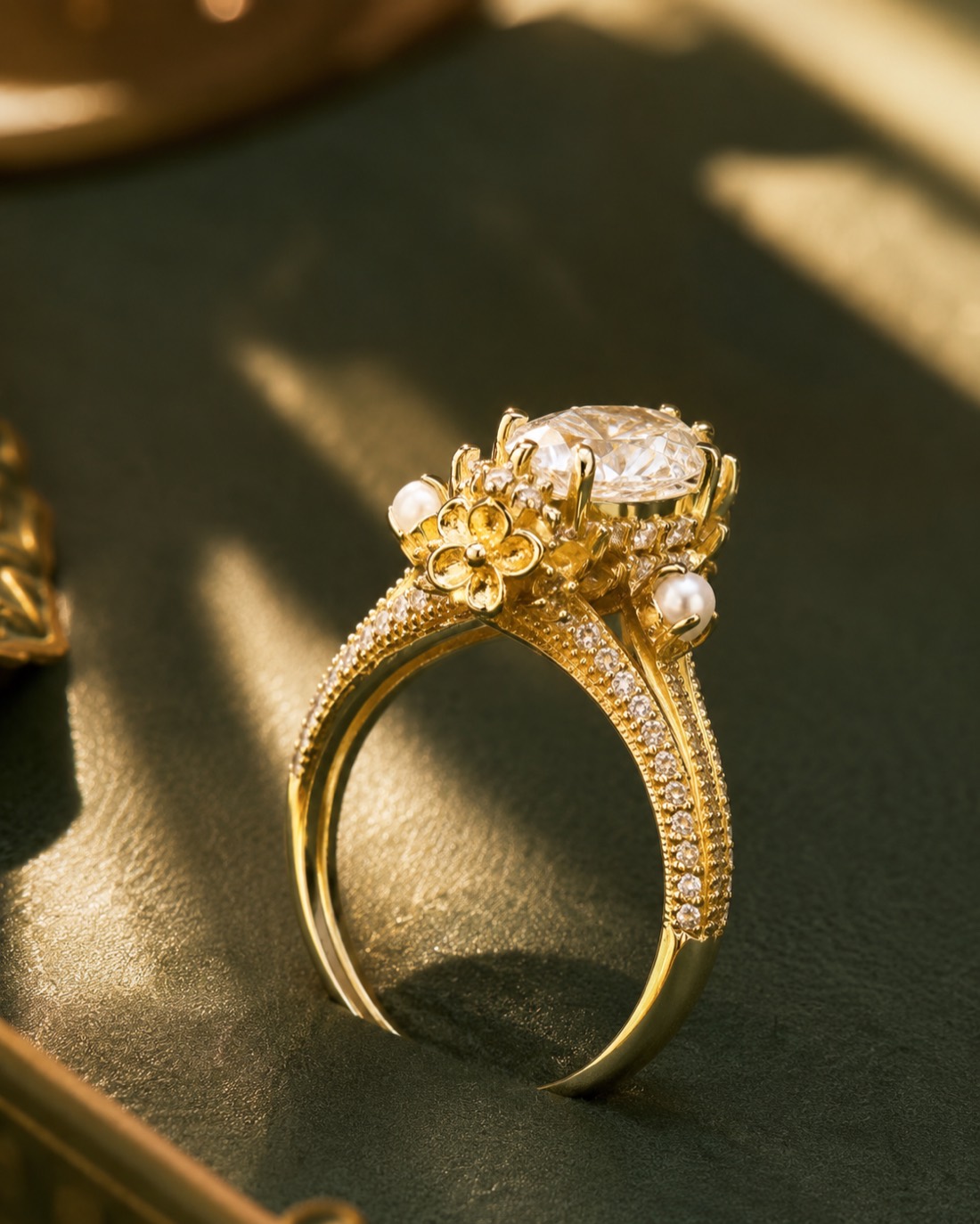
This is part of our full guide to why custom doesn't cost more.
What $3,000 has to cover
Before allocating, be clear about the full scope. This budget needs to include the center stone, the metal, any accent stones, the setting labor, and ideally a small buffer for sizing and the appraisal.
A workable split at this level:
- Center stone: roughly $1,800-$2,200
- Setting (metal, labor, accent stones): roughly $600-$900
- Buffer: $100-$200 for sizing, appraisal, insuring it in year one
That center-stone allocation is what everything below is built on.
The version that maximizes size: lab-grown
With around $2,000 for a lab-grown center stone, you're generally shopping in the 1.5 to 2.5 carat range depending on shape, cut grade, and market conditions.
Realistic spec target at this budget:
- Shape: oval, pear, or emerald — elongated shapes cover more finger per carat
- Cut: excellent or ideal. Do not compromise here; it's the only C you can see from across a room
- Color: F-H. In 14k yellow or rose gold you can comfortably go warmer
- Clarity: VS1-VS2, eye-clean. Paying for VVS at this budget is spending carat weight on a certificate
- Lab: IGI is the most common grader for lab-grown; verify the report yourself
Setting: 14k white, yellow, or rose gold. A solitaire with a slim band, or a hidden halo, or modest pavé along the front half of the shank. All three are achievable inside $600-$900.
This is a ring with real presence. A well-cut 2ct elongated oval on a slim band reads as a substantial ring by any standard.
The version that prioritizes natural origin
Same $2,000 for the stone, natural instead of lab-grown, and you're generally looking at roughly 0.50 to 0.75 carat with good grades — or edging toward a carat if you accept a lower color, visible-but-small inclusions, or a compromised cut. That last option isn't a good trade.
The honest framing: at $3,000, natural means choosing a modest, well-cut stone. That's a perfectly good ring — a beautifully cut 0.7ct round on a delicate band is elegant and looks intentional. But it is a different ring than the lab-grown version, not a slightly smaller one.
The trap to avoid: trying to get natural and size at this budget by dropping cut grade. A poorly cut 1ct natural stone will look duller and often smaller than a well-cut 0.7ct. Cut is where the light performance lives — see diamond 4Cs explained.
Which way to go depends on what she'd actually value, and it's worth finding out rather than assuming. Our lab-grown vs. natural comparison covers the full picture.
What you're specifically giving up at $3,000
Being concrete about it:
Platinum. It's a few hundred dollars more than 14k gold, and at this budget those hundreds are better spent on the stone. 14k white gold with rhodium plating looks essentially identical; it needs replating every couple of years. That's a fine trade here.
Heavy stone work. Full eternity bands, three-stone designs with meaningful side stones, and dense pavé across the whole shank all add both stone cost and significant setting labor. At $3,000 you're choosing one accent feature, not three.
Chasing top grades. D-E color and VVS clarity are real premiums for differences invisible without magnification. At this budget, spending there costs you visible carat weight.
Substantial natural carat weight. This is the plain truth of the budget. If both natural origin and a large stone are non-negotiable, $3,000 isn't the number.
What you should absolutely not give up
Cut grade. Repeating it because it's the mistake people make. Excellent cut, always.
An independent lab report. GIA or IGI on the center stone. No exceptions at this size.
Structural quality. Prongs of proper thickness, a shank that isn't paper-thin, secure setting. A ring that needs repair in year two isn't cheaper.
Eye-clean. SI1 can be eye-clean or it can have a visible inclusion depending on where it sits. Look at the actual stone or its images, don't just read the grade.
Design moves that stretch a $3,000 budget
- Go elongated. An oval or pear at the same carat weight covers noticeably more finger than a round.
- Slim the band. A 1.6mm band makes the same stone read larger than a 2.6mm band does. Contrast is free.
- Hidden halo. Small stones tucked under the center stone, invisible from the top, adding sparkle and lift for a fraction of what a bigger center would cost. See our engagement ring styles guide.
- Stay just under a round weight. A 1.9ct costs less than a 2.02ct and nobody has ever noticed.
Shape is the biggest lever of the four — compare them in our diamond shapes guide.
Frequently asked questions
Is $3,000 a low budget for an engagement ring?
It's below what marketing has trained people to expect and it's a completely normal amount to spend. With lab-grown it buys a genuinely substantial ring. The number that matters is whether you can pay it comfortably, not how it ranks against an average skewed by outliers.
Can I get a 2 carat ring for $3,000?
With a lab-grown center stone, yes, that's a realistic target depending on shape and grades. With a natural stone, no.
Should I buy a smaller natural or a larger lab-grown at this budget?
Depends entirely on what she cares about, and the difference is dramatic at this specific number — roughly triple the carat weight. It's worth learning her actual preference instead of guessing.
Will a $3,000 ring look cheap?
Not if it's well cut and well built. What makes a ring look cheap is dull light performance, sloppy setting work, and thin flimsy metal — none of which are functions of the budget. They're functions of who made it.
What's not included in that $3,000?
Usually: sizing, the appraisal, insurance, and sometimes shipping. Ask for the out-the-door total. Our hidden fees guide covers what tends to arrive after the quote.
So where does this leave you?
$3,000 is a real budget that buys a real ring — but it's a budget where one decision dominates everything else. Choose lab-grown and you're picking a size and a shape. Choose natural and you're picking a beautifully cut modest stone and building the design around it.
Everything else at this level is small by comparison. Metal choice, setting style, accent details — all worth getting right, none worth trading carat weight or cut grade for.
If you want to see how the calculus shifts when there's more room, our $5,000 ring walkthrough covers what the extra actually buys — and where it doesn't buy much.
What $3,000 looks like when you're not paying for a showroom
Here's the part that changes this whole calculation. That $3,000 has to stretch a lot further at a store with rent and inventory than it does with a designer.
We're designers, not a retail store. What you pay us for is the design and the craftsmanship — typically $1,500 to $4,000 — and you still walk away with a real, certified diamond ring. If you want a larger or rarer stone, or the design gets genuinely complex, it can run higher. We'll tell you that in the meeting, with the reason, before you commit.
For scale on what that means at this budget: a comparable ring at a traditional retail jeweler runs around $12,000, and buying that identical finished ring wholesale still runs about $8,000. That's the same ring. Natural diamonds brought prices down, lab-grown brought them down again, and designer-direct is the third era — you pay for the design and the making instead of the display case.
The process: we sit down in person or virtually and build the concept together in the meeting, with AI-assisted visuals so you can see the ring rather than picture it. CAD file about three days later. You approve it and pay the balance from a link we email you. Ring ready roughly two weeks after that.
Amana means "trust." Earn your trust, make your ring.