Toi et Moi Rings: History, Meaning & Style Guide
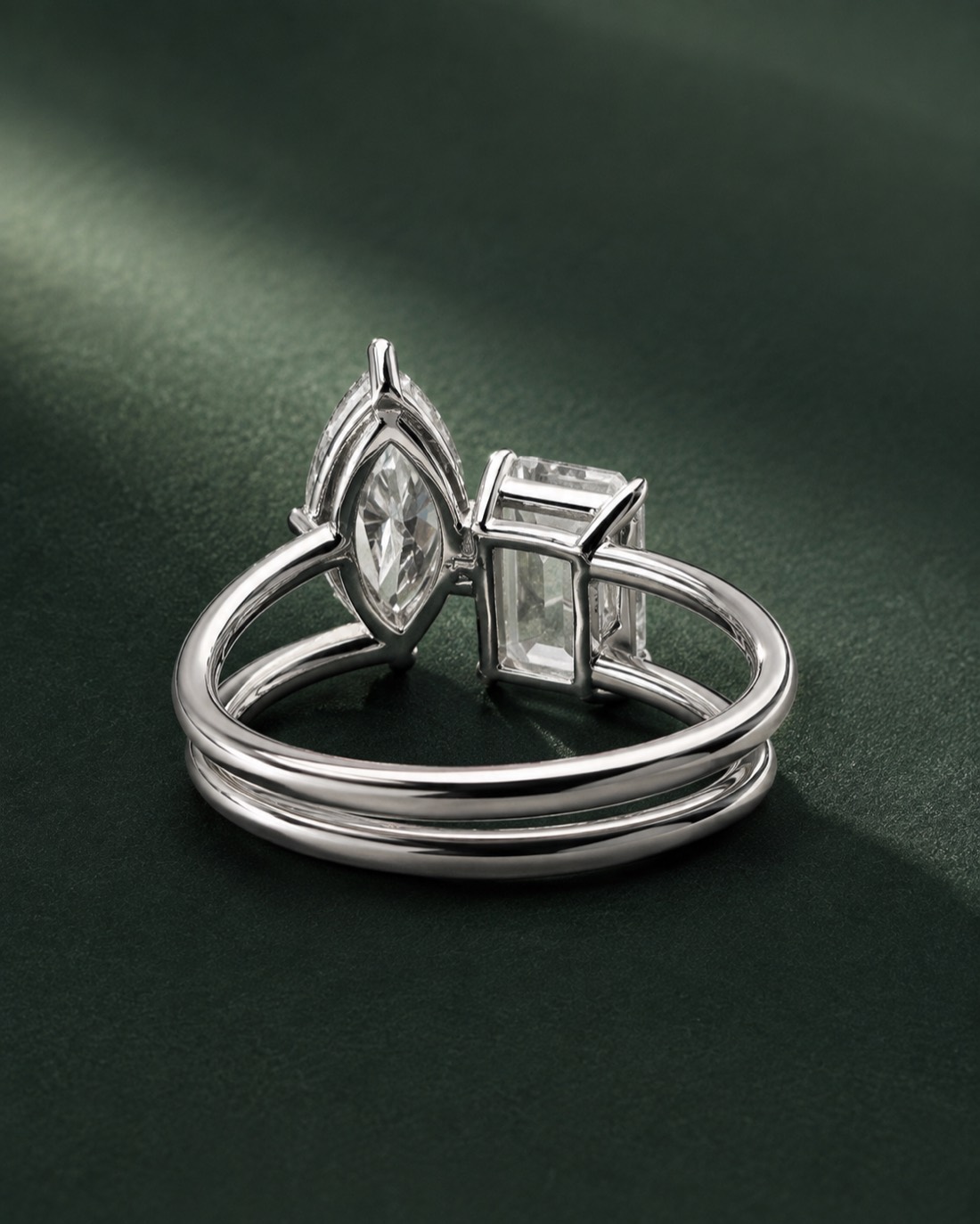
If you've seen a ring with two different-colored or different-shaped stones sitting next to each other and wondered what that design is called or what it means, here's the full picture — where it comes from, what it symbolizes, and what to actually consider before choosing one.
Where the toi et moi ring comes from
The style is most famously tied to Napoleon Bonaparte, who in 1796 gave Josephine de Beauharnais a ring featuring a pear-shaped sapphire and a pear-shaped diamond set side by side — widely considered one of the earliest and most iconic examples of the design. The ring survives today and has been sold at auction, cementing its place as a historical reference point for the style.
Beyond that single famous ring, the toi et moi concept has roots in a broader European jewelry tradition of pairing symbolic elements — sometimes two stones, sometimes a stone paired with an engraved motif — to represent a bond between two people. By the Victorian era, two-stone rings using contrasting gems had become a recognized, if less common, alternative to a single solitaire.
What makes a ring "toi et moi" versus just "two stones"
Not every ring with two stones is a toi et moi ring. The defining feature is that the two stones are usually different from each other — different shapes, different colors, or both — rather than a symmetrical pair of matching stones. A ring with two identical round diamonds side by side reads differently than a ring pairing an oval diamond with a pear-shaped sapphire; the second is unmistakably toi et moi, while the first can read more like a simple two-stone accent design.
This distinction matters because it's tied directly to the symbolism: two different stones, each keeping its own identity, sitting together as equals. It's a visual metaphor for two individuals rather than one uniform pair.
Common stone pairings
There's no single "correct" combination, but a few pairings show up often:
- Diamond and colored gemstone — a diamond paired with a sapphire, emerald, or morganite, echoing the original Napoleon and Josephine ring.
- Two different diamond shapes — an oval and a pear, or a round and a marquise, keeping the stones monochromatic but still visually distinct.
- Two different colored gemstones — no diamond at all, often chosen to represent each partner's birthstone.
- Different sizes of the same stone type — less traditional, but sometimes used to represent the two people without leaning on color contrast.
Symbolism people attach to the style
Because the design pairs two distinct elements rather than one center stone, couples often attach specific meaning to it beyond the general "two as one" concept — using each partner's birthstone, a stone that represents a place significant to the relationship, or simply choosing two stones that each partner picked out individually. It's one of the few mainstream ring styles where the meaning of the design is often as much a talking point as how it looks.
Practical considerations before choosing one
A toi et moi setting asks more of the design than a single solitaire does, and a few things are worth thinking through:
- Symmetry and balance. Two stones of different shapes or sizes need to be set so the ring reads as intentional, not lopsided — this is where a skilled setter and a properly proportioned band matter.
- Everyday wearability. Two raised stones side by side can sit slightly higher or wider than a single solitaire, which is worth considering if the wearer has an active lifestyle or works with their hands.
- Wedding band pairing. Because the setting isn't a standard single-stone shape, finding or designing a wedding band that pairs well with it usually takes more planning than pairing a band with a solitaire.
- Stone durability. If you're pairing a diamond with a softer gemstone like morganite or opal, it's worth understanding how that stone holds up to daily wear compared to the diamond next to it.
Frequently asked questions
Is a toi et moi ring the same as a two-stone ring?
Not exactly. All toi et moi rings are two-stone rings, but the term specifically implies two different stones — in shape, color, or both — symbolizing two distinct people, rather than a matching pair.
What's the story behind Napoleon's toi et moi ring?
In 1796, Napoleon gave Josephine a ring featuring a pear-shaped sapphire and a pear-shaped diamond set side by side. It's the most widely cited historical example of the style and the reason many people associate the design with romantic symbolism specifically.
Can you use two different gemstones instead of diamonds?
Yes — many toi et moi rings use two colored gemstones, often chosen as each partner's birthstone, with no diamond involved at all. The style is about the pairing, not a specific stone requirement.
Is a toi et moi ring harder to pair with a wedding band?
Often, yes, compared to a standard solitaire. Because the setting isn't a single symmetrical shape, a band typically needs to be custom-fitted or specifically designed to sit flush against it.
Is a toi et moi ring more delicate than a solitaire?
It depends on the setting and stone choices, not the style itself. Two stones set low and securely can hold up just as well as a solitaire; the main variable is how each stone is protected in its individual setting.
So where does this leave you?
A toi et moi ring is one of the few engagement ring styles where the design itself carries a specific, centuries-old meaning — two distinct stones, deliberately different, sitting together as equals. If that story resonates with how you think about your relationship, it's worth exploring seriously rather than treating it as a simple stone-count decision. If you're still deciding between this and a more traditional three-stone vs. two-stone approach, it's worth comparing both directly, and our broader look at engagement ring symbolism and meaning covers other styles that carry their own story.
The style rewards a designer who can balance two different stones thoughtfully rather than just placing them side by side.
Where Amana fits in
A toi et moi design is exactly the kind of ring where a conversation matters more than a catalog. We talk through which two stones actually represent the two of you — birthstones, shapes, colors, even alternative center stones if a diamond isn't the right fit for one or both — and build the setting around getting the balance and proportions right, since that's what separates a toi et moi ring that reads as intentional from one that just looks like two stones stuck together.
Because every Amana ring is designed and produced in-house rather than assembled from pre-made components, a fully custom toi et moi ring typically runs $1,500–$4,000 total for the design and finished piece — compared to roughly $8,000 through a traditional jeweler or $12,000 at retail for comparable custom work. Two-stone designs with larger or more complex stone pairings can run past that range, and we'll always walk you through exactly why before you commit to anything.
If a toi et moi ring feels like the right story for your relationship, book a consultation and we'll help you design it.