Three-Stone vs. Two-Stone Rings
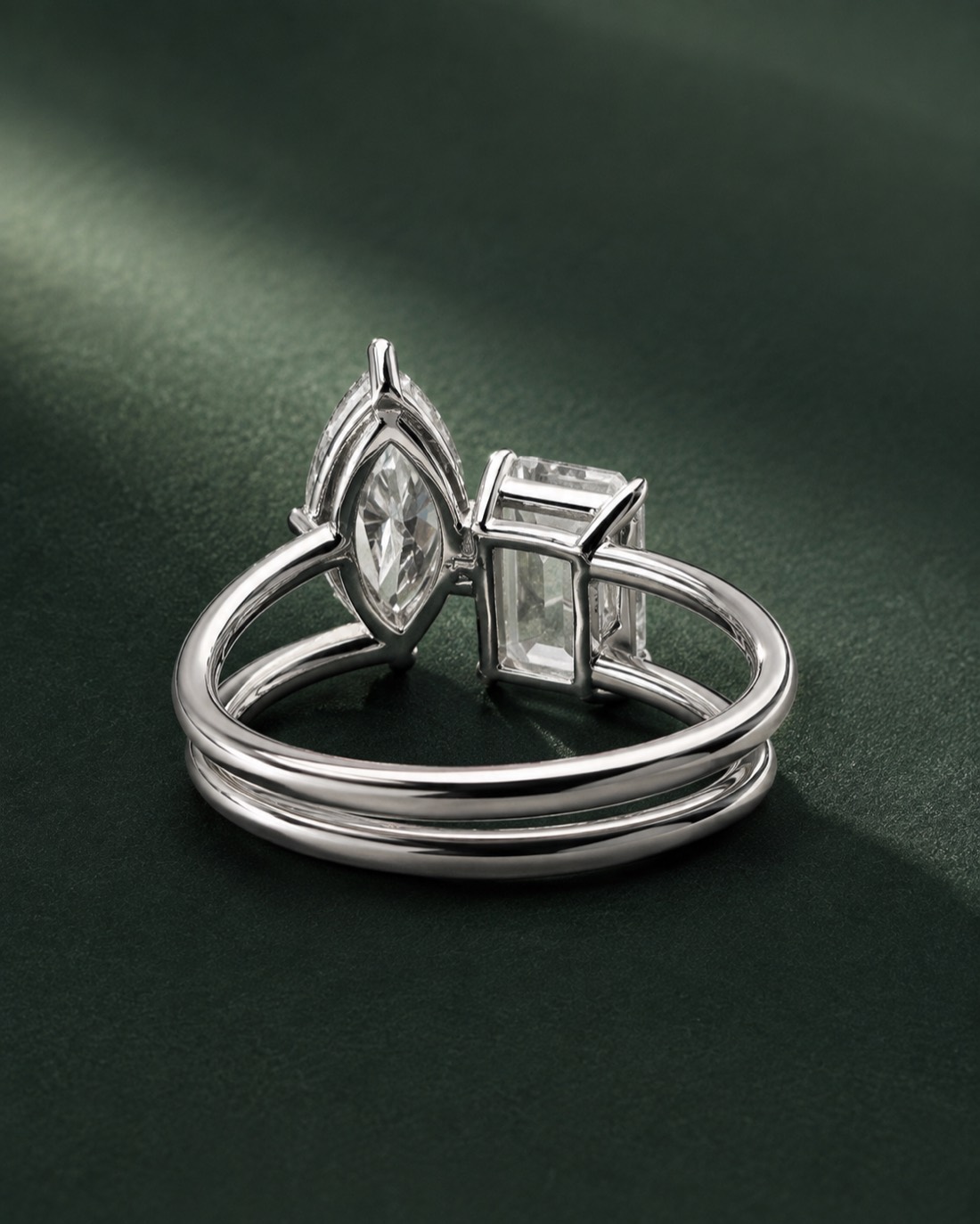
This is decision one and two of seven — center stone and shape — in our complete guide to designing a custom engagement ring.
What each design is saying
Symbolism is the reason most people land on either of these, so let's take it seriously.
Three stones carry the "past, present, future" reading — where you came from, where you are, where you're going. It's a clean story and it's been attached to the style for decades. Some people read it instead as friendship, love, and fidelity. Either way, the structure is one anchor with two supporters, and it reads as a life with a center to it.
Two stones say something different and more specific: two people, side by side, neither one subordinate to the other. The toi et moi has a long history — Napoleon proposed to Joséphine with one in 1796 — and it came back hard in the last few years because it says something a solitaire can't. It's also the only mainstream engagement ring design where there's no hierarchy between the stones.
If the symbolism genuinely matters to her, that's not a soft consideration. It's the most durable reason to pick one, because trends move and meaning doesn't.
How they look on the hand
This is where they diverge most.
A three-stone ring sits like a solitaire with wings. The eye goes straight to the middle and the side stones widen the ring's footprint across the finger without competing for attention. It fills the finger well, which is genuinely useful if the center stone is smaller than you'd like — two 0.30 carat side stones flanking a 1.00 carat center gives you 1.60 total carats of visible diamond and a much broader presence.
The classic proportion is side stones somewhere around a quarter to a third the size of the center. Go bigger and the ring starts to look like it has three centers and no focus. Go much smaller and the sides read as accents rather than as part of the trio.
A two-stone ring sits diagonally. The two stones are usually set on an angle or in a bypass shank, so they run along the finger rather than across it. That makes it look longer and more sculptural, and it means the ring has a clear "top" — she'll notice if it rotates.
Two-stone rings also tend to sit wider than people expect. Two 0.75 carat pears set side by side cover a lot of finger. If she has smaller hands, that's something to see rendered before committing.
Shape combinations, and why two-stone is harder
Three-stone rings are usually built from one of a few reliable combinations. Round center with round sides. Round or cushion center with tapered baguettes — very Art Deco, very clean. Oval or emerald center with trapezoids or half-moons, which hug the center closely and make the whole thing read as one solid shape.
The rule of thumb: matched shapes look classic, contrasting shapes look designed. Baguettes and trapezoids also cost less per carat than rounds, which is a quiet efficiency.
Two-stone rings are harder because the two stones have to relate to each other with no center to referee. The combinations that work best are usually either identical twins (two matched pears, two matched ovals) or a deliberate contrast where the shapes complement — a pear next to an oval, an emerald cut next to a round. What doesn't work is two shapes that are almost the same, because "almost matched" just reads as a mistake.
Sizing matters too. Two stones of noticeably different carat weights can look intentional and lovely — some people specifically want one stone for each person, sized differently. But it needs to be a decision, not an accident.
Cost, honestly
At the same total carat weight, a three-stone ring usually costs less than one big solitaire, because smaller stones are cheaper per carat. A 1.00 carat center with two 0.30 side stones costs meaningfully less than a single 1.60 carat stone, and covers more of the finger.
Two-stone rings run the other way. Because the two stones are close in size and both are prominent, you're buying two mid-to-large diamonds instead of one large and two small. And if you want them matched — same color, same clarity, same cut quality, same measurements — you're paying for the matching, because finding true pairs takes sourcing work.
Setting labor is higher on both than a plain solitaire. Three-stone needs the sides aligned and level with the center. Two-stone needs the angles right, which is fussier.
Living with them
Three-stone rings pair with wedding bands about as well as any non-solitaire design, though not perfectly. If the side stones sit low and close to the band, a straight wedding band may not sit flush. Many people solve this with a slight contour or by having the band designed at the same time.
Two-stone rings are harder to pair. Because the stones sit diagonally and often extend past the shank on both sides, a straight band frequently won't sit against it. The usual solutions are a contoured band that curves around the lower stone, or simply wearing the band on the other hand. Worth deciding before, not after.
Durability: both are fine as long as the shapes are set correctly. Pointed shapes — pears and marquise, which show up constantly in two-stone rings — need protective V-prongs at the tips, because that point is the most fragile part of any diamond. Baguettes and trapezoids in three-stone rings need channel walls or well-placed prongs at the corners for the same reason.
Frequently asked questions
Is a two-stone ring too trendy?
It's had a visible surge, so it does read as "of this moment" more than a three-stone does. But the design is 200+ years old, and unlike a lot of trends it's rooted in a meaning rather than a look. If she loves the meaning, the trend cycle is beside the point.
Can side stones be gemstones instead of diamonds?
Absolutely, and it's one of the best ways to personalize either design. Sapphires, emeralds, and moissanite all work. Just know that softer stones — emerald in particular — need more protective settings and more care than diamond.
Which one makes the center stone look bigger?
Neither really enlarges the center the way a halo does. A three-stone ring makes the ring look bigger overall while keeping the center clearly dominant. A two-stone ring has no center to enlarge — the whole point is that neither stone dominates.
Do three-stone rings have to be symmetrical?
Traditionally yes, and the symmetry is most of the appeal. Asymmetrical variations exist, but at that point you're closer in spirit to a two-stone or a cluster design.
What's the ideal side-stone ratio for a three-stone ring?
Most designs land with side stones between 25% and 35% of the center's carat weight. That reads as clearly supportive. Anything above about half and the hierarchy starts to blur.
So where does this leave you?
Go three-stone if you want a design that reads as classic on sight, fills the finger efficiently, carries a meaning that's easy to explain, and behaves predictably with a wedding band. Go two-stone if the "two of us" symbolism is genuinely the thing, and if she'd rather have a ring people ask about than a ring people recognize.
Now here's the part that decides how well either one turns out. Both of these designs live or die on proportion — the exact ratio of side stone to center, the exact angle two stones meet at, how high they sit relative to each other. That's not a preference you can express by pointing at a display case. It's a set of measurements.
And it's exactly what mass production can't accommodate. A finished three-stone ring in a case was manufactured with one specific center size in mind. Bring your own stone that's a bit larger or a bit smaller and the proportion is simply wrong — the sides are suddenly too big or too timid, and nothing can be done about it, because the sides are already set. Manufacturers build the ratios that sell to the most people. That's not dishonest; it's just what making thousands of something requires.
When the ring gets designed around your stones, the proportions are yours
We're designers at Amana, not a store with cases to clear. When you come in — in person or over video — we design the ring with you in the room, using AI-assisted visuals so you can actually see what 0.30 carat side stones look like next to your center versus 0.40, or what two pears look like at fifteen degrees versus twenty-five.
About three days later you get a CAD file: a precise 3D model of your exact ring, with your exact stones. If the side stones look heavy, or the two-stone angle isn't sitting right on her finger, tell us and we revise. That happens on most projects and it's a normal part of the process — small stuff, usually, like sitting the ring lower or switching to double claws. We keep revising until you approve it. Then the ring is ready in about two weeks.
Our design and craftsmanship typically runs $1,500 to $4,000, and what you get at the end is a real, certified diamond ring. Larger or rarer stones, or a genuinely complex build like a matched pair for a toi et moi, can run higher — and when that's the case we explain exactly why before you commit to anything.
Compare that to about $12,000 for a comparable ring at a traditional retail jeweler, or roughly $8,000 for that same finished ring bought wholesale. We charge for the design and the craftsmanship, because that's the part that's actually work.
Amana means "Trust" in Arabic. Earn your trust. Make your ring.