Ring Styles 101: Solitaire, Halo, Hidden Halo, Three-Stone, Two-Stone, Tension & Bypass Explained
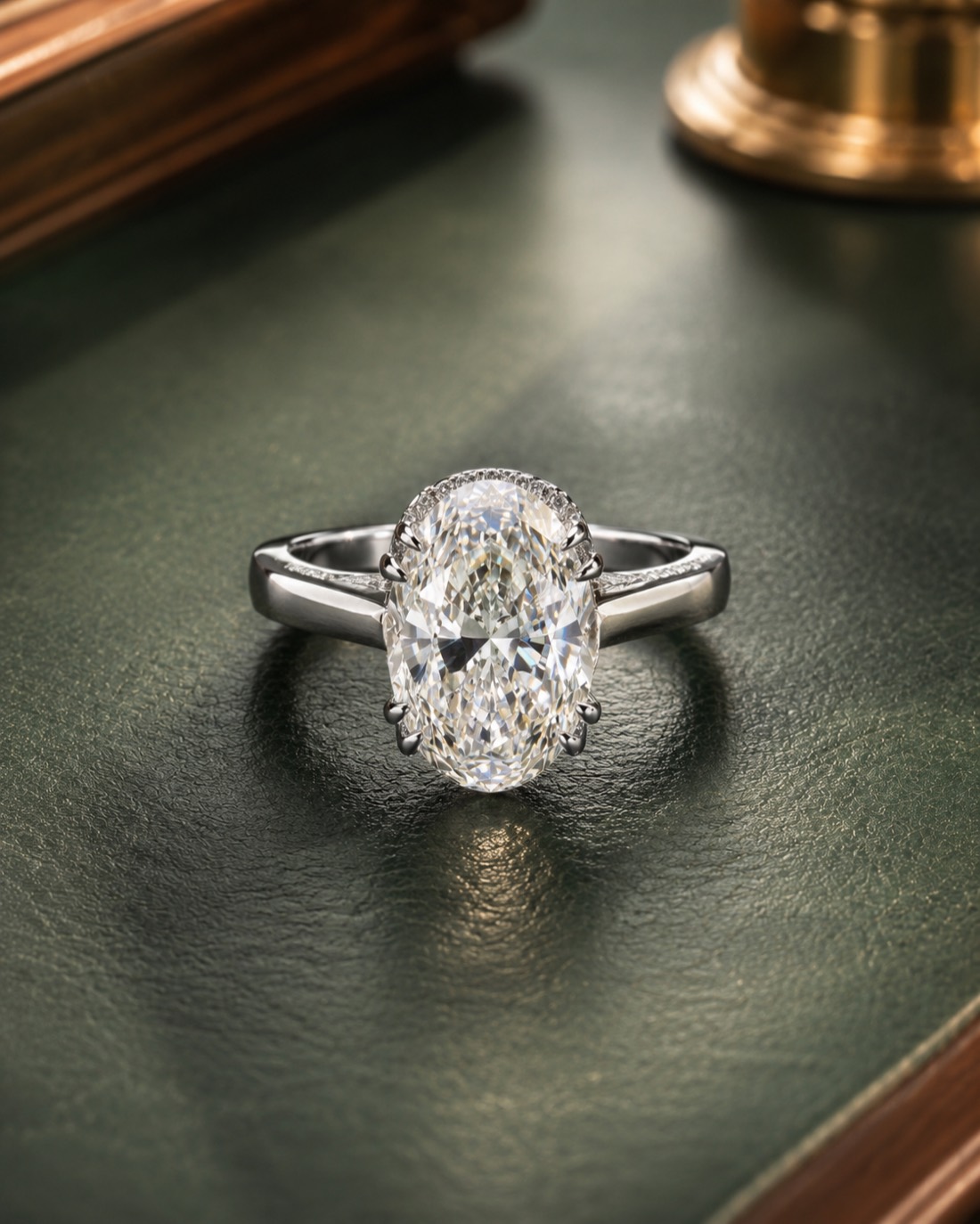
Setting style is decision three of seven in our complete guide to designing a custom engagement ring.
Solitaire
A single diamond, held by prongs, with no accent stones.
- What it means: The purest, most classic expression — nothing but the stone itself. Historically the original engagement ring style.
- Who it fits: Anyone who wants the diamond to be the entire focus, with a minimalist, timeless look that won't compete with other jewelry.
- Good to know: Often the most budget-efficient style, since every dollar goes toward the center stone rather than accent stones or detailed metalwork.
Halo
A center stone surrounded by a circle (or "halo") of smaller accent diamonds.
- What it means: Originally popularized in the Art Deco era, the halo is meant to frame and amplify the center stone.
- Who it fits: Anyone who wants their center stone to look larger and catch more light without paying for a bigger center diamond.
- Good to know: A halo can make a smaller center stone appear 20-30% larger visually, making it a popular budget-stretching choice.
Hidden Halo
Nearly identical to a standard halo, except the ring of accent stones sits underneath the center stone rather than visibly around it — invisible from a top-down view, but revealed from the side.
- What it means: A "secret" detail — extra sparkle and dimension that only the wearer (and anyone who looks closely) knows is there.
- Who it fits: Someone who loves the boosted sparkle of a halo but prefers a cleaner, more minimalist look from the front.
Three-Stone
A center stone flanked by two smaller stones of equal or near-equal size.
- What it means: Traditionally symbolizes a couple's past, present, and future together — one of the most sentimentally-loaded styles in engagement ring history.
- Who it fits: Couples who want built-in symbolism, or who like a fuller, more substantial look across the finger.
Two-Stone (Toi et Moi)
Two stones of similar size set side by side, often (but not always) different shapes or colors from each other.
- What it means: French for "you and me" — symbolizing two individuals coming together as partners, side by side rather than one stone dominating.
- Who it fits: Couples who want a distinctive, less traditional look with strong personal symbolism; this style has seen a major resurgence in recent years.
Tension
The center stone appears to float, held in place by the pressure ("tension") of the metal band itself rather than visible prongs.
- What it means: A modern, architectural style — less about tradition, more about showcasing engineering and a bold, minimal aesthetic.
- Who it fits: Someone with a modern or minimalist taste who wants their stone to look like it's suspended in mid-air; best suited to more durable metals like platinum given the engineering demands.
Bypass
The band splits and "bypasses" itself around the center stone, with the two ends crossing rather than meeting on either side of the diamond.
- What it means: A flowing, asymmetrical look, often interpreted as two paths crossing or wrapping around each other.
- Who it fits: Someone who wants a distinctive silhouette that doesn't look like a traditional round band with a stone on top.
How to actually choose a style
Style is where a lot of the ring's personality lives — more than the shape or the metal, in many cases. A useful way to narrow it down: does your partner wear mostly simple, minimal jewelry day-to-day, or bolder statement pieces? Solitaire and hidden halo tend to fit the first group; halo, three-stone, two-stone, tension, and bypass tend to fit the second.
Frequently asked questions
What's the difference between a halo and a hidden halo?
A standard halo is visible from the top, framing the center stone. A hidden halo sits underneath the center stone and is only visible from the side — a more subtle version of the same effect.
Does a three-stone ring have to use the same size stones?
No — many three-stone designs use a larger center stone flanked by two smaller accent stones, though equal-sized versions exist too.
Is a tension setting less secure than a prong setting?
When properly engineered (usually in platinum for its strength), a tension setting is just as secure as a prong setting — but it requires a skilled setter, since the stone's placement depends entirely on precise metal pressure.
Can I combine styles, like a halo with a two-stone design?
Yes — most styles can be blended or customized. This kind of combination is much easier to do with a designer than by picking from a pre-made retail catalog.
So what does this actually mean for choosing your style?
Every one of these styles carries its own meaning, and none of them is objectively "better" — the right one depends entirely on your partner's day-to-day style and what the design symbolizes to the two of you. The challenge is that most retail stores only stock a handful of these styles in a limited range of sizes, which quietly narrows your choice before you've even started.
Why style should be designed, not just selected
A retail case might carry a few solitaire and halo options in standard sizes — but hidden halo, two-stone, tension, and bypass settings are far less common on a store shelf, because they're harder to mass-produce and don't sell as predictably. That doesn't mean they're rare or risky designs; it just means retail isn't built to offer them easily.
At Amana, every one of these seven styles is equally available to you, because we're not selecting from inventory — we're building your ring from scratch around whichever style actually fits your partner. During your consultation, we'll show you AI-assisted visuals of multiple styles on your chosen diamond so you can compare a halo against a hidden halo, or a three-stone against a two-stone, before deciding anything. And because our pricing is built around the design and craftsmanship rather than what's profitable to keep in a display case, choosing a less common style like tension or bypass doesn't carry a retail premium — design and craftsmanship typically runs $1,500–$4,000 across all of these styles (stone size and complexity are what shift that number, and we'll walk you through it honestly).
Book a free design consultation and see your favorite styles rendered side by side — no guessing from a case, no settling for "close enough."