Prong Styles Compared
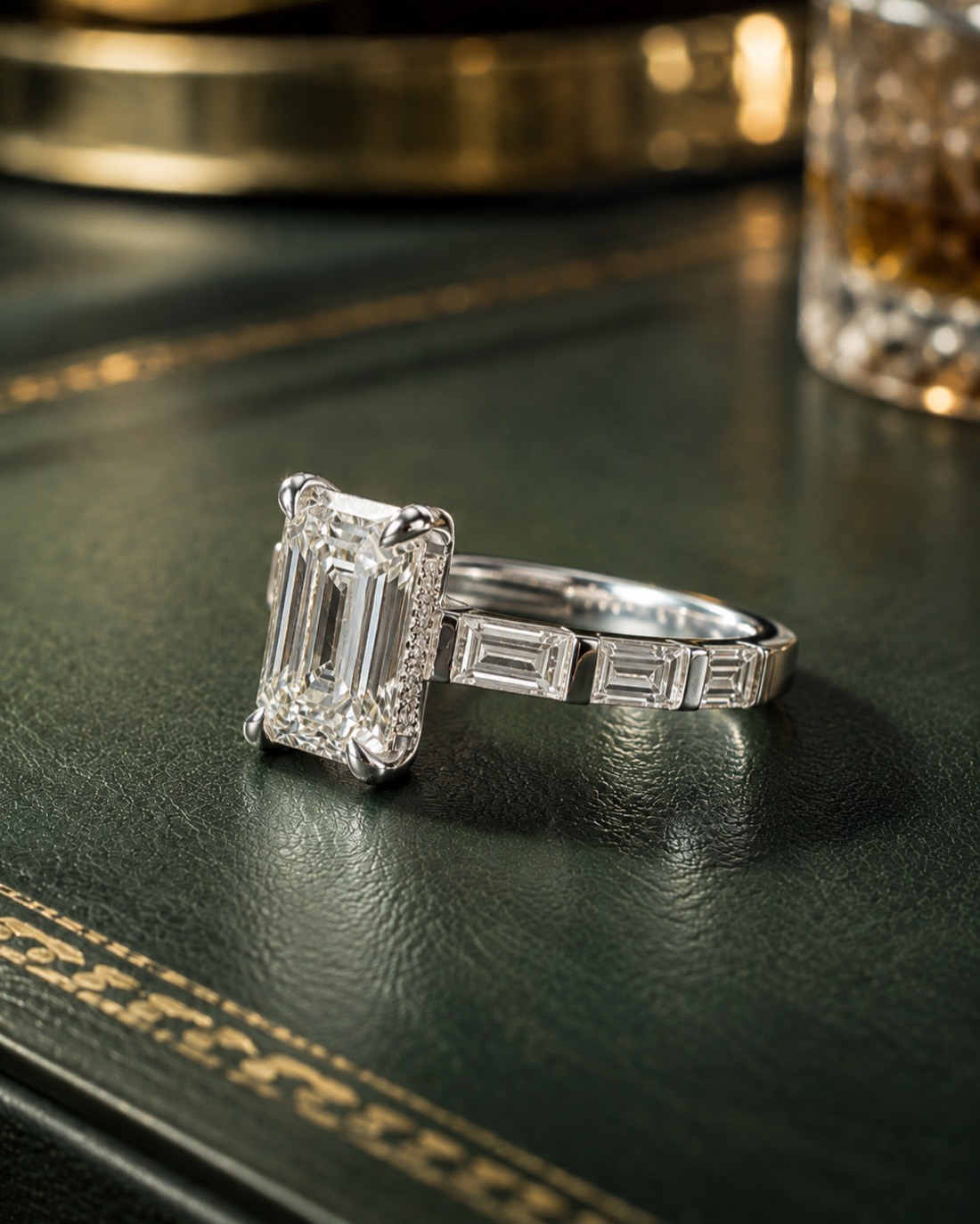
This is decision five of seven in our complete guide to designing a custom engagement ring, and it's the one most people never realize they get to make.
Four prongs or six: the actual difference
Start here, because it changes the ring more than the prong shape does.
Four prongs hold the stone at four points, usually at the compass positions or rotated 45 degrees. Less metal touches the diamond, so more of it is visible — a four-prong round diamond looks marginally larger than the same stone in six prongs. Four prongs also frame a round stone in a way that reads slightly squarer, which some people like and some don't.
The catch: fewer contact points means each one carries more responsibility. Lose one of four and the stone is genuinely at risk. Lose one of six and the remaining five will hold it while you get it fixed.
Six prongs spread the load and produce the classic "Tiffany" look — the round, evenly spaced arrangement most people picture when they picture an engagement ring. More metal on the stone, so slightly less visible diamond, but a rounder, softer overall impression and meaningfully more security.
The practical guidance most benches would give you: on stones under about 1.5 carats, four prongs are perfectly secure and let the diamond show. Above that, or if she's hard on her hands, six is the safer default. And if you love the four-prong look on a bigger stone, double claws get you the security without the six-prong look.
The prong shapes, one by one
Round prongs are finished into a small dome over the edge of the stone. They're the most common, the most forgiving, and the most timeless. Because they're rounded, they snag less than pointed prongs and they wear down gradually rather than thinning to a fragile point. If you want a ring that looks correct in every decade, round prongs are it.
Claw prongs (sometimes called pointed or talon prongs) taper to a narrow tip over the stone. Less metal on the diamond means more visible stone and a sharper, more contemporary look. They're popular on ovals and pears because the taper echoes the shape. The trade-off is that a thinner tip has less material to lose before it needs retipping, and pointed tips catch on fabric more than domed ones.
Flat tab prongs are pressed into a flat, squared-off shape against the stone. They cover slightly more diamond and read distinctly modern and architectural. They're durable because there's more metal in the contact area. They show up a lot on bezel-adjacent and minimalist designs.
V-prongs are shaped like a V and used specifically to cup the point of a pointed stone. On a pear, marquise, princess, or trillion, that tip is the most chip-vulnerable part of the entire diamond, and a V-prong wraps it from both sides. This isn't a style preference — if she picked a pointed shape, a V-prong at the point is close to mandatory. Skipping it to show more stone is a bad trade.
Double claws are two smaller prongs placed side by side at each position instead of one. Four double claws means eight points of contact but reads visually as four. They add real security, they look intentionally detailed, and they carry a slightly vintage or European feel. They're one of the most common things people ask for after they see their first design rendering.
Compass prongs sit at north, south, east, and west rather than the rotated diagonal positions. It's a subtle change that makes a round stone look more deliberately placed and gives ovals a nice symmetry. Purely aesthetic.
Basket prongs vs. surface prongs — a note on structure rather than shape. In a basket, the prongs are part of a cage that supports the stone from underneath. In a surface or "floating" style, the prongs rise directly from the shank with less underneath. Baskets are sturdier and easier to clean; the floating look sits lower and shows more of the stone from the side.
How prong choice actually affects sparkle
Less metal on the stone means more light in and out. That's the whole mechanism, and it's why four claw prongs will let a diamond perform marginally better than six flat tabs.
But "marginally" is the honest word. The difference between prong styles on a well-cut diamond is small compared to the difference cut quality makes. If you're choosing between a slightly better-cut stone in six prongs and a slightly worse-cut stone in four, take the better cut every time.
Where prongs genuinely matter optically is the impression of size. A four-prong claw setting can make a stone look a hair larger by exposing more of its outline, and on a stone under a carat that's a real, if modest, win.
Maintenance: the thing nobody mentions at purchase
Prongs wear. Metal against skin, fabric, countertops, and steering wheels for a decade thins them out. That's normal and it's not a defect.
Which means prong settings come with a maintenance schedule: have them checked roughly once a year, and expect retipping — adding a small amount of metal back to worn prong tips — somewhere in the five-to-fifteen-year range depending on wear and metal.
Metal affects this too. Platinum prongs are the toughest for this job because platinum displaces rather than sheds when it's scratched, so a platinum prong thins far more slowly than a gold one. Plenty of white gold rings are made with platinum prongs for exactly this reason, and it's a smart, cheap upgrade.
Signs a prong needs attention: a stone that moves or clicks when you tap the ring gently near your ear, a prong tip you can catch a fingernail under, or a prong that looks visibly flatter than its neighbors.
Matching prongs to the shape
- Round — four or six, round or claw, all work. Six for larger stones.
- Oval — four or six; claw prongs flatter the shape. Prongs at the ends should be slightly wider, because the ends of an oval are its thinnest points.
- Emerald / Asscher — corner prongs, sized to grip the cut corners. Four is standard.
- Cushion — four prongs at the corners, often double claws for the vintage feel that suits the shape.
- Princess — V-prongs or well-formed corner claws at all four corners. Non-negotiable; those corners chip.
- Pear — V-prong at the point, then two or four more around the body.
- Marquise — V-prongs at both points. Two vulnerable tips instead of one.
- Radiant — corner prongs like a princess, though the cut corners are less fragile.
Frequently asked questions
Are six prongs really more secure than four?
Yes, mainly because of redundancy. Six prongs each carry less load, and losing one leaves five holding the stone. On larger stones or hard-worn rings, that redundancy is worth the tiny bit of covered diamond.
Do prongs snag on clothing?
Some do. Pointed claw prongs and tall settings snag most; round and flat tab prongs on lower settings snag least. If snagging is a real concern, a lower-profile setting or a half bezel solves it more thoroughly than a prong change alone.
What are double prongs for?
Two small prongs at each position instead of one. You get more contact points and a vintage, detailed look while keeping the visual rhythm of a four-prong setting. It's the most requested tweak we see at the design-review stage.
Can prong style be changed on a finished ring?
Not meaningfully. Changing prongs means unsetting the stone, cutting off the old head, fabricating a new one, and resetting — which typically costs more than designing it right originally and risks the stone in the process. Prong style is effectively permanent from the moment the diamond is set.
Does prong metal have to match the band?
No, and it often shouldn't. Platinum prongs on a white gold or yellow gold band are common and practical — platinum wears more slowly, so the prongs outlast the alternative. White prongs on a yellow band also keep a diamond looking whiter.
So where does this leave you?
If you want a shortlist: six round prongs for a classic look with the least to think about. Four claw prongs for a modern look and maximum visible stone. Double claws when you want security plus character. V-prongs, always, on anything with a point. And platinum prongs regardless of what the band is made of.
Now sit with that last FAQ answer for a second, because it's the whole thing. Prong style is decided once, at the moment the stone gets set, and after that it's essentially permanent. Not "expensive to change" — practically speaking, done.
Which is why it's genuinely strange that prong style is a decision almost nobody buying a finished ring realizes they had. It's not hidden from you. It just isn't available, because the ring already made the call. And it can't be available on a finished ring — a store would need every design in four-prong and six-prong, round and claw and double claw, across every metal and stone size. Each of those is a separate item that has to sell before it costs money to sit there. So manufacturers build the two or three most popular versions and the rest simply never exist.
That's not retail being shady. It's arithmetic.
The choice only exists if the ring hasn't been made yet
At Amana we're designers, so this is just a question we ask you. Four or six? Round, claw, or double? Platinum prongs on that gold band? None of it depends on what's in a case, because there is no case.
Here's the process. We meet in person or over video, and we design the ring with you sitting there, using AI-assisted visuals so you can see four claw prongs versus six round ones on your stone instead of trying to picture it. About three days later you get a CAD file — a precise 3D model of the exact ring. If you look at it and think the prongs read heavy, or you want double claws instead of single, you say so and we revise. That's normal; most people want one small change. We keep going until you approve. Then the ring's ready in about two weeks.
Design and craftsmanship typically runs $1,500 to $4,000, and you get a real, certified diamond ring out of it. Larger or rarer stones, or a genuinely complex build, can run higher — and if yours will, we explain exactly why before you commit.
Meanwhile a comparable ring at a traditional retail jeweler is around $12,000, and buying that same finished ring wholesale still runs about $8,000. We charge for the design and the craftsmanship, because that's the part that's actually work.
Amana means "Trust" in Arabic. Earn your trust. Make your ring.