Emerald Cut: What to Know Before You Commit
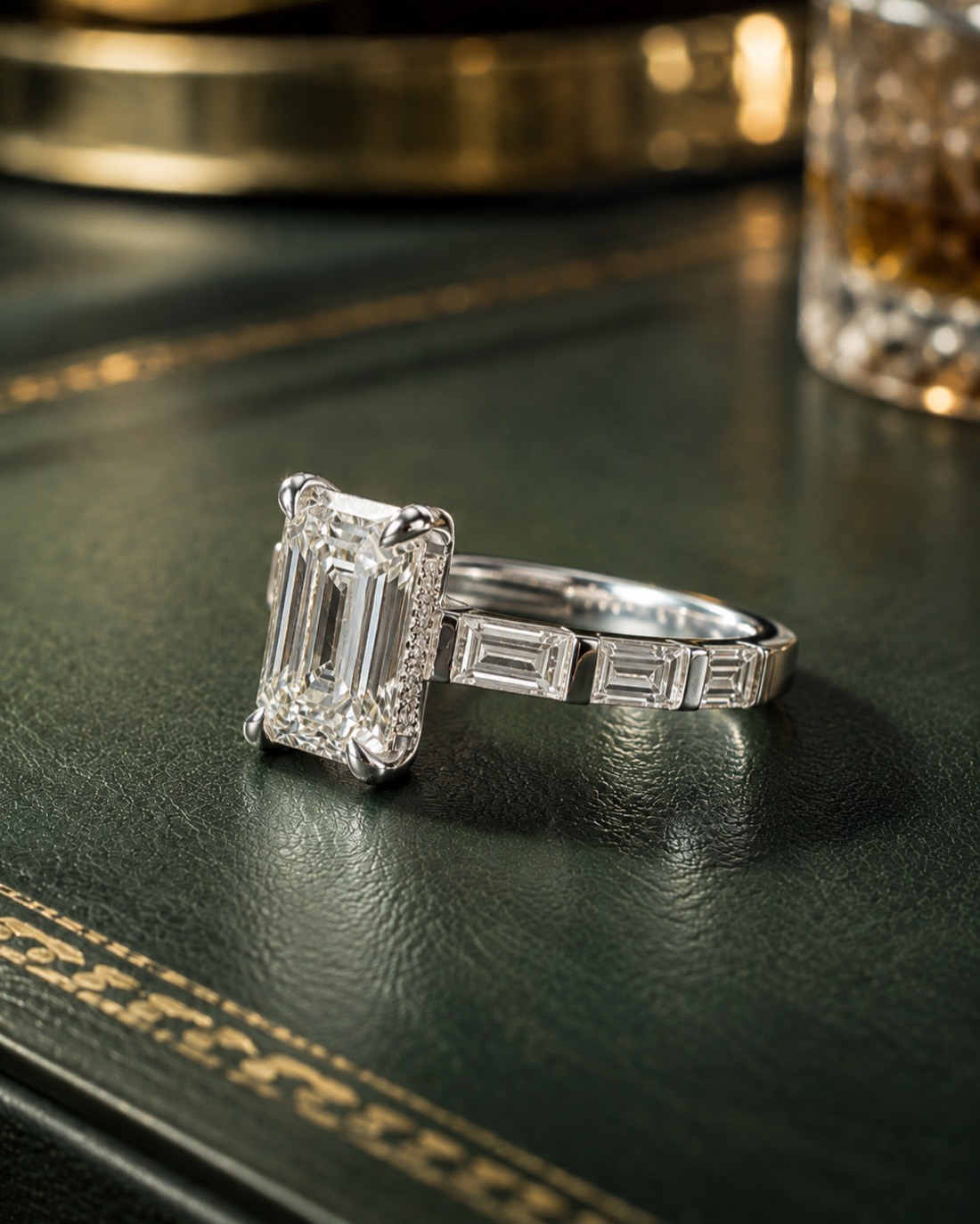
This is one piece of our full diamond education guide.
What a step cut actually is
Most diamond shapes you've seen are brilliant cuts — round, oval, cushion, pear. They're covered in dozens of small kite and triangle facets arranged to bounce light around chaotically and throw it back at your eye as sparkle.
An emerald cut is built on the opposite principle. It has broad, flat, rectangular facets arranged in parallel rows descending from the table like steps, plus cut corners at the four angles. Typically around 50 facets, and they're big.
The result isn't sparkle in the conventional sense. Look down into an emerald cut and you see long parallel planes reflecting into each other — the effect the trade calls the hall of mirrors. Light comes back in wide, slow, dramatic flashes rather than fast pinpoint scintillation.
It's a fundamentally different aesthetic: architectural, clean, deliberate. People who love emerald cuts usually love them specifically because they don't look like everything else.
It reads bigger than its weight
Emerald cuts have a large open table and a relatively shallow profile, which means more of their carat weight sits in face-up surface area rather than in depth.
At 1.00 carat, a typical emerald cut measures roughly 7.0mm × 5.0mm, versus a round brilliant's 6.4–6.5mm diameter. The rectangle covers more finger, and the elongation reads longer still.
It's also cut efficiently from rough diamond — much more efficiently than a round, which wastes over half the crystal. That efficiency is why emerald cuts, like most fancy shapes, run 10–25% less per carat than a comparable round.
So the shape is bigger-looking and cheaper. Which is the same pattern as most fancy shapes, and it comes with the same catch: there's something the report won't tell you.
The trade-off: it hides nothing
This is the whole thing you need to understand before buying an emerald cut, and it's the reason a cheap one can be a disaster.
Clarity. In a brilliant cut, dozens of facets throwing light in all directions act as camouflage — an SI1 inclusion can vanish into the visual noise. An emerald cut has no noise. You're looking down through big flat panes of transparent material with nothing in the way. An inclusion that would disappear in a round can sit there in plain view in an emerald.
Practical floor: VS2 or better, and even then look at the stone rather than the grade. Check specifically under the table, where you're looking straight down through the most material.
Color. Same logic. Brilliant cuts flood your eye with white and spectral flashes that mask faint body color. Step cuts let you see through the body of the stone, so warmth registers. If a round is comfortable at G or H, an emerald in white metal wants F or G. Full detail in our diamond color guide and clarity guide.
There's a real irony in this. The shape that costs less per carat is the shape that needs higher grades — so the savings partially wash out. That's fine, and worth knowing up front rather than discovering after you've bought a cheap SI2 emerald that looks like it has a bug in it.
Cut quality, without a cut grade
GIA gives an overall cut grade only to round brilliants. An emerald cut gets polish and symmetry grades and nothing else — so its most important quality is not on the report at all.
What to look at:
Depth and table. Emerald cuts generally sit well around 61–68% depth and 61–69% table. Too deep and the center goes dark; too shallow and it windows.
Windowing. Hold it over printed text. If you can read through the middle of the stone, light is passing straight through instead of reflecting back — the center will look flat and glassy in real life.
Even step reflections. The parallel rows should look crisp and regular, not wavy or misaligned. Sloppy step alignment ruins the hall-of-mirrors effect, which is the entire reason to buy the shape.
Corners. The cut corners should be even. Uneven corners throw off the whole rectangle visually and complicate setting.
Because none of this is graded, an emerald cut has to be seen — in high-quality video or in person — before you buy. That's not optional in the way it arguably is with a round.
Ratio changes the personality
Length-to-width ratio matters more here than in almost any other shape:
- 1.20–1.30 — squarish, closer to an Asscher in feel, chunkier
- 1.30–1.40 — the classic emerald rectangle, balanced
- 1.40–1.50 — elongated, sleek, strongly finger-lengthening; the Art Deco look
- 1.50+ — very long and narrow, dramatic, and starts to look thin on wider fingers
There's no correct ratio, but there's a big visual difference between 1.25 and 1.50, and pictures online rarely tell you which you're looking at. Ask for the number.
Living with one
Durability. The cut corners are actually a strength — emerald cuts don't have sharp exposed points the way a princess or pear does, so they're relatively chip-resistant. Four-prong or corner-prong settings work well, and bezels suit the shape beautifully.
Show it clean. Because you're looking straight through the stone, skin oil and lotion film on the pavilion kills the hall-of-mirrors effect fast. Emerald cuts look noticeably better freshly cleaned than any brilliant cut does.
Setting style. The clean geometry pairs naturally with Art Deco detail, baguette side stones, and simple solitaires. Halos work but slightly fight the shape's own architecture. Our engagement ring styles guide covers how shape and setting interact.
Frequently asked questions
What clarity do you need for an emerald cut diamond?
VS2 or better as a practical floor. The open step facets provide no camouflage, so inclusions that would be invisible in a brilliant cut can be visible in an emerald cut.
Do emerald cut diamonds look bigger?
Yes, per carat. Their large open table and shallower profile put more weight into face-up area — a 1.00ct emerald runs roughly 7.0mm × 5.0mm versus a round's 6.5mm diameter.
Are emerald cut diamonds cheaper than round?
Generally about 10–25% less per carat, because the shape is cut more efficiently from rough. The savings narrow somewhat because emerald cuts need higher clarity and color grades.
Why doesn't my emerald cut sparkle much?
It isn't supposed to sparkle like a round. Step cuts produce broad, slow flashes rather than rapid pinpoint scintillation. If it looks flat rather than flashing, though, check for windowing — that's a cut problem, not the shape.
What's the best length-to-width ratio for an emerald cut?
Most people choose between 1.30 and 1.50. Around 1.40 is the classic rectangle; higher ratios read sleeker and more elongated, lower ratios read squarer and chunkier.
So where does this leave you?
The emerald cut is one of the few shapes where the smart advice actually points up on two of the four Cs. That makes it a useful test of who you're buying from.
Anyone can sell you an emerald cut. Selling you a cheap one and letting you find the inclusion at home is easy. Telling you "for this shape you need to go to VS2 and F color, and here's why, and let's look at the stone together" costs the seller a conversation — and on a commissioned floor, that conversation ends with a smaller sale as often as a bigger one.
Why we'd rather have the conversation
Amana is a design studio. We don't hold inventory, nobody works on commission, and there's no version of this where we come out ahead by letting you buy a step cut that shows its flaws. We'll pull the stone up and look at it with you.
The numbers. A comparable ring at a traditional retail jeweler runs about $12,000. That same finished ring bought wholesale still runs around $8,000. Our design and craftsmanship typically run $1,500–$4,000, and you still get a real certified diamond in a ring built to your design. Larger stones, or rarer and more complex ones, can run higher — and we'll explain exactly why before you commit.
Natural diamonds set the price. Lab-grown brought it down. Designer-direct is the third era, and it's where the markup goes instead of the stone.
The process: design together, in person or over video, with AI-assisted visuals. CAD file about three days later. Approve and pay the balance through an emailed link. Ring's ready roughly two weeks after that.
Earn your trust. Make your ring.