Cushion vs. Round Diamonds
This is one piece of our full diamond education guide.
Two different ideas about what a diamond should do
The round brilliant is a piece of optical engineering. Its 57-or-58 facet arrangement was worked out mathematically in the early 1900s to return the maximum possible light through the top of the stone. Everything about it is optimized, and it shows: crisp, bright, high-contrast flashes with clear on/off transitions as the stone moves.
The cushion is older in spirit. It descends from the old mine cut — the pillowy, hand-cut squares of the 1700s and 1800s, made by candlelight for candlelight. Those stones had big facets, high crowns, small tables, and a soft, glowing quality. Modern cushions are cut with modern precision, but the family resemblance is the point. They're chosen for character, not for maximum output.
If a round is a studio recording, a cushion is a record player. Neither is objectively better, and people usually know immediately which one they respond to.
The thing nobody tells you: crushed ice vs. chunky
Here's the single most useful cushion fact, and it explains why two stones both labeled "1.00ct cushion" can look nothing alike.
Crushed ice cushions have extra facets under the crown that split light into many small, scattered, glittery pinpoints. The face-up look is shimmery and busy — like the surface of a glass of crushed ice, which is where the name comes from. They twinkle constantly, and they read as sparkly in almost any lighting.
Chunky (or "antique," "old mine style") cushions have fewer, larger facets that return light in big, distinct, blocky flashes. The look is bolder and more dramatic, with clear dark-and-light contrast between flashes. It's the closest modern shapes get to the old mine cut character.
The market treats "cushion" as one thing. It isn't. These are meaningfully different stones, and if you order online from a listing that just says "cushion cut," you may be surprised by what shows up.
Practical read on which suits whom:
- Crushed ice hides inclusions and warmth exceptionally well, thanks to all that visual noise. Great for stretching a budget on clarity and color.
- Chunky faceting gives a more distinct, characterful sparkle but shows inclusions and body color a bit more, since there's less noise.
Ask which one you're looking at. It's a completely normal question and a lot of sellers won't volunteer it.
Sparkle character, side by side
| Round brilliant | Cushion | |
|---|---|---|
| Sparkle style | Sharp, organized, high contrast | Soft, scattered, glowing |
| Fire (rainbow) | Strong and controlled | Often more rainbow, especially in chunky cuts |
| Light performance | Highest of any shape | Very good, less optimized |
| Character | Precise, classic, modern | Romantic, vintage, warm |
| Cut grade on report | Yes (GIA) | No — polish and symmetry only |
That last row matters. GIA assigns a full cut grade only to round brilliants. A cushion gets polish and symmetry grades, and nothing that tells you whether the facet work actually performs. Which means cushions have to be evaluated by looking, the same way ovals and their bowtie risk do — though cushions are far less prone to bowties, since they're not strongly elongated.
Warmth is a feature here
An interesting quirk: the cushion's vintage character makes it unusually tolerant of lower color grades.
Because the reference point for a cushion is antique — old mine cuts, candlelight, warm gold settings — a faint warmth in the stone reads as authentic rather than as a flaw. A J color cushion in yellow gold looks completely intentional. A J color round in platinum can look like a compromise.
Combine that with crushed ice faceting, which scatters light heavily and further masks body color, and cushions become one of the more forgiving shapes for saving on color and clarity. Detail in the diamond color guide.
Size and price
Size. A 1.00ct cushion typically measures around 5.5–6.0mm across, depending on how square or elongated it is and how deep it's cut. That's smaller face-up than a 1.00ct round at 6.4–6.5mm. Cushions are often cut deep, carrying weight below the girdle.
This surprises people who assume every fancy shape looks bigger than a round. Elongated shapes like oval and pear do. A square-ish cushion generally does not — it trades face-up spread for depth and body. Elongated cushions (ratios around 1.20–1.30) split the difference and cover more finger.
Price. Cushions run roughly 15–30% less per carat than rounds, for the same reason every fancy shape does: they're cut more efficiently from rough, wasting less of the original crystal than a round's punishing yield.
So a cushion is cheaper per carat but not automatically bigger-looking. You're buying character and price, not spread. If maximum perceived size is the goal, that's a different conversation — carat weight vs. visual size covers it properly.
Setting and wear
Cushions have gently rounded corners with no sharp points, which makes them durable and easy to set. They take four-prong and double-prong settings naturally, and they suit halos unusually well — a halo echoes the pillowy outline instead of fighting it.
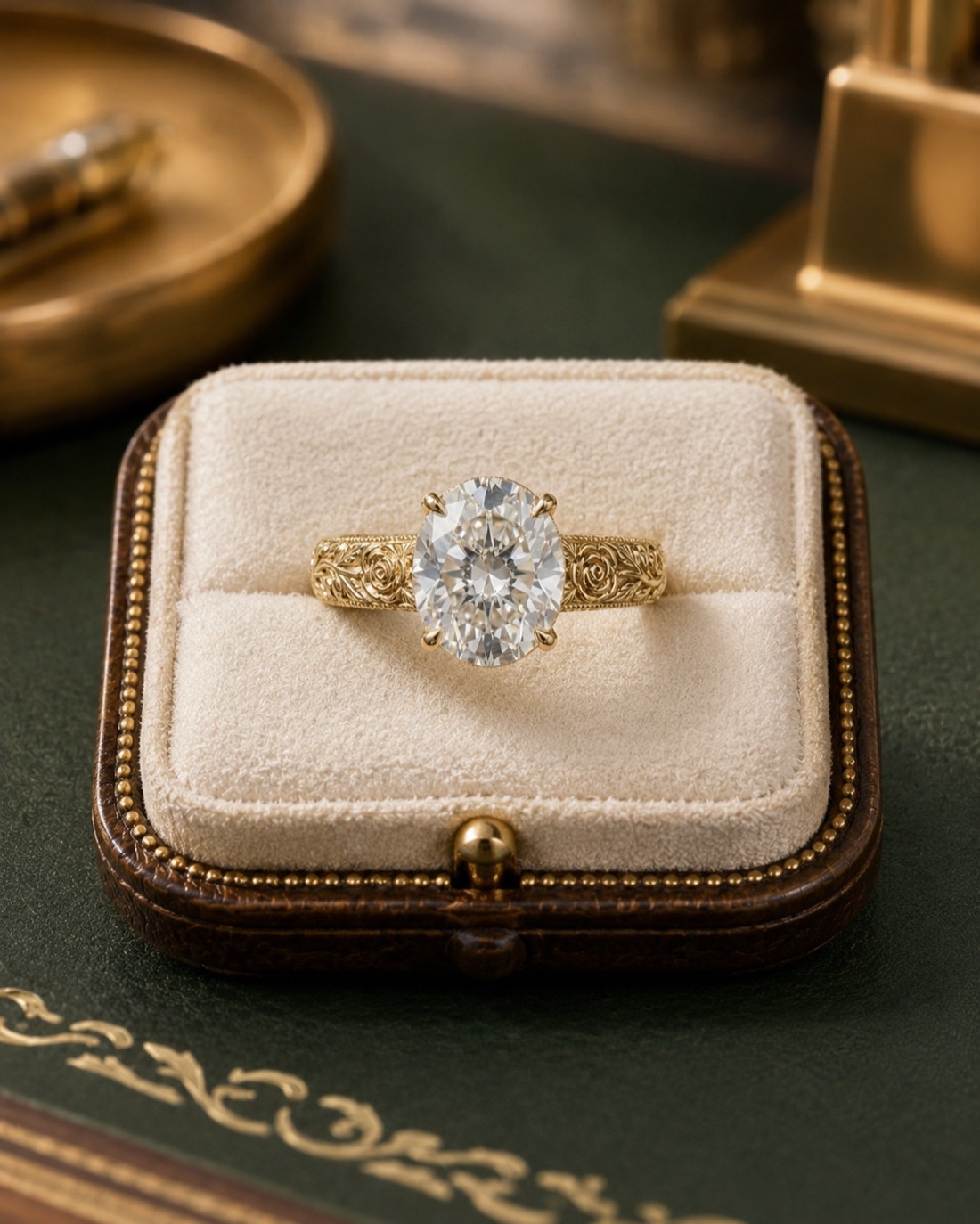
They also pair beautifully with vintage-leaning detail: milgrain edges, filigree galleries, rose or yellow gold. If the whole appeal is the antique character, the setting can lean into it.
Frequently asked questions
Which sparkles more, cushion or round?
A round brilliant returns more light overall — it's the most optically optimized shape. But cushions often show more rainbow fire, and crushed-ice cushions produce constant shimmer. "More" and "different" aren't the same thing here.
What's the difference between crushed ice and chunky cushion cuts?
Crushed ice cushions have extra facets producing many small scattered sparkles. Chunky cushions have fewer, larger facets producing bold, distinct flashes with more contrast. Both are sold simply as "cushion," so ask which you're seeing.
Are cushion cut diamonds cheaper than round?
Yes, generally 15–30% less per carat, because cushions are cut more efficiently from rough diamond than rounds are.
Does a cushion cut look bigger than a round?
Usually not. A 1.00ct cushion runs about 5.5–6.0mm versus a round's 6.4–6.5mm, because cushions often carry weight in depth. Elongated cushions cover more finger than square ones.
Do cushion cuts hide inclusions well?
Crushed ice cushions hide them very well — the scattered sparkle is excellent camouflage. Chunky-faceted cushions hide them less, so lean toward VS clarity there.
So where does this leave you?
If you want the brightest, most verifiable, most classic stone available, and you're comfortable paying the premium for the shape with the best yield problem, buy a round.
If you want warmth, softness, vintage character, and a lower price per carat — and you're willing to look at the actual stone to figure out which kind of cushion you're getting — buy a cushion.
But notice what the cushion decision really requires: someone willing to tell you crushed ice and chunky are different things, that a cushion won't look bigger than a round, and that a J color is fine here. Three facts, all of them true, all of them pointing away from the largest possible sale.
What changes when there's no sales floor
Amana designs rings. We don't stock cushions we need to move, and nobody here earns a percentage of your total, so there's no reason for us to leave the crushed-ice question unasked.
The money, plainly. A comparable ring at a traditional retail jeweler runs about $12,000. That same finished ring bought wholesale still runs around $8,000. Our design and craftsmanship typically run $1,500–$4,000, and you still get a real certified diamond in a ring built to your design. Larger stones, or rarer and more complex ones, can run higher — and we'll show you exactly why before you commit to anything.
Natural diamonds set the price. Lab-grown brought it down. Designer-direct is the third era, and it works because there's no inventory sitting between you and the ring.
The process: design session in person or over video with AI-assisted visuals, CAD file about three days later, approve and pay the balance through an emailed link, ring's ready roughly two weeks after that.
Earn your trust. Make your ring.