Carat Weight vs. Visual Size
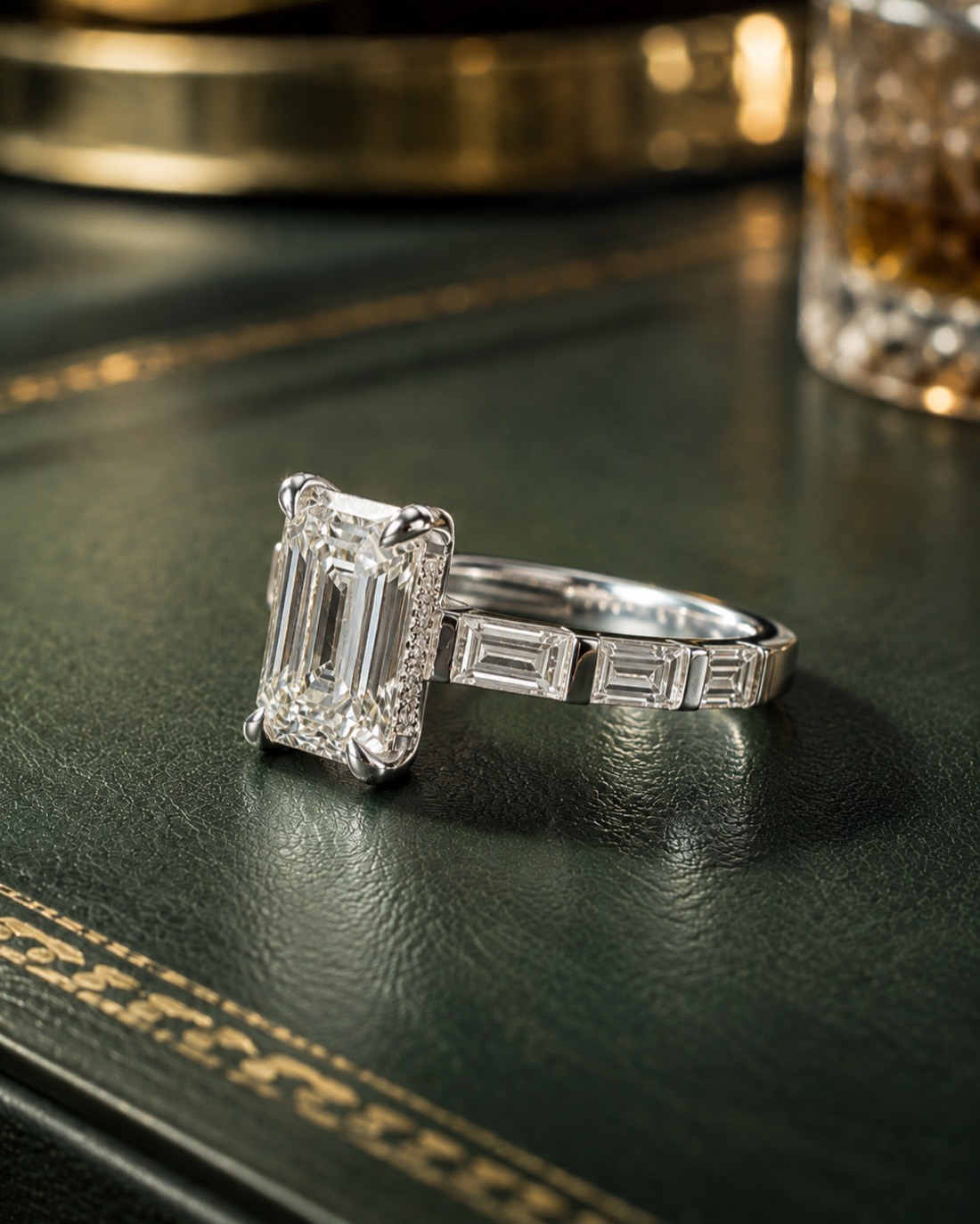
This is one piece of our full diamond education guide.
The unit itself
One carat equals 0.2 grams, and it divides into 100 points — so a 0.75ct diamond is "seventy-five points," and a 0.50ct is "a half carat" or "fifty points."
That's it. It's a scale reading. It tells you what the stone weighs, and weight is a proxy for size only if you also know how the stone was cut — which is exactly the assumption that costs people money.
The mm chart
Millimeters are what you actually see. This is the honest measurement, and it's the one to ask for.
Approximate face-up dimensions for well-cut stones:
| Carat | Round (Ø mm) | Oval (mm) | Cushion (mm) | Emerald (mm) | Pear (mm) | Princess (mm) |
|---|---|---|---|---|---|---|
| 0.50 | 5.2 | 6.5 × 4.5 | 4.9 × 4.9 | 6.0 × 4.0 | 7.7 × 5.0 | 4.4 × 4.4 |
| 0.75 | 5.8 | 7.0 × 5.0 | 5.5 × 5.5 | 6.5 × 4.5 | 8.5 × 5.5 | 5.0 × 5.0 |
| 1.00 | 6.5 | 7.7 × 5.7 | 5.8 × 5.8 | 7.0 × 5.0 | 9.0 × 6.0 | 5.5 × 5.5 |
| 1.25 | 6.9 | 8.2 × 6.0 | 6.2 × 6.2 | 7.3 × 5.3 | 9.5 × 6.4 | 5.9 × 5.9 |
| 1.50 | 7.4 | 8.5 × 6.5 | 6.5 × 6.5 | 7.5 × 5.5 | 10.0 × 6.7 | 6.2 × 6.2 |
| 2.00 | 8.1 | 9.3 × 7.0 | 7.2 × 7.2 | 8.5 × 6.0 | 11.0 × 7.0 | 7.0 × 7.0 |
Two things jump out.
First, at the same carat weight the shapes are not remotely the same size on top. A 1.00ct pear is 9mm long. A 1.00ct princess is 5.5mm across. Same weight, wildly different presence.
Second, the numbers grow slowly. Which brings us to the math that surprises everyone.
Why doubling the carats doesn't double the look
Weight scales with volume, and volume scales with the cube of linear dimensions. So diameter scales with the cube root of weight.
The cube root of 2 is about 1.26. Meaning: double the carat weight, and the diamond gets about 26% wider. Not 100%.
Concretely, a 1.00ct round is 6.5mm. A 2.00ct round is 8.1mm. You've doubled the weight — and often far more than doubled the price, because larger rough is disproportionately rare — for 1.6 extra millimeters of width.
That's not an argument against buying a 2-carat stone. It's an argument for knowing what you're buying. The perceived jump from 1 to 2 carats is real but much smaller than the numbers suggest, and the price jump is much larger. The pricing side of this is in does a bigger diamond cost more.
Spread: where the weight hides
Two diamonds of identical weight can measure differently across the top, because cut proportions decide how much of the stone you can see.
The trade term is spread — how wide a stone measures relative to its weight.
A stone cut deep carries a lot of its mass below the girdle, in the pavilion, where you can't see it. It weighs a full carat and measures 6.2mm instead of 6.5mm. You paid for a carat and are wearing a stone that looks like 0.90.
A stone cut shallow spreads wider — maybe 6.7mm at a carat — but shallow cutting leaks light out the bottom, so it looks bigger and duller. That's a bad trade.
The sweet spot is a well-proportioned stone at correct depth, which both maximizes light return and gives normal spread. Which is one more reason cut is the C to protect — full explanation here.
The practical check: don't only ask the carat weight. Ask the millimeter dimensions and the depth percentage. Both are printed on the grading report. A round at 59–62.5% depth is in normal territory; noticeably deeper than that and weight is hiding underneath.
Carat thresholds and the price cliffs
Diamonds are priced in weight tiers, and the tier boundaries sit at the numbers people shop for: 0.50, 0.75, 0.90, 1.00, 1.50, 2.00.
Crossing a boundary jumps the price per carat for the entire stone — not just for the extra weight. So a 1.00ct doesn't cost slightly more than a 0.95ct; it can cost noticeably more, because it moved into a higher tier.
And the visual difference? A 0.95ct round is about 6.4mm. A 1.00ct is about 6.5mm. A tenth of a millimeter. That's smaller than the thickness of a business card edge, and nobody alive can see it on a hand.
The useful move is to shop just under the thresholds:
- 0.90–0.98 instead of 1.00
- 1.40–1.48 instead of 1.50
- 1.90–1.98 instead of 2.00
These "under-sized" stones are less in demand precisely because people ask for round numbers, which is exactly why they're priced better.
Shape is a size lever
Since carat is fixed weight, shape decides how it's distributed. Elongated shapes spend it on length:
- Pear and marquise cover the most finger per carat
- Oval is close behind and more classic
- Emerald and radiant spread well thanks to large tables
- Round is the benchmark
- Cushion, princess, Asscher are compact for their weight, carrying more in depth
If maximum perceived size is the goal, elongated shapes get you there — and they cost 10–30% less per carat than round, since they're cut more efficiently from rough. See the diamond shapes guide.
Frequently asked questions
How big is a 1 carat diamond in mm?
A well-cut 1.00ct round brilliant measures about 6.4–6.5mm in diameter. Other shapes at the same weight vary widely — a 1.00ct oval is about 7.7 × 5.7mm, a 1.00ct princess about 5.5 × 5.5mm.
Does a 2 carat diamond look twice as big as a 1 carat?
No. Weight scales with volume, so doubling the carat weight increases the diameter by only about 26% — roughly 6.5mm to 8.1mm for a round.
Why is a 0.90 carat diamond so much cheaper than a 1.00 carat?
Diamonds are priced in weight tiers with boundaries at round numbers. Crossing into the 1.00ct tier raises the price per carat for the whole stone, even though the visual difference is about a tenth of a millimeter.
What is diamond spread?
Spread is how wide a diamond measures relative to its weight. A deep-cut stone hides weight below the girdle and measures smaller face-up; a well-proportioned stone shows normal spread with good light return.
Should I ask for carat weight or millimeters?
Ask for both, plus depth percentage. Millimeters tell you what you'll see; carat weight tells you what you're paying for. When they disagree, the cut is why.
So where does this leave you?
The size you're actually buying lives in the millimeter measurements and the depth percentage, not in the carat number. Shop just under the round thresholds, check the spread, and pick a shape that spends its weight on the top of the stone rather than the bottom.
Do all of that and you get a ring that looks bigger for less money. Which is, again, the pattern: the true answer and the cheaper answer keep turning out to be the same answer. Carat is the easiest number in the world to sell — it goes up, and so does the total. Millimeters require a conversation.
We'd rather show you the millimeters
Amana is a design studio, not a store. There's no case of inventory here that needs to move, and nobody works on commission, so we have no reason to steer you toward the round number instead of the stone that looks better on her hand.
The numbers we can be straight about. A comparable ring at a traditional retail jeweler runs around $12,000. That same finished ring bought wholesale still runs about $8,000. Our design and craftsmanship typically run $1,500–$4,000, and you still get a real certified diamond in a ring built to your design. Larger stones, or rarer and more complex ones, can run higher — and we'll explain exactly why before you commit to anything.
Natural diamonds set the price. Lab-grown brought it down. Designer-direct is the third era of that same drop, and it comes out of the markup.
The process: design together, in person or over video, with AI-assisted visuals so you see it forming. CAD file about three days later. You approve and pay the balance via an emailed link. Ring's ready roughly two weeks after that.
Earn your trust. Make your ring.