Art Deco Engagement Rings: A Complete Design Guide
Where the art deco style comes from
Art deco emerged in the 1920s and 1930s as a broader design movement across architecture, fashion, and decorative arts — think the geometric skylines and streamlined machine-age aesthetic of that period. Jewelry from the era picked up the same visual language: symmetry, straight lines, stepped layers, and a bold, confident use of contrast, replacing the flowing, nature-inspired curves of the Art Nouveau period that came right before it.
You don't need an antique stone to get this look — the "art deco style" is a design vocabulary that custom designers still use today, built fresh with modern materials and modern-cut diamonds.
The core visual elements of art deco design
Geometric symmetry: Straight lines, hexagons, and stepped tiers replace curves and organic shapes. Everything tends to mirror itself precisely down the center axis.
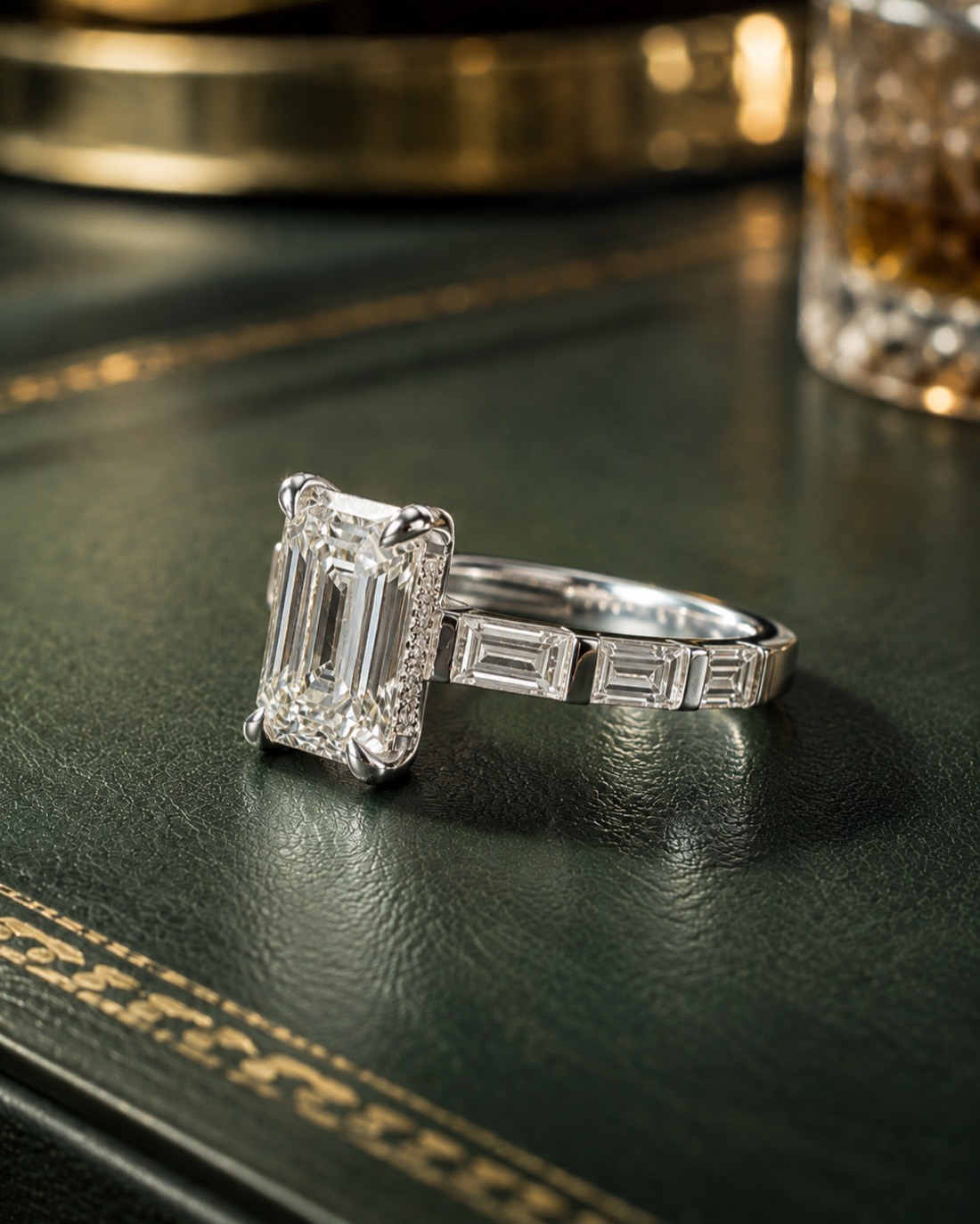
Step-cut stones: Emerald and asscher cuts — with their flat, layered facets — are strongly associated with art deco design because their linear facet pattern matches the era's geometric aesthetic better than a brilliant-cut round.
Contrasting color: Pairing a white diamond with a colored accent stone (sapphire blue, emerald green) or a dark accent (black onyx, black enamel) for high visual contrast was a signature move of the period.
Milgrain and filigree metalwork: Fine beaded edging (milgrain) and delicate cut-out metalwork patterns (filigree) add texture and an intricate, handcrafted look without softening the overall geometric shape.
Halo and stepped-tier settings: Rather than a single round halo, art deco halos often step outward in geometric tiers — hexagonal, octagonal, or elongated shapes that frame the center stone with hard edges rather than a soft circle.
How art deco differs from other vintage styles
It's easy to lump all "vintage-inspired" rings together, but art deco has a distinct visual signature compared to other historical styles:
- Victorian rings tend toward romantic, nature-inspired motifs (flowers, bows, hearts) and softer detailing.
- Edwardian rings lean toward delicate, lace-like filigree with a lighter, airier feel.
- Art Nouveau favors flowing, asymmetrical, nature-inspired curves.
- Art deco is the most geometric and symmetrical of the group — bold rather than delicate, structured rather than flowing.
If you like the idea of "vintage" but geometric symmetry and clean lines appeal to you more than florals and curves, art deco is likely the specific vintage style you're picturing.
Which diamond shapes pair best with art deco design
Step cuts (emerald and asscher) are the most historically authentic choice because their facet pattern echoes the movement's geometric language. Old European cut and old mine cut round diamonds — round-ish but with a smaller table and higher crown than modern rounds — were also common in original art deco pieces and are available today as a deliberate stylistic choice. That said, plenty of modern art deco-inspired designs successfully frame a round or cushion-cut diamond within a strongly geometric halo and band — the era's design language can be layered onto most shapes if the setting carries the geometry.
Practical considerations for wearing an art deco-style ring
Because filigree and milgrain involve intricate, sometimes delicate metalwork, an art deco ring built for everyday wear benefits from slightly thicker structural elements where the design allows it, and periodic professional inspection to catch any worn prongs or thinning filigree before it becomes a problem — the same way you'd maintain any ring with fine detail work.
Frequently asked questions
Is art deco the same as "vintage style"?
Art deco is one specific vintage style among several (Victorian, Edwardian, Art Nouveau, Retro, etc.), defined by geometric symmetry and bold contrast rather than being a catch-all term for anything old-looking.
Do I need an antique diamond for an art deco ring?
No — the art deco look is a design style you can build with any modern diamond. Some people do seek out antique cuts like old European or old mine cuts specifically for their softer, more romantic sparkle within a geometric setting, but it's a preference, not a requirement.
Are art deco rings more fragile than modern designs?
Filigree and fine milgrain detailing can be more delicate than a plain, solid band, but a well-built art deco-style ring with thoughtful structural reinforcement can absolutely hold up to daily wear — it's a design and craftsmanship question, not an inherent flaw of the style.
What metal is most associated with art deco rings?
Platinum was the signature metal of the original art deco era because it was strong enough to hold intricate, delicate filigree work in fine detail. White gold is a common modern alternative with a similar look at a different price point.
Can I combine art deco elements with a more modern setting?
Yes — many custom designs blend a geometric halo or step-cut stone with simpler, more modern band styling, giving you the art deco visual signature without a fully vintage-styled ring.
So where does this leave you?
Art deco is one of the most distinctive, recognizable engagement ring styles you can choose — bold, symmetrical, and built to make a clear visual statement. If that's the energy you're going for, the details (step-cut stone, geometric halo, milgrain, contrast color) are what actually deliver it, more than any single "vintage" label.
Getting the details right on a custom art deco design
Art deco design lives and dies on precise geometric detail — a slightly off-center halo tier or uneven milgrain reads immediately, in a way it wouldn't on a simpler setting. That's exactly the kind of precision a custom CAD design process is built for: you see the exact geometry, proportions, and stone pairing rendered before anything is made, so you can catch and correct it before it's real.
At Amana, design plus your finished ring typically runs $1,500–$4,000 total, with more intricate designs (like detailed filigree or multi-tier halos) or larger center stones running above that range — always discussed openly before you commit. You'll design with a real person, see your concept visualized with AI in your consultation, review your CAD file about 3 days later, and have your finished ring roughly 2 weeks after approval.
If art deco is calling to you, reach out and we'll help you build it — geometry, contrast stones, and all.